The Worst Resolution

The Worst Resolution

“Never change. Never, never change.”

I heard it all the time growing up from my pastor, a respected leader who preached the same message – if a different sermon – three times a week, and wore a navy blue, double-breasted suit every single day for decades.

He was resolved, and it was the worst resolution.

It seemed to suit his personality not to change, as it suited his theology and philosophy. For Dr. R., truth was an objective absolute, a straightforward proposition. Once you found it, that was that. It was settled. So find it, base your life on it, and “never change.”

If you grant the premise, it makes all the sense in the world. It would be the safest way to live well if reality worked that way.

But it never made much sense to me.

There’s no learning, no growth, no life without change. Change defines healthy life in every context. And when change stops…well, that’s death.

The turn of the year, 2017 to 2018, has me remembering his words. I had lunch on New Year’s Eve with old friends who knew him as well, and the question came up, “What happened? What went wrong in the mega church and extensive ministry he built and led?” It’s all gone now.

“Never change.”

Change isn’t always good. “Change for change’s sake” is not a good idea (except when it is). But to reject change for its own sake is a path to certain stagnation and death.

Changing one’s mind is rarely easy. It can be incredibly difficult to let go of beliefs and assumptions that have defined the world for you. The things that have given us the bearings we need to make good decisions with confidence, to live and feel secure about our lives. Those beliefs are often entwined with so much of our lives and pulling them is messy work that can leave us feeling unmoored and unsure of what our new reality will be grounded in.

But learning requires changing our minds, and learning also requires an openness to change. It nearly always involves being able to let go of something I believed, something I imagined to be true, in order to embrace newly discovered truth.

And that’s a moving target. Because if there is something, anything, that could in any way be accurately described as absolute and unchanging truth, it is so unknowably vast that our meanderings through it will feel ever changing. We can’t grasp the whole, and so we’re always unlearning and learning. Always learning to see anew. Always changing in response to what we’ve seen.

The “immutability” (unchangeableness) of God never made a lot of sense to me either. It’s an idea of perfection from Greek philosophy that was imported into and imposed upon the Jewish thinking of the biblical writers. The Bible shows us a God fully engaged, arguing with his people and changing his mind. A Jesus who learned and grew. That God engages people in real ways, relates as a person who thinks and feels and whose thoughts and feelings change. The God who “does not change” in the Bible has a consistent character that does not change but is progressively revealed and understood more clearly.

We’re still at that – understanding the character of God more clearly. It has the power to transform our lives and our hearts if we are open to it – the change that each new year, each new day holds out. Ever learning and growing and expanding our hearts.

Ever changing.

Advent and the World Turned Upside Down

Advent and the World Turned Upside Down

Mary was a girl, a young woman, from a working class family in a small Jewish town in the backwater of the Roman Empire.  As an unmarried girl in a country under military occupation, she was the most vulnerable of people, but she was no shrinking violet.

When the Angel Gabriel tells her she will have a child – the Messiah and promised leader of his people, she asks questions first: “How exactly is that going to work?” When she says yes, her assent is not merely submissive obedience. She is a full participant, agreeing to put her body and life on the line for the freedom of her people.

Mary has never known a world at peace. Revolution has been brewing longer than she can remember as the Jews grow increasingly discontent under the power of Rome and her representatives. And Mary knows she has been asked to be the mother of their deliverer.

Like many a young unwed mother, Mary travels to spend time with relatives out of town. Maybe she was trying to get away from gossiping neighbors, or her family’s disappointment and struggles to believe her story – “So an angel told you God was going to make you pregnant????” Whatever she faced at home, it couldn’t have been easy.

But when she arrives at her cousin Elizabeth’s, she doesn’t even have to tell them her story. The miracle baby Elizabeth herself is carrying after decades of barrenness leaps in her womb, and Elizabeth knows: “Blessed are you among women, and blessed is the child you will bear! But why am I so favored, that the mother of my Lord should come to me? As soon as the sound of your greeting reached my ears, the baby in my womb leaped for joy.”

And Mary responded with a song of relief and rejoicing. Her song of praise – her “Magnificat” – expresses far more than her sense of honor at being chosen by God:

“God has brought down the powerful from their thrones,” she sings,

“and lifted up the lowly;

he has filled the hungry with good things,

and sent the rich away empty.”

Mary is singing a song of revolution, a song of reversals, of God turning the way things are on their head!

The powerful will be cast down, and those without power raised up. The hungry will be satisfied, and the wealthy will go hungry. As John, “the voice crying out in the wilderness,” will proclaim, “Every valley shall be lifted up, and every mountain made low.” The prophet Isaiah provided those words, and these:

God will “provide for those who mourn in Zion– to give them a garland instead of ashes, the oil of gladness instead of mourning, the mantle of praise instead of a faint spirit.”

In Mary’s song and John’s prophetic work, God’s kingdom is proclaimed as a kingdom that turns the way things are upside down!

Mary knew, and we know, that doesn’t happen peacefully. The powerful are rather attached to their thrones and not inclined to give them up without a fight. And the rich protect their wealth and security. We don’t want to give up the power, influence, and resources we have. We fight to protect them. But…

The valleys will be lifted up and the mountains laid low.

The powerful will be cast down and the powerless raised up.

The poor will be filled and the rich will go hungry.

When you hear those things, does your heart flinch a little in fear? Mine does. As much as I want to think I’m on Jesus and Mary’s side in this, I’m afraid of all I have to lose when the world turns upside down.

The Holy Spirit’s job is to “comfort the afflicted and afflict the comfortable.” I heard that a lot growing up in church. The thing is, I don’t think anybody neatly fits into either category most of the time.

I was talking to a friend recently who, after being well-off most of his life, really struggles to make ends meet these days. He works at Trader Joe’s, and told me recently about a young couple who came through his check-out line. They were clearly wealthy – he recognized designer clothes and tastefully expensive jewelry. But they were quietly arguing and she was trying to hide tears. “Sure, they have money,” he said, “but they’re suffering in ways I know nothing about, and I’ve never known anyone who isn’t.”

I think he’s right. Most of the time, each of us are comfortable in ways and truly afflicted in other ways. We have a good job, but our marriage is struggling. Our kids are doing great, but our parents are suffering. And if we have a season when everything is going well, an illness comes, or an unexpected death, and suddenly our lives are turned upside down.

We’re all going to need comforting – and Jesus came for that. He brings good news to the oppressed, binds up the brokenhearted, gives the oil of gladness instead of mourning.

But that flinch of fear in my heart, that clinch in my stomach, when I hear that God is in the business of turning the way things are on their head. That feeling? That tells us where we’re comfortable. Where we feel threatened by God’s work in the world.

Don’t shuffle that feeling off to the side. Don’t try to silence it with justifications. Sit with it this Advent and Christmas. Listen to it. Let it make us uncomfortable. Let it show us how we can best join in God’s business of turning the way the world works on its head.

Recognize the power you have and use it on behalf of those who don’t have; or better yet, share it with them. Share the wealth and resources you have with those who don’t have much. Choose to let the heart of God turn your world upside down.

In agreeing to be the mother of Jesus, Mary put her heart and body on the front lines of her people’s fight to overthrow the power of the Roman Empire and turn their world upside down, and God had even more in mind for her son than she knew. Mary had a choice – she could’ve turned away. She could have protected her reputation and the possibility of a normal, uneventful life.

But Mary said yes to God and his plan to turn the way the world is on its head, whatever it cost her. What will we say?

The Life of the World to Come

The Life of the World to Come

We said it in church this morning – that last line of the Nicene Creed. The one that reads, “We look for…the life of the world to come.”

For years that meant the life after death to me, and it held deep personal significance. In “the life of the world to come,” I’d see my daddy again. But it was more than that.

When my grandmother was in the last few years of her life, missing the friends and family who were gone, never quite happy, always wanting more of her only grandchild and unable to enjoy me for who I was, I learned to love her beyond what chafed and hurt by believing that in the life to come, she would finally be everything she was meant to be, full of joy and understanding. When I met her then our relationship would be everything it could be, everything it was meant to be.

That same hope got me through several break ups and many bouts of unrequited love. And as I began to realize that so many of the mentors and teachers who have given me the most cannot understand or approve of where their gifts have taken me, I have hoped that in that “life to come,” they will see their way clear to be proud of who I am.

But alongside the comfort, there was also a kind of stuckness. Hope was out there, not here. The great reconciliation, true healing, and abundant life were all beyond the scope of this world.

And sometimes they are.

That’s the first line of the Serenity Prayer: “God, grant me the serenity to accept the things I cannot change.” It’s important, that bit. The whole prayer is named for it, after all.

But that’s pretty much where it stopped for me. God was sovereign, in control of all things and working them all together for good. What could I possibly do in light of that other than show my trust in him by waiting as faithfully as I knew how?

But there’s more to the prayer than serenity. There’s courage. And wisdom. And when it comes to it, serenity isn’t worth much without her sisters.

In the past year, I’ve also learned to hear those words in the Creed another way.

The “life of the world to come” starts tomorrow. And tomorrow is what we are making it today.

This life to come is the second part of the prayer – “the courage to change the things I can.” To change the things we can.

“We look for the life of the world to come.”

If the “arc of the universe bends towards justice,” it does so through us. Because we bend it that way. Because the life of the world to come is not yesterday, and tomorrow does not need to use the road maps of the past.

We look for the life of the world to come because we know there is more than this. More than death, yes. But also more than this, more than today. More than what we find ourselves with. There can be more, we can do more. We can make changes. We can take a step in the direction of justice, in the direction of Love.

And it’s never wasted. That’s what the concept of karma is really about. It’s not just that what you put out there will come back to you. It’s that what you put out there contributes to something greater than you. We are shaping the “arc of the universe” every day. We are making “the life of the world to come” – a life and world we will share.

So I have begun to look for life in this life. I look for life in each step, in each choice I make: what will bring life in the world to come? What will bring life to the world tomorrow?

And there’s always something. Something that in the midst of all the things I can’t change, that I can. It is wisdom that helps me do what I can rather than camp out at the door of all I can’t.

I lived there too long. It’s time to begin moving into the life of the world to come. Today.

Walking the Wild Goose

Walking the Wild Goose

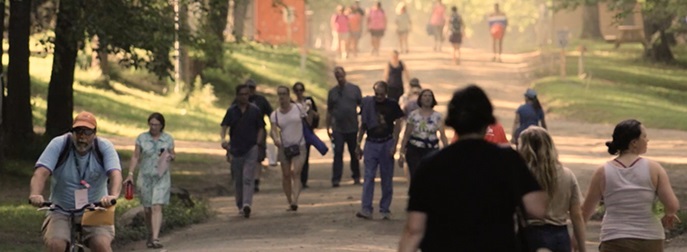
When I think back on my years attending the Wild Goose Festival, I think of walking.

The first year I attended, I came to speak with a friend. I was still a somewhat conservative but curious evangelical, recovering from my hardcore fundamentalist roots. My friend and I participated in a pre-festival retreat for the speakers, and I remember sitting and listening to Frank Schaeffer, a fellow recovering fundamentalist, speak (or more accurately, rant) and wondering what I’d gotten myself into. Frank felt angry to me, and wherever I was going, I didn’t want it to be an angry place. I was troubled.

Later that evening, long past dark, the retreat ended with a prayer walk through Shakori Hills (where the festival spent its first two years). Gareth Higgins handed me a flashlight, and we all began to slowly venture into the night, a flashlight here and there to help us along. It was hard to see much of anything, but as we walked, silent except the scuff of shoes on the dirt path, my eyes began to adjust. I realized that Frank and Genie Schaeffer were walking beside me, following the light of my flashlight.

And I knew in that moment that we were walking the same path in a much larger sense. My journey would not look quite like theirs, nor theirs like mine. But we had found ourselves here, walking alongside one another and doing our best to find our way forward.

Our paths crossed several times that weekend, and I began to know the whirlwind that is Frank and the calm that is Genie. I heard Frank talk about struggling with the anger he’d brought with him from his fundamentalism, of not wanting his granddaughter to know him as that “angry man.” I sat with Genie in the heat of an afternoon as we talked of transitions and changes and grace.

As year followed year, I’ve walked with many different people at the Goose, renewing friendships and adding them. As I moved farther from traditional evangelicalism, I found new “elders” for my life when the old ones could no longer understand the path ahead of me. I can’t count the times I’ve greeted someone and heard the reply, “Where are you headed? Can you walk with me?” And wherever I was headed, my answer is almost always yes.

I walked alongside Vince Harding one hot afternoon, and was left with an embrace and blessing I will always remember. I’ve walked many times now with my friend Nathan, a young man who I saw come out publicly for the first time during the Q & A of a Goose session, and who the next year told me about his new boyfriend and plans to start seminary. I’ve walked the Goose with Paula Stone Williams, a fellow recovering fundamentalist and one of the bravest people I know. I’ve walked with a newly-out and newly-single father and helped wrangle his two young children.

These days, it’s the first thing I do once I’ve settled in – begin walking the paths looking for friends. Looking to learn what the Goose will have to teach me this year. As the years have gone by, I attend fewer and fewer sessions, my time filled more and more with conversations along the way.

I’ve walked with heroes and strangers. I’ve hugged friends as we’ve passed, and had the joy of introducing and connecting people. This year, I look forward to walking with friends I’ve yet to meet in person, as well as an old friend of my parents who I haven’t seen in around thirty years. I’m eager to see friends from around the country whose faces are dear to me and too rarely seen.

The Wild Goose is far more than a destination; it’s a journey each one of us walks in our own way. And for a few days in July, we have the gift of walking together.


I’m thrilled to be speaking at this year’s Goose July 13-16! Join me and save 25% off weekend pass with the code BEMYGUEST.