Unclobbering and Shared Stories 

Unclobbering and Shared Stories 

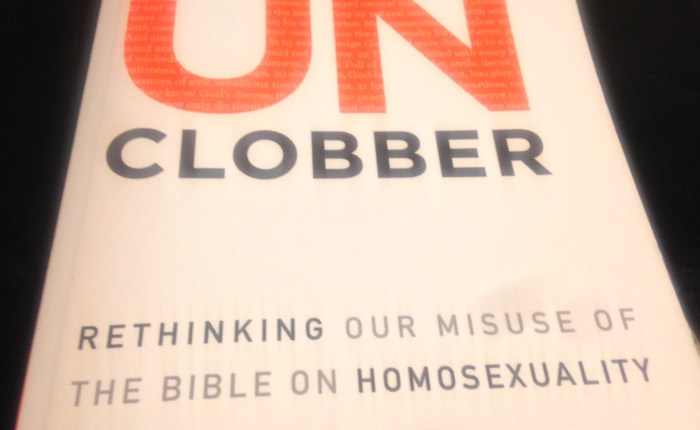
A friend of mine, Colby Martin, has written a book that’s about to be released. I’m proud of him, not just because of the enormous work such a project means, and not even because it’s a brave and beautiful book.

I’m proud of him most because of the life he has engaged and shaped in himself – it’s a brave and beautiful journey he has walked to be able to write this book.

Unclobber is part memoir and part exploration of the Bible’s “clobber” passages – those verses that convince believers that God condemns same sex desires and acts. When Colby came to understand those passages differently, he lost friends and the position as pastor he was called to in a conservative evangelical church.

It’s not the book about affirming my LGBTQ+ sisters and brothers that I would write, and I’m glad. While there is strong resonance between our journeys, Colby’s story is uniquely his and uniquely valuable for that.

For me, his story is most powerful in a place where it both deeply connects with and departs from my own.

Colby changed his mind and heart because of his deep commitment to be faithful to Scripture and following Jesus. He had no questions about his own sexuality, no friends or family members who were gay.

Like me, Colby didn’t come to see things differently because he had a stake in the game. I would say that we both began to look deeper because we saw that Jesus has a stake in the game.

It’s not an easy path. While there is, as Colby expresses so well, a deep peace that comes with living in alignment – mind, heart, spirit, and outward behavior all in harmony; that peace can come with deep loss.

I am fortunate that, unlike Colby, my own journey did not jeopardize my calling or the ability to support a family. But there are deep losses nonetheless. When what it looks like to be faithful changes for you, to those for whom it hasn’t changed, you appear to be unfaithful.

Following Jesus can take us down different paths, paths that can seem confusing (and worse) to those who love us. But once seen, the vision cannot be unseen. Once known, new understanding cannot be unknown.

I’m reminded of the parable Jesus told of the Pearl of Great Price. A merchant sells everything in order to gain one thing that matters most to him (a thing that would look absurdly impractical to the parable’s audience – he can’t eat it or shelter under it, and it would be difficult to sell, if he even intends that).

It’s a parable that challenges us to know what it is that we value most. That will not look the same for all of us, even those of us who follow Jesus, and that’s hard sometimes.

I’m grateful for Colby and his journey. I’m grateful for friends who have counted and paid the cost, and continue to follow as faithfully as they know how.

And as we share our stories, I’m hopeful. I’m hopeful that we can continue to challenge our fears and blindspots, that we can embrace a faith that is ever more just and generous.

That together we can create a world that overflows with the shalom, beauty, and love of God to all.

Remembering Wayne

Remembering Wayne

One of the hardest moments in my journey was the day I realized that so many of my most beloved mentors, men and women whose fingerprints are still on my life, would not be comfortable with who I am. It would cause them deep concern or even grief.

And yet it was so many of the gifts they gave me that helped bring me here. The truths they taught me, the love they showed me, the lives of faith they modeled for me.

One of those mentors died unexpectedly this week.

Wayne was my pastor after college, when I first stepped outside the walls of fundamentalism. It wasn’t a step very far in retrospect – to a conservative Southern Baptist church. But Wayne’s preaching was steeped in grace, cool water to my parched soul.

A couple of years after I’d first come to the church, through a random series of events, Wayne and I discovered that my father had been his best friend at the military boarding school they attended together for one year of high school.

Daddy died when I was three, and I had spent years trying to find the men whose names were in his high school yearbooks, longing for someone who could tell me stories and help me know him. But even after visiting the campus, I’d not managed to track any of them down.

The Sunday evening after church when Wayne realized I was my father’s daughter and learned of his death, he must have hugged me a dozen times. We both cried, and I remember him saying, “Oh, Honey! I got your Daddy into more trouble!”

That night he gave me his unlisted phone number to call if I “ever needed anything,” and a relationship began that was one of the sweetest gifts of my life.

As he travelled the country speaking in churches, Wayne would tell his friends about the discovery of “my other adopted daughter.” When they’d come to the conferences we sponsored at the church, I’d barely get myself introduced before they’d exclaim, “Oh, Jennifer! Wayne told us about you!”

Every couple of months he’d take me to lunch, and we’d talk about life and his ministry and Daddy. Wayne was the only person in my life who ever sat across a table from me and exclaimed, “That look is your daddy all over your face! He used to give me that look all the time!”

Those looks, from both Daddy and me, were in response to Wayne’s outrageous stories and antics. I’ve never met someone so irrepressible, and so fond of practical jokes. A part of Wayne never outgrew the ten year old in him, and we loved him for it.

There were stories about Wayne plotting chaos at the full-dress parades where Daddy called the orders, and about Wayne showing up for inspection, standing at attention half naked and covered in fire extinguisher foam. “I could hear that deep base chuckle your daddy couldn’t keep in down the line.”

After Wayne and I had both left Chattanooga, I’d drive down to a church in small town North Carolina for his meetings there every year. We’d sit in the pastor’s study for an hour or two before the service and catch up.

One of the last conversations I remember having with him was an affectionate tussle over the “inerrancy of Scripture.” I’d begun to question the usefulness of the term at the least, and if it really reflected what God gave us in the Bible. Wayne listened and thought with me, and held to inerrancy.

That didn’t surprise me. It also didn’t change the way I heard his message that night, continuing to persuade people that it’s God’s grace that does the work of transforming our lives.

I’ve known for years that following Jesus has taken Wayne and me down different paths – paths that sometimes look to be in conflict, even. I can’t explain that away and I won’t discount the real differences.

But Wayne taught me to trust Jesus, and he showed me a glimpse of the delight God has in us.

The delight God has in me.

I do my best to trust Jesus in both of our journeys. I still hold the gifts Wayne gave me. They’re in me every time I preach or study the Bible. I wish he could be proud of me.

Maybe today he can be.

And I cry, because I miss him.

Antsy

Antsy

I feel antsy tonight.

I get that way sometimes these days. It feels like there’s a lull in the momentum of my life, and I get antsy.

I felt stuck for so many years, at the mercy of a life that wasn’t my own (after all, I was “bought with a price,” as Paul wrote). In order to honor the God who loved me, I had to keep my life a blank slate, so that all that would be written on it would be whatever he would write.

But he didn’t give me life so I could hold it for a few moments until he could take it back – so that I could keep it tucked away and safe until he comes for it. He gave me my life – this one life – so I could live it. So I could make things happen with it. That’s not safe; it’s risky. I could lose everything. But maybe that’s the point.

Somewhere over the past few years I discovered something: my own agency. The gift of my life, of making choices and messing up and sometimes soaring.

Choices used to scare me frozen. There were too many implications, so many ways to get it wrong (I must not get it wrong). So I would pray and wait for God to show me his will. It was like a celestial game of “Mother, may I?”

It’s hard to live when you’re always trying to avoid messing something up.

And it rang wrong somehow. In the middle of this amazing world God made, full of beauty and possibility and choices, it came to feel like refusing a gift – the gift of living my life.

So I’ve grabbed on to it with both hands and jumped in. And on this beautiful summer day, when there’s a pause, I feel antsy.

I know I’m not stuck. I know things will continue to happen and choices will continue to come. The next step – for my vocation, at my job, in my dating, into my future – will come. But something in me remembers the long stuckness, and that something doesn’t want it again. And I hold on to my agency, the gift of living my life.

And maybe eventually I’ll learn to feel the difference between stuckness and stillness.

Hope Comes

Hope Comes

Hope comes last.

Do you have any idea how much that bothers me?

In Romans 5, Paul says that “suffering produces perseverance; perseverance produces character; and character, hope.”

Sometimes I don’t know what kind of world he lived in to say such a thing. Not the part in the middle – “perseverance produces character.” That can make sense. Practice and exercise, sticking with it – I see that producing character in myself and others.

But “suffering produces perseverance”? No. It doesn’t. Not on its own, at least. Unrelieved suffering without hope produced despair. Then numbness. Deadening. Unrelieved suffering produces the realization that one can actually get through the unendurable, but not intact.

I’ve lived with enough suffering myself, and alongside the suffering of others, not to spiritualize it. Abusive relationships, abusive systems. Suffering kills.

Persistent suffering teaches a person that it won’t matter what you do. It kills agency. You feel like a placeholder in the world, but something knows you’re meant for more than that.

Suffering produces silence.

Without hope.

Hope can change everything.

Hope is a gift we can give each other, but we have to receive it, or give it to ourselves, first.

Hope says, this can change. I – we – can do something different.

Hope says, this world can change. We can grow and learn, and it can be filled with beauty, love, and peace. We can choose that.

Hope says, I can change. My life can change. But I have to choose to change things.

In so many ways, I was taught to wait for things to change. To “wait on the Lord” – for direction, for a date, for a calling, for life. I remember the day, Easter Sunday in the parking lot after church, when I first said it (to myself as much as to my friend). “If I want my life to be different, nothing is very likely to change unless I make some changes.”

That was the day I began to find my agency. When I began to go out to find direction, a date, a calling, a life. And it turns out, they are there for the finding (though not without that perseverance).

Suffering will happen – the result of wrongs done both intentionally and accidentally, by both ourselves and others. The result of death, that final enemy. The result of life that just is, changing seasons and moving ever onward with little regard for our three-score-and-ten.

But we have today – really that’s all we have. And we can chose beauty and love and generosity today, even if we know that choice will bring suffering tomorrow.

That’s the hope – that there is always beauty and love and generosity to be chosen.

Paul’s equation only works as a cycle. It only works when, in the face of suffering, we can share hope with each other. When we can choose together beauty and love with generosity in the middle of suffering. When we can fight alongside each other for the agency to right the injustices that so often trap us in suffering.

Then suffering can produce perseverance, and perseverance can produce character, and character can produce even more hope. Enough to infect the world.