Blue Woad for Courage

Blue Woad for Courage

A friend of mine said once that courage is doing really scary stuff really scared. It’s the only idea of courage I’ve ever been able to relate to.

It’s not so much about sticking around when the bad stuff hits. Shock usually takes care of that for me. While my emotional brain is still reeling, the hyper-rational me steps in and takes care of things. (From what I’ve been told, I’m the most rational person you’d ever break up with.)

No, where the scary stuff comes in is the next day. When my world has shifted or shattered and I have to figure out how to live in a new reality.

That’s when just showing up is courage.

Theater people taught me a lot about showing up. When I was in high school hanging out with college theater majors, it was the costuming department I spent the most time with.

Costumes were important because they revealed the character – to the audience, yes, but first and more importantly, to the actor. And the principle bled over into everyday life. What we wore was about more than self-expression; it was self-revelation.

Showing up with who you really are, even when it gets scary.

Courage is about the willingness to be vulnerable. I almost said “the strength,” and it may be strength, but it never feels like it at the time.

It feels like showing up with all your wounds, your hurt, your vulnerabilities on display. It feels like saying, “I’m here; I’m hurting but I’m not going to hide.”

My seminary boyfriend used to complain that whenever he tried to break up with me (sometimes successfully), if he saw me the next day I would be looking particularly good just to torture him. Some of that was doubtless his penchant for regrets, and some of it was probably that I really did look particularly good.

But not for his sake. I was claiming me in the face of rejection. If he wasn’t going to value me, I certainly was.

There is a tradition that the ancient warriors of Scotland went into battle naked, their bodies painted blue with woad.

They didn’t put on armor that would protect them from assault, cover the softness of skin and muscle that bleeds.

And they didn’t camouflage themselves with colors that would help them blend into their surroundings and hide from their enemies.

No. They took one of the brightest and rarest of colors and they painted themselves with it, all their wounded and scared and vulnerable flesh. And they showed up, with all of who they were and nothing but blue woad for courage.

On my scariest days, the ones when I can either show up or lose something of myself I don’t want to live without, I show up.

I show up trembling, and yes, stubborn. I don’t put on armor – something that covers my softness with cold, hard bravado. And I don’t try to hide, blending in and unnoticeable.

I put on whatever feels most like me, with all my longing vulnerabilities and defiance and aching wounds and love.

And I show up, with nothing but blue woad for courage.
The Beautiful Mess

The Beautiful Mess

I love shabby-chic. (I love new things with clean lines, too, but then, I have eclectic tastes.)

And let me be clear, if it’s sold at Target or Macy’s or Anthropologie as “shabby-chic,” no. That’s missing the point for me altogether.

It’s not really about an aesthetic. It’s a desire to live in a space that reflects who I am, that is an outward expression of my life.

That life has a history.

The brass bed that my great-uncle rescued used from the basement of a furniture store something like seventy-five years ago. After his early death, it came to my father in his teen years, and by the time I’d started school, became mine. Daddy, military school student that he was, kept it shiny and sparkling. I like its aged patina (and dislike constant polishing).

The narrow bookshelf with a clock face mounted on top. My grandfather, who I never knew, collected the wood (including the finials and clock) the day Prohibition went through and they tore out the bar on Main Street. He took it home and turned it into a bookshelf.

A bald eagle and shield needlepoint. In the early 1970s, as Daddy’s ALS began restricting his activities, he wanted something to do with his hands that didn’t involve arm strength, and decided to try the needlework my mother did so beautiful. He chose a bicentennial design (produced by AVON, according to the bag) and outlined and filled in maybe 20% before the disease took enough of his dexterity that he had to give it up.

Roughly thirty years later, I found it and finished his project. It now hangs over the Prohibition bookshelf, signed with both our initials.

The canister set that sat on my grandmother’s kitchen counter and held her baking staples – the ingredients for all her wonderful homemade cakes and cookies.

The funky printed, wide-legged denim jeans my grandmother custom-made for my mother in the 70s (and that actually fit my hips and sometimes my mood).

The small, personalized photo album – a high school graduation gift from Kenny, a popular upperclassman who befriended an awkward middle-schooler and in doing so, gave me the gift of acceptance and a sense of worth, just as I was.

And so many books – old friends and mentors in the journeys of my life.

Most everything in my home has a history, a history I’ve inherited or a history I’ve given them.

Things don’t match. But they belong. They fit somehow. The beauty is in the relationships between them, the lived-ness they reflect.

Like my life, it’s a beautiful mess – full of story and legacy and love and change and unfinished business and moving forward anyway.

I don’t want a life of matching sets.

I don’t want the registered china. I want one setting of your favorite design, a table full of the unique gifts of friends, mixed and matched for this particular celebration of togetherness.

I don’t want a life that fits neatly. Cleanly.

I want questions and discovery and the chaos of living in a world of surprise and revelation. I want the assumptions I don’t know I have disrupted, my expectations interrupted.

I want the beautiful mess.

A life – and faith – with cracks in the foundation, layers of paint and wallpaper that are worn down and showing through, corners that don’t meet at right angles, walls that don’t meet at all, doors that won’t shut right.

A drafty life where the sun and the moon leak in light and the holy wind is always whistling through and tossing things around.

Things get broken, but that’s what happens when you use grandma’s crystal rather than leaving it to collect dust in the china cabinet. When you stop saving it all for special occasions and celebrate every moment as a special occasion worthy of celebration or mourning – of honoring.

Things get broken, but then they get glued back together and the cracks become part of the story.

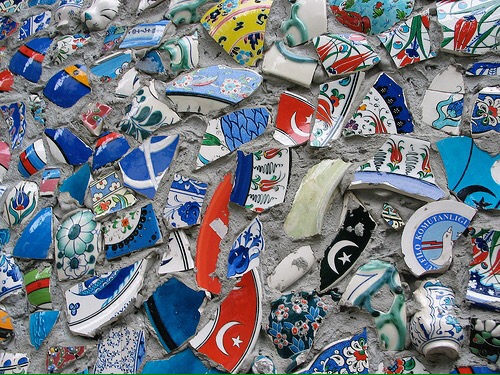
Things get broken, sometimes too broken to glue back together. But then it’s time to make a mosaic.

Antsy

Antsy

I feel antsy tonight.

I get that way sometimes these days. It feels like there’s a lull in the momentum of my life, and I get antsy.

I felt stuck for so many years, at the mercy of a life that wasn’t my own (after all, I was “bought with a price,” as Paul wrote). In order to honor the God who loved me, I had to keep my life a blank slate, so that all that would be written on it would be whatever he would write.

But he didn’t give me life so I could hold it for a few moments until he could take it back – so that I could keep it tucked away and safe until he comes for it. He gave me my life – this one life – so I could live it. So I could make things happen with it. That’s not safe; it’s risky. I could lose everything. But maybe that’s the point.

Somewhere over the past few years I discovered something: my own agency. The gift of my life, of making choices and messing up and sometimes soaring.

Choices used to scare me frozen. There were too many implications, so many ways to get it wrong (I must not get it wrong). So I would pray and wait for God to show me his will. It was like a celestial game of “Mother, may I?”

It’s hard to live when you’re always trying to avoid messing something up.

And it rang wrong somehow. In the middle of this amazing world God made, full of beauty and possibility and choices, it came to feel like refusing a gift – the gift of living my life.

So I’ve grabbed on to it with both hands and jumped in. And on this beautiful summer day, when there’s a pause, I feel antsy.

I know I’m not stuck. I know things will continue to happen and choices will continue to come. The next step – for my vocation, at my job, in my dating, into my future – will come. But something in me remembers the long stuckness, and that something doesn’t want it again. And I hold on to my agency, the gift of living my life.

And maybe eventually I’ll learn to feel the difference between stuckness and stillness.

Love and Longing

Love and Longing

By the time I was fourteen, most of my friends were college students.

I grew up on a university campus, sort of a fundamentalist Baptist enclave. The school had an elementary and high school as well as the college, and I graduated from all three.

From third grade on, I was what I now think of as the class scapegoat – my classmates cast all their fears upon me and drove me outside the camp. At best, I felt tolerated.

My seventh grade year I struck up an unlikely friendship with a junior who was new to the school. We both read through lunch hours, and soon found ourselves reading through our lunches companionably together. When she graduated, my social world moved with her to the university.

I will always be grateful to those college theater majors who welcomed an awkward teenager in and never made me feel like an outsider.

And of course, I had crushes on most of the guys. Talented, good looking college men who were more than kind to me – what teenager wouldn’t?

I was so full of longing.

Romantic longing, yes. But also longing for affirmation, for belonging. Longing to be seen – not to be invisible. Longing to be valued for who I was, not just tolerated out of obligation.

My longing, however innocent, was deep. And good. Longing tells us we’re alive to the world.

I remember sitting in the kitchen at some point in those years, talking to my mother about it. I’d realized that a crush was about who I wanted someone to be, rather than who they really were. If I wanted to get beyond a crush, I was going to need to really get to know them and love them.

We only ever get to love someone for who they are, where they are.

Love may come to see possibilities, may hope for more for someone (or even with them), but it can only live in the present. In the reality of here, now.

I’d like to say I’ve gotten good at it, thirty years later. That it’s easier.

Those years have certainly given me lots of practice, and it’s become, at least to some degree, part of who I am.

But if anything, it’s only gotten more complex. Loving doesn’t always diffuse the longing. Sometimes they coexist, and often in circumstances that make that coexistence less than comfortable. Sometimes they are even intertwined.

I still try, though. I still think about it. And with every date, every encounter, I try to own my longings and let loving surpass them.

It never quite feels the same. Sometimes the longings rage with the power of a summer storm over the Lake. Other times they are more like my cat when I wake him up in the morning – sleepily insistent on making his presence known.

Loving means listening to something other than the longings. Or more accurately, someone. We only really get to love someone for who they are, where they are.

That listening is so hard, and I get it wrong. I wish I were better at it than I am most of the time, but I keep trying. I hope the trying shows.

And even when I think I’m doing it well, there’s probably nothing in my life that’s harder. To let loving surpass longing – oh, dear God, it hurts sometimes.

But I keep choosing it. For the first date that will not turn into a second, as well as for the relationship that is developing. For the attraction I cannot return as much as for the one not returned to me. For all the possibilities that won’t be.

I do not believe that the love I give, whether it’s returned or not, whether it’s even spoken, has ever diminished me.

It hasn’t diminished my longing either.