The Life We Choose

The Life We Choose

Life is a funny thing. In so many ways, it chooses us. When we live, the family and communities we are born into, and where. The traditions we know, the language we learn.

We choose none of them and yet they form the foundation of who we are and how we see the world.

And for most people through most of history, that was it. Those parameters defined their lives, the choices available to them prescribed already.

But even the most constrained, I think, had to choose to live, choose to be awake to life. To seek beauty and goodness and faithfulness with each breath.

Born in this time, to my parents, in a place called the United States, I’ve had the privilege of more choices than most. The privilege to make choices for myself that matter. To choose where I live and how, to know that there is more to learn, and that what I believe need not be the same thing my parents believed.

In so many ways, a field of options has been opened before me.

But in all of those choices, I must still choose to live.

Near the beginning of the movie The Way, Martin Sheen’s character tells his son, “My life here might not seem like much to you, but it’s the life I choose.” His son replies, “You don’t choose a life, Dad. You live one.”

They are both right, of course. We make choices that shape our lives – our homes, families, work, education, worship, beliefs – but we must still choose to live them.
And choosing to live our lives goes far beyond those other choices we make.

There’s an embroidered sampler that hangs in my kitchen. It is the Serenity Prayer.

God, grant me the serenity
To accept the things I cannot change,
The courage to change the things I can,
And the wisdom to know the difference.

There is so much I cannot change.

The faith I was given as an infant, its names and symbols and stories. They are with me – embraced or abandoned, I must wrestle them. But I can choose the shape of my belief and how I live it out. I cannot choose what that faith has done in the world – done to the world – for good or ill, but I can choose what it will do in the world through me.

For the most part, I’ve had no choice in the people I meet. But I can choose who I seek to know, whose lives I invite to shape my own, who I choose to partner in the project of humanity with. And I can choose to put myself in places to meet new people, to learn new stories, to allow my vision of humanity to be expanded and changed.

I cannot choose who will accept or reject me, but I can choose who I accept or reject. I cannot choose who will love me, but I can choose who I will love.

I cannot choose the days that will be given me to live, but I can choose to live them, all of them. The ones filled with the choices I have made, and the ones filled with the choices others made for me, and the ones filled with things no one chose or we all chose in some amalgamated impossible way.

The ancient text presents a choice to the people: “Today I have placed before you life and death, blessing and cursing. Now choose life.”

It is the one choice we have every day, with every breath. Today. Whatever it brings to us or we bring to it, we can choose to live it, to the depth of our lungs and the tips of our fingers and the reaches of imagination and hope.

Now choose life. This life. Your life.

Whatever you do. Live.

Holding the Door

Holding the Door

Driving to work this morning I heard a story about Nashville artist Jason Isbell. Isbell is from rural north Alabama near the Tennessee state line (a couple of hours west of where I grew up). He’s a thoughtful and curious songwriter whose songs are full of the nuances of humanity and real life, and he feels the tensions of the history-haunted south.

I’m a white man living in a white man’s world
Under our roof is a baby girl
I thought this world could be hers one day
But her momma knew better

…I’m a white man living on a white man’s street
I’ve got the bones of the red man under my feet
The highway runs through their burial grounds
Past the oceans of cotton

I’m a white man looking in a black man’s eyes
Wishing I’d never been one of the guys
Who pretended not to hear another white man’s joke
Oh, the times ain’t forgotten

…I’m a white man living in a white man’s nation
I think the man upstairs must’a took a vacation
I still have faith, but I don’t know why
Maybe it’s the fire in my little girl’s eyes

(from “White Man’s World,” by Jason Isbell)

Isbell has found an audience beyond country music, and that audience is growing. “Doors are open to me and I’ll be damned if I’m not gonna walk through ’em,” he says. “But I’m also gonna try to hold ’em for somebody else before they slam in their face. And at the very least, at the very least, discuss it with people.”

It’s a good image: holding the door open for somebody else. He sees what’s happening for him, and he recognizes others aren’t getting the same opportunity.

When I was in college, I took a class in Apologetics. I attended a fundamentalist Baptist university, and that class was part of the theology program. It was a large class, and I was one of only a few women. Apologetics is about how Christians answer hard questions, and I had lots of questions (that had something to do with why I took the class!). But I could sit forever with my hand in the air and never get called on by the (generally good natured) professor. He was never rude or unkind to me, but it was like my hand was invisible. After a few weeks of this, the student who sat behind me, Nate, started raising his hand if mine had been up a while. When the prof called on him, he’d act confused and defer to me to ask my question first.

He held the door open.

Later, in my first real job, I worked as the one-woman office staff for my pastor’s speaking ministry. I had a great relationship with both my pastor and my boss and a good relationship with the other men on the ministry’s board. When they decided to launch a national radio ministry, we began to work with an agency that produced and distributed many of the most well-known evangelical radio ministries. Things were still in development when the president of the agency, Jon, and I met at a conference, and we hit it off. He began to informally mentor me, and when it was time for him to fly in for his first meeting with the board, he asked if I would be in the meeting. I’d never been in a board meeting before, but it was clear Jon expected me to be there. My boss decided I could sit in a chair in the corner of the room and take notes.

Jon arrived, and after the introductions and greetings had gone around the room, he spoke up and said, “Before we get started, can we find another chair? I’d like to make room for Jennifer here at the table.” He shifted things around and held a chair for me right beside him.

He literally and figuratively made a place for me (the only woman in the room) at the table and was intentional about including me in the ensuing discussion.

When it was time for our people to fly out to California to meet with the agency production and distribution teams, Jon told them, “Don’t bother to come if you don’t bring Jennifer!” So off I flew. I learned a lot on that trip, and future board meetings included me. Jon saw I had something important to contribute, and the men started to listen when I spoke up.

Jon held the door open for me.

Doors don’t open the same for everyone. For some of us, generations of access to education and systems that were designed for our benefit turn a lot of doors into the kind that see us coming and slide open with a whoosh of anticipation. We hardly even know a door was there. But those doors don’t recognize everyone, and others of us have to exert a lot of effort to push and pry them open. Sometimes it just requires more than we have. And sometimes the doors are locked to us.

If I can pay attention and recognize the doors, if I can notice when those doors that open for me aren’t opening for someone else, that’s when I can hold the door for them.

And maybe if enough of us notice, we can get the doors re-programmed, or just take them out altogether.

Proud.

Proud.

The first weekend in June my friend Lauren was in town and we connected for dinner. It was the second time this spring we’ve had the chance to connect, and I’ve been so grateful for these opportunities. We were friends and fellow students in seminary over ten years ago, and we hadn’t seen each other since.

A lot has happened in those ten years. My own faith has come alive in new ways as I have sought to follow Jesus outside the lines and delve deeper into the Love that is the Life of all things.

And Lauren…when we were in school together, Lauren was a “he.” She transitioned a few years ago and I am so glad I have the opportunity to know the beautiful woman she is today.

While we were good friends in seminary, I had no idea Lauren was trans. What I did know was that my friend didn’t fit the masculine ideals our conservative evangelical school had for ministers. (Of course, I hardly fit those ideals either, but since they hadn’t quite figured out the same kind of ideals for women in ministry, I never encountered the same kind of pressure to conform.)

The school nearly refused to grant Lauren’s degree, though in the end, Lauren managed.

As she put it to me, she “zipped up her man-suit every morning,” but it was killing her.

There’s no way I can know what that must feel like. I can barely imagine.

What I do know is that there is life and peace in her now that wasn’t there before. She is at home in her own skin in a way she never was in seminary, and it is beautiful to see.

In that sense, Lauren’s story is much like that of other trans folk I know. They fight to live with honesty in the world with courage that takes my breath away. They have been willing to lose the whole world to gain their own soul. I am beyond grateful for all I have learned from them.

That is true to some degree of every LGBTQ+ person I know, and I am proud of them. Proud to know them, and proud to stand beside them.

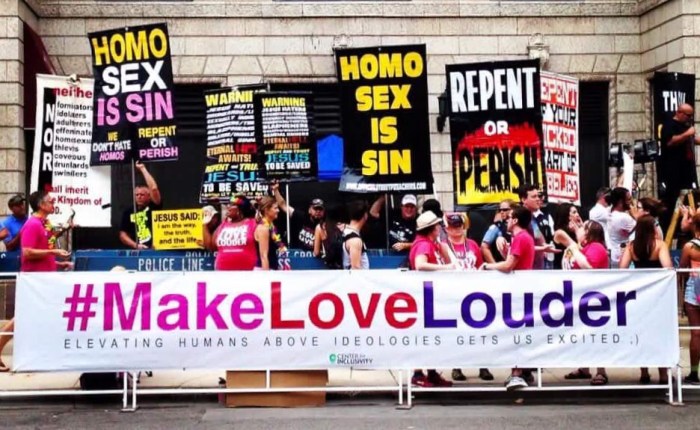
June is Pride month, and in a couple of weeks I will be at Chicago’s Pride parade, standing for Love between the parade and the “Christian” protesters who proclaim something else entirely. Cheering on the friends and strangers marching, encouraging them to “Make Love Louder” than the hate.

Because there’s more than one kind of pride. There’s the pride of vanity and privilege and self-aggrandizement. And then there’s the pride that stands tall in the face of all that would demean and dehumanize. The pride that refuses to bow to shame and fear. The pride that won’t hide inside that zipped up suit that isn’t who they are. The pride of those who know Who loves them.

That pride is hard-won, and I am so proud of those who have won it.

Happy Pride, y’all!

Losing Terry

Losing Terry

When I met Terry we were standing in front of a shark tank.

I was a member at the Tennessee Aquarium, and between my college classes during the day and political events I attended as a Republican activist, I loved to spend an hour or two at the aquarium enjoying the beauty of the darkened “river canyon” walkway with its glowing tanks. The Gulf tank was the largest, rising three stories high.

Terry worked at the aquarium and tended to be on duty the same days I was a regular. I would come an hour or two before closing on weekdays. There were usually few visitors then, and in the glow of the Gulf of Mexico tank we started talking.

I don’t remember how many weeks it took for us to exchange names and contact information, but we learned a lot about each other.

I was in college at the fundamentalist Baptist university in town, from a family where far more of the men were preachers than not. Terry was a biology major at the local branch of the State university, the youngest son of a black Church of God minister.

We talked about the animals – I’m sure we started there. But since I was always (always) wearing a bright blue “I BACK ZACH” button for the local Republican congressional candidate, we were talking politics before long. Affirmative action was a long running discussion and I heard Terry’s perspective (though it was years before those seeds blossomed into a different position).

For all our differences, we became friends. We met for lunch sometimes, or dinner. I introduced him to some of my friends, and they became friends in their own right. My grandmother, who always wanted to know what I’d been doing when she called, started asking if we were dating, but no. We were friends. (She eventually started started expressing concern about what people might think of me if they thought we were dating. I assured her that anyone who would think less of me for dating Terry because he was black was not someone whose opinion I cared about. She stopped.)

Terry came to my college graduation knowing not a soul there except me. My family was looking for him, though, and when he showed up with flowers for me, both grandmothers hugged him warmly.

I’d met some of his family once or twice when we’d stop by his house. His father and I sat on their stoop one afternoon good naturedly debating eternal security (the idea that a person is “once saved, always saved”). He had at least five or six older brothers and sisters, all with or pursuing advanced degrees. Their mother had volunteered at their schools, Terry told me, and had known their assignments better than they did. She was determined her children would succeed academically, and they did.

When I came to Terry’s graduation in the huge university arena, his family were watching for me, and I was brought back to their house for the celebratory dinner. I sat squeezed around the table in the tiny kitchen with Terry and several of his siblings, and the rhythm of give and take and teasing eventually drew me in. Terry and I had always had a similar rhythm and soon his sisters were teasing him about the little blonde white girl getting the best of him.

We both stayed in the area and stayed in touch, and a few months later when I began to have debilitating anxiety attacks that wrecked me physically and kept me unable to work or drive safely for months, Terry nervously drove out to my folks’ place in rural northwest Georgia to visit and take me on outings. (He joked nervously that he could always feel the neighbors staring at him as he drove into the neighborhood.)

I remember one night when we spent hours on the phone. He’d just been to a family gathering and found out a cousin he was close to was gay. He was wondering what it would mean if it turned out to be biological. I remember saying that “we’re born sinful” and why would this be different? Something to be repented, changed, healed, but that didn’t mean he didn’t love his cousin.

That was what I believed, and I believed it was enough for a long time.

Eventually Terry moved down to Atlanta, but every time he was home for a visit or holiday, we’d make plans to get together. We had plans one Thanksgiving, but then I didn’t hear from him. I called his folks, but they always said he was out. I didn’t hear from him that weekend, and he never returned any of the messages I left on his Atlanta number.

Eventually, I stopped calling.

And then over a year later, I thought of him, impulsively dialed his number, and he picked up.

He was surprised to hear from me, caught off guard, but we ended up talking for hours. That previous Thanksgiving he’d come out as gay – to his family (he’d had to leave the house and hadn’t been back) as well as most friends. Everyone but me. He hadn’t been able to bring himself to tell me, he said.

“But why couldn’t you?” I remember asking through tears. “Didn’t you know I’d still love you?”

“That’s why I couldn’t tell you. I knew you’d still love me, and I knew what you believe and that it would always hurt you for me, and I didn’t want you to think of me that way.”

We cried and we talked, and we found our friendship again, tentatively, over the distance.

A couple of months later or so, I was huddled on the living room sofa, reeling and crying and devastated over the breakup of my first serious relationship (my first relationship period, and I was blind-sided on Valentines Day, no less, but that’s another story). The phone rang and my mother came in to tell me it was Terry calling for me.

And I couldn’t do it. I was overwhelmed with pain and confusion and I couldn’t handle the emotional complexity of loving Terry in that moment. I told her to tell him I was sorry but I couldn’t talk right then and would call him back when I could.

I wanted to find my balance first, to be present to something other than the pain that was swallowing me.

But deep down, I knew what he’d likely hear. After our vulnerable connection after all those months, he’d just hear no. He’d hear rejection.

And when days later I called him, he never returned my calls. I was sorry, but deep down, I wasn’t surprised. I had let my own stuff trump what I knew my friend needed.

I never heard from Terry again, and I’ve never managed to contact him since.

It was decades before my understanding and beliefs about what it means to be gay (or lesbian or bisexual or trans or queer or intersex) changed. And when I love and enjoy my LGBTQI+ friends and advocate for them and their community, I’m not making anything up to Terry. They aren’t Terry.

But I think of him, and I hope that I will never again let my own sense of need get in the way of accepting and welcoming a friend and making sure they know it.