Still Summer

Still Summer

It’s still summer – I know because of the sun and the heat and the ice cream carts.

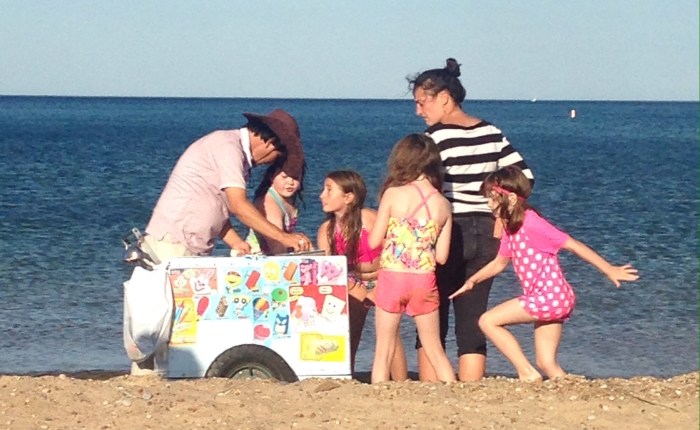
Ice cream carts are a summer fixture in Rogers Park, up and down the sidewalks, near parks, and especially on the beach. They plow through the sand bringing frozen goodness to anyone with a little cash.

And everyone, it seems, loves them. In my United Nations of a neighborhood, ice cream bars are trans-cultural.

I don’t want it to end – summer on the Lake. I knew I’d moved to a diverse neighborhood, but I didn’t realize just how diverse until I came to the beach Memorial Day weekend.

I lost count of the languages. Women in scarves and head coverings sat on blankets at the water’s edge alongside women in bikinis. Children of every shade of skin tone squealed as the cold lake waves splashed at their knees. Men tended grills – this one smelling of fresh tamales, that one of burgers, others of spices unrecognizable to me.

The sun and the Lake brought us all out to enjoy the gifts of summer.

Rogers Park is one of the most diverse neighborhoods in the country. In Chicago’s patchwork quilt of ethnic neighborhoods, Rogers Park is plaid – people of different ethnicities and economic status live next door to each other. More than eighty languages are spoken here, many by refugees and other new residents.

When the weather is cooler, I catch glimpses of these neighbors. I pass them on the sidewalk going to the train station, or in the aisles of the local market (it squeezes a remarkable collection of food into a small space). But for the most part, we frequent different restaurants, attend different churches, keep different schedules.

Our kids would be in school together, if I had kids. I see them all congregated outside the elementary school across the street when I leave for work in the mornings. It’s harder to find those common spaces as a single.

Except for the summer, it turns out. When the beauty of the beach is open to all. It’s a glimpse of how it should be more often – shared smiles at the antics of children, apologies for stray volleyballs and frisbees, admiration of dogs, and ice cream.

I’m glad I’m not the only one still hanging on to it.
Unclobbering and Shared Stories 

Unclobbering and Shared Stories 

A friend of mine, Colby Martin, has written a book that’s about to be released. I’m proud of him, not just because of the enormous work such a project means, and not even because it’s a brave and beautiful book.

I’m proud of him most because of the life he has engaged and shaped in himself – it’s a brave and beautiful journey he has walked to be able to write this book.

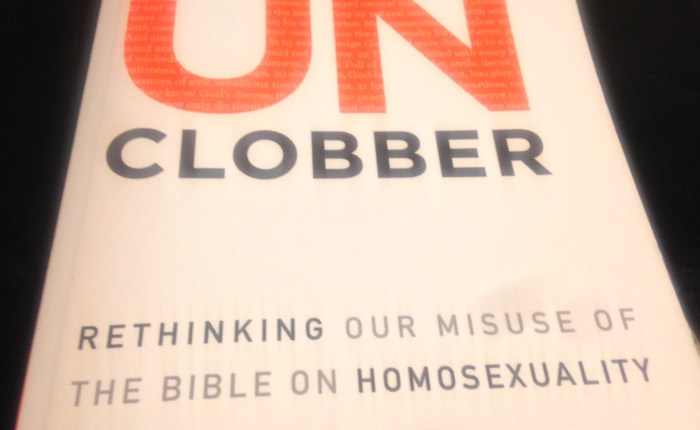
Unclobber is part memoir and part exploration of the Bible’s “clobber” passages – those verses that convince believers that God condemns same sex desires and acts. When Colby came to understand those passages differently, he lost friends and the position as pastor he was called to in a conservative evangelical church.

It’s not the book about affirming my LGBTQ+ sisters and brothers that I would write, and I’m glad. While there is strong resonance between our journeys, Colby’s story is uniquely his and uniquely valuable for that.

For me, his story is most powerful in a place where it both deeply connects with and departs from my own.

Colby changed his mind and heart because of his deep commitment to be faithful to Scripture and following Jesus. He had no questions about his own sexuality, no friends or family members who were gay.

Like me, Colby didn’t come to see things differently because he had a stake in the game. I would say that we both began to look deeper because we saw that Jesus has a stake in the game.

It’s not an easy path. While there is, as Colby expresses so well, a deep peace that comes with living in alignment – mind, heart, spirit, and outward behavior all in harmony; that peace can come with deep loss.

I am fortunate that, unlike Colby, my own journey did not jeopardize my calling or the ability to support a family. But there are deep losses nonetheless. When what it looks like to be faithful changes for you, to those for whom it hasn’t changed, you appear to be unfaithful.

Following Jesus can take us down different paths, paths that can seem confusing (and worse) to those who love us. But once seen, the vision cannot be unseen. Once known, new understanding cannot be unknown.

I’m reminded of the parable Jesus told of the Pearl of Great Price. A merchant sells everything in order to gain one thing that matters most to him (a thing that would look absurdly impractical to the parable’s audience – he can’t eat it or shelter under it, and it would be difficult to sell, if he even intends that).

It’s a parable that challenges us to know what it is that we value most. That will not look the same for all of us, even those of us who follow Jesus, and that’s hard sometimes.

I’m grateful for Colby and his journey. I’m grateful for friends who have counted and paid the cost, and continue to follow as faithfully as they know how.

And as we share our stories, I’m hopeful. I’m hopeful that we can continue to challenge our fears and blindspots, that we can embrace a faith that is ever more just and generous.

That together we can create a world that overflows with the shalom, beauty, and love of God to all.

Abandoning the Shoes that Brought Me Here

Abandoning the Shoes that Brought Me Here

There’s a poem I’ve been living with for the last couple of months. Written by David Whyte, it’s about a pilgrimage in Spain, Camino de Santiago or The Way of St. James, and the traditions that have arisen at its end at Finisterre:

The road in the end taking the path the sun had taken,
into the western sea,

and the moon rising behind you
as you stood where ground turned to ocean:

no way
to your future now but the way your shadow could take,
walking before you across water, going where shadows go,

no way to make sense of a world that wouldn’t let you pass
except to call an end to the way you had come,
to take out each frayed letter you brought
and light their illumined corners, and to read
them as they drifted through the western light;
to empty your bags; to sort this and to leave that;

to promise what you needed to promise all along,

and to abandon the shoes that had brought you here
right at the water’s edge, not because you had given up
but because now, you would find a different way to tread,
and because, through it all, part of you could still walk on,
no matter how, over the waves.

from Pilgrim, copyright 2012 Many Rivers Press

My family is hardcore fundamentalist. I often tell people that they believe Jerry Falwell started to compromise along the way. It’s funny (not to them), but true. They didn’t jump on the anti-gay bandwagon in the 90s; my step-father built it in the 80s.

They taught me many things.

They taught me that God’s love was great and that he had committed himself to working certain ways, within certain boundaries.

That’s the thing about fundamentalism (and much of Christianity that wouldn’t describe itself as such) — it’s not just people that are inside or outside those boundaries. God’s work is inside them, too, and his only work outside those boundaries is to call people to come inside them to him.

They also introduced me to Jesus and taught me to do what he wanted me to do no matter what they or anybody else thought.

And I followed Jesus to places that stretched them. I went to seminary and got an MDiv at a scary “neo-evangelical” school. I started preaching a little. And they rolled with it.

But then I saw Jesus dancing on the other side of the boundary line, and I knew what it would mean to cross that line, to follow him there. In the end, it was no choice really — of course I would follow him.

But I didn’t know how. The shoes that had brought me here weren’t made to dance, much less walk on across the water.

I didn’t begin to know how to walk across that line.

So with the help of a friend, I began to walk along it — to get to know a community of LGBTQ followers of Jesus who were trying to figure things out themselves. I listened, for months. Some of them came to trust me enough to honor me with the gift of their stories and struggles. They grew to be family to me.

They gave me space to learn to take off my shoes, to learn to walk without them. To let old ways of understanding and believing and relating die, and new ones be born and grow.

And one day, after about a year, I looked around and realized I’d left the line far in the distance. I’d taken off my shoes to find the ground on which I was standing was holy.

That moment was beautiful and terrifying.

I knew what it would mean. I knew that for many of my family and friends, crossing that line meant they would rewrite the story of Jesus in my life as a delusion — if the path had led me here, it had to be false.

And that meant that so many people I love, whose fingerprints I’m proud are on my life, who gave me the shoes that brought me here, would no longer be home for me. Elders whose voices brought deep wisdom to my life would not advise me going forward.

I’d found a new family, new elders, but they will never be replacements.

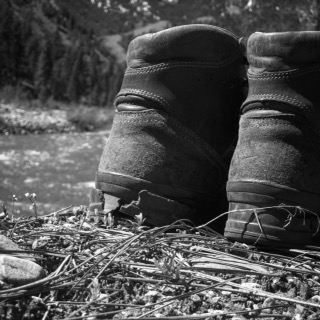
The shoes that brought me here still mark the water’s edge. They are well worn to the shape of my feet and journey. And they stand empty there in testimony that there is yet more beyond.

…to abandon the shoes that had brought you here
right at the water’s edge, not because you had given up
but because now, you would find a different way to tread,
and because, through it all, part of you could still walk on,
no matter how, over the waves.

Wading into the Wild Goose

Wading into the Wild Goose

Tomorrow I’ll head out for the hills of western North Carolina and the Wild Goose Festival (named for the Celtic symbol of the Holy Spirit).

Five years ago, when I went to the Goose for the first time, I had no real idea what I was getting into. I realized pretty quickly that I was one of the most conservative people there.

That’s not true this year — hasn’t been true for the past few years.

Wild Goose did not begin the journey for me — that happened something like 15 years ago in North Carolina when I picked up a new non-fiction at the library called A New Kind of Christian.

Or 20 years ago when I first became friends with some Presbyterians and learned that there’s not just one “right” way to read Scripture.

Or nearly 30 years ago when fundamentalist missionaries I was visiting in France explained how culture contextualized their understanding of the morality of wine.

Or 35 years ago when I stumbled onto Madeleine L’Engle’s A Circle of Quiet and first encountered a woman who loved Jesus and looked nothing like Christians I knew.

Or when I first learned to read and enter others’ stories and lives and see a world of endless perspectives.

I’m not sure our journeys ever “begin,” but there are moments that shift something, that change something. That take all the things that came before and reorder them into new realizations and new ways of seeing.

Wild Goose gave me a space, for four days each summer, to dive into that. To live beside and walk with and listen to and share beauty and grief and pain and joy with people who lived very different lives and fought very different battles than I had.

And, it turned out, some from remarkably similar places.

Wild Goose is a spiritual refugee camp for a motley collection of people who, for a host of reasons, find themselves outside the lines traditional Christianity has drawn.

Having that space each summer opened me up. It gave me the space to ask questions, of myself as much as others. And it prepared me to dive into a different kind of community at home and be changed by it.

Wild Goose showed me Jesus obliterating the lines, loving and walking with people in all sorts of journeys, just wading in.

And I waded in after him. I’m looking forward to wading in deeper this year!

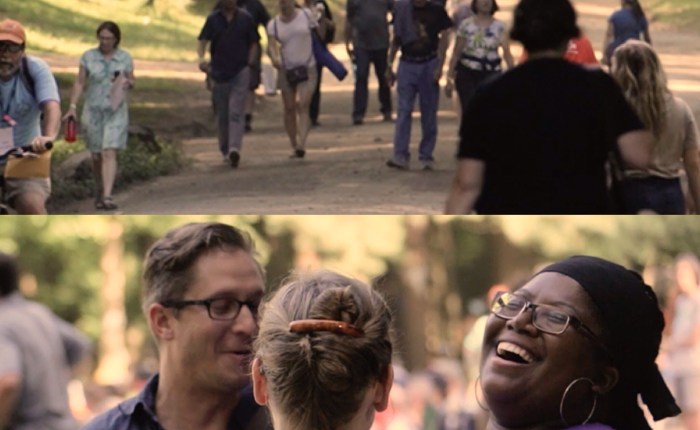
(That’s the back of my head in the picture!)