To Be a Woman

To Be a Woman

In 6th grade, I was an outcast.

It was nothing new; it’d been that way for several years by then. By 4th grade, the girls in my class at the Christian day school we attended had decided I was unworthy, and it stuck. As an adult I came to understand that I was their scapegoat – they projected all their own fears of rejection on me and cast me outside the camp. But at the time, I just knew that they despised me.

I didn’t wear the right clothes, or look the right way. I didn’t care about the things they cared about. I thought the things they cared about were silly and did little to hide it. (That didn’t exactly help.)

But I longed for friends. I was living as an introvert, quite contrary to my nature, and I longed to be seen – for my companionship to be enjoyed simply because I was myself.

One day at school, while a group of us were working on a special project, a couple of the girls included me in their play. They were braiding each other’s hair and trying different styles, and they began to brush my long hair and pull it into a complicated kind of ponytail, a new style for me to try.

I loved it. I felt alive. Part of the reason girls play with each other’s hair is because it can feel so good and be so relaxing. The pull of a brush, the tug of braiding, the focus of attention. It’s an intimacy, allowing another to shape your appearance, however impermanently.

I thought that, for whatever reason, the wall had cracked and a friendship had begun with these girls. I wasn’t so thoroughly on the outside anymore.

Then, as we were rejoining the rest of the class, one of them said something about the other girls maybe liking me now, with my new hair style, and it all came clear. I had merely been their project, an object of their pity. They wanted to change me so I would be more acceptable.

I fought back tears as I pulled that carefully worked ponytail apart.

I had nothing against the hair style, but I wanted to be wanted for who I was. Not because I’d changed something to fit in.

I became possibly the first of the hipsters in that moment in the early 80s. If it was popular, “in,” I despised it. And when the girls adopted something trendy – neon sweatshirts or black lipstick – I despised them for it.

There was little I understood about those girls, or most females really – particularly in groups. And while there were and are women in my life I love and respect and even like, I avoid groups and activities for women like the plague. There is nothing more likely to make me feel like the only alien on the planet.

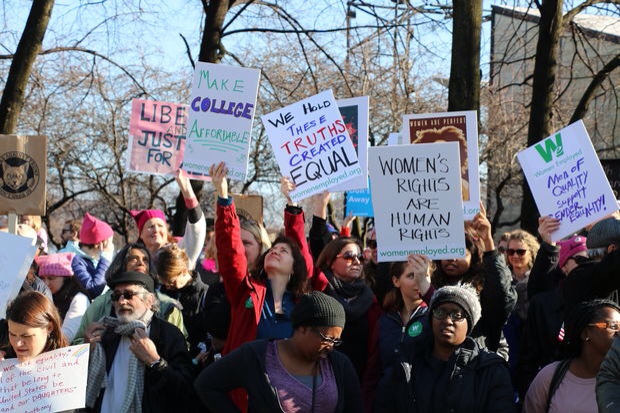
But when I went to the Women’s March a year ago this weekend, I didn’t feel that way.

I didn’t go as part of any organized group, though there were many represented, and it didn’t matter. I hadn’t even particularly planned on going. I was meeting an old friend for breakfast that morning and had thought I could maybe go downtown to the march when we were done. He ended up deciding to go too, and by the time we got to the area, the Chicago march had been officially canceled due to the crowds. But it didn’t change anything.

The streets were filled with women of all ages and colors and sizes. A sprinkling of men were there too, most carrying daughters or pushing strollers. The signs made it clear that there were many concerns represented – all of the things women care about. Though the most common sign, “Keep your hands off my pussy!”, referenced the bragging claim of the recently elected president and asserted a woman’s self-possession. Her possession of a fully human self, with all the rights of dignity and self-determination that entails.

And for once, surrounded by hundreds of thousands of women, I didn’t feel like an alien. I felt no pressure – explicit or implicit – to fit anyone else’s idea of what it means to be acceptable as a girl, as a woman.

All I had to do was show up, as a woman, for other women.

And I marched, for hours up and down the streets of Chicago.

I marched for the women I know who were and are afraid every day. The women who are afraid because of the color of their children’s skin. The women who are afraid to go to a public bathroom, afraid they will be harassed or attacked because they don’t fit someone’s idea of what a woman looks like.

I marched for the women who are my neighbors, who are afraid their families will be torn apart by deportations. I marched for my nieces and great-nieces, for the daughters of friends, so that they would never believe that any man has the right to their body. I marched for the dignity and equality of my sisters. I marched for every little girl who doesn’t fit.

I marched for a lot of women I love who hated the very idea of that march.

I marched because we don’t have to fit anybody else’s idea of what it means to be a woman.

This weekend, women around the country marched again. Women around the country are running for office. Women around the country (and the world) are speaking up against harassment and abuse and their own silence in the face of the assumptions of men.

They aren’t marching because they can’t deal with these things – women have for millennia been figuring out how to deal with these things. How to survive. They, we, are marching because no woman should have to deal with these things.

And no woman should ever have to fit anyone else’s idea of what it looks like to be a woman.

The Luxury of Time

The Luxury of Time

“People need time to adjust.”

Time to change. Time to learn. Time to get used to new ideas, new things.

I’ve heard it over and over again, especially in the church, and especially from people who are concerned with community – with the connections we have across difference and disagreement.

I’ve heard it when we talk about trans folks having the freedom to use the bathroom that best fits their identity (instead of being harassed or attacked if they try to use the one that matches their birth certificate). I’ve heard it when we talk about gay marriage. I’ve heard it when we talk about white privilege and the systemic discrimination people of color face in churches and society.

And it’s true. Change does take time. None of us leapfrog to new things. We get there one step at a time.

The problem is that when we appeal for time for people to adjust to something new, we’re privileging those for whom the status quo is not a problem. People who didn’t (don’t) see the need for change on their own are already privileged, even if they rarely recognize that reality. Those of us with power and privilege can rarely see what they we have. It feels normal to us, and we naturally assume that what is normal to us is also normal for others. It’s just “how the world works.”

But the world may work radically different for someone else, and it is radically different for people who are different from me.

I began to realize that in my late twenties when I lived in North Carolina. It was a time of dramatic change as North Carolina had the fastest growing Hispanic population in the country. Immigrants from Mexico were flowing into the state, and some smaller communities were reeling as their Spanish-speaking population increased from near zero to 20% or more in only a few years. That’s radical change.

In the area where I lived, the impacts were focused in a few neighborhoods, one of them already the most struggling neighborhood in town. It had quickly shifted to being roughly a third Hispanic, a third black, and a third white (mostly aging folks in homes they’d owned for decades). Friends of mine from church bought a home in there and enrolled their daughter in the local school. Several of us met in their home weekly and started to get involved in the community and the schools there.

It didn’t take long at all for my illusions about equality of opportunity and access to get blown out of the water. Black and Hispanic neighbors both, for somewhat different reasons, faced discrimination and barriers beyond what I’d imagined. I knew poverty – our family had struggled to make ends meet when I was growing up. But this was beyond poverty. These folks’ lives were so very different than mine.

The change they are waiting for is us.

The world works pretty well for us already, and we don’t want that to change. So we’re content for it not too until they can convince us there’s a problem, and that it’s not a problem of their own making, to the standards of our assumptions about how things are.

Because we can afford to take the time.

Even if they can’t.

Learning takes time. Changing takes time. Journeys happen one step at a time. I took the time; I walked – and sometimes ran – each step; and I’m still learning.

But when we make our learning and our comfort the criteria for change desperately needed by those who are vulnerable? That is the epitome of perpetuating and protecting our privilege.

A friend of mine who is a pastor recently related the words of a parent whose teenager had come out to them: “I suppose I should have cared enough when it was other people’s children.”

When we take our time, it always costs someone who can’t afford it.

Advent in the Dark

Advent in the Dark

It’s dark.

The days keep getting shorter, and what daylight we have in Chicago is often cloudy and gray.

Advent – the four weeks leading up to Christmas – is always that way (at least in the northern hemisphere). The nights creep ever earlier, dawn ever later, and we live more and more in the dark.

“In the dark” – it means we don’t know what’s happening or what happens next. It’s a lot like the centuries before Jesus came in Israel, and even after he came. They were in the dark. A people struggling to live under empires that could’ve cared less about them. Promised something more, they had no idea where it would come from, what it would look like. Their heroes kept failing them, and for the most part, their hopes got it wrong.

The world seems pretty dark to a lot of people these days, too. Full of fear and uncertainty and instability and failed heroes.

We celebrate Advent with the beautiful words: hope, peace, love, joy. We celebrate Advent like we know what comes next. But the kicker is, they didn’t. And beyond the words of the Christmas story, neither do we.

Advent is about confusion. Living in the dark. Finding enough light to keep living, nonetheless.

The pregnant teenager with no good explanation. The kid hiding their reality in a closet, terrified of how their family and community would respond if they knew. The un- and under-employed, stuck in a system that seems determined to keep them there. The persistently single, longing for a chance to get excited about someone. The refugee longing for a peaceful life when the world has crumbled out from under them.

We live most of our lives in the dark, and it rarely feels safe. So much haunts us there – fears of the past, fears of the future, fears for tonight.

So we light candles of longing, candles of coping, sometimes candles of change. Candles that defy the dark with kindness, generosity, solidarity, risk.

We tell ourselves and each other stories – stories we can’t be sure will be true, but we offer them in hope anyway. We create paths of flickering light with our words, like luminaries in the night that may lead to a bonfire on the beach with something warm to drink, a sweet bread to savor, and others with stories to share.

We look for those flickering lights to lead us to each other, and maybe that’s the only hope we really have in the dark.

To Belong

To Belong

The spaces that belong to you are not always the spaces where you belong.

The green carpeted floor underneath the ash pews in the church I was born in. That space belongs to me. Full of “aunts” and “uncles” and friends like Patty and Garrett (the first boy who ever proposed to me – we were maybe five), a community  I’d never known life without. People who knew my father before his illness and death, who knew my parents before their marriage.

That space is mine in the way only the place you were born can be. It accepted you for no reason beyond your existence.

The university campus I grew up on, a kid running more or less wild after the 3:00 school bell, playing games of tag with my brother and his friend that ranged through the several city blocks of interconnected campus buildings. Exploring roofs and nooks and crannies forgotten by all but the cleaning crew. There are few places on earth I will ever know so well, from the inside out.

Full of people who watched me grow up, who surrounded our family from its initial blending when my mother’s remarriage brought me a new step-father and two brothers, through my stepfather’s cancer and death, and then Mom’s second remarriage. People who saw and didn’t see.

This space is mine in the way places you grew up are, especially when that growing up was such a profound suffering.

But even then, there were signs I didn’t belong. Growing up I found my home in the stacks of the campus library and, as early as junior high, with the theater majors – the most classic of misfits. (The fact that I was socialized by fundamentalist Baptist theater majors may explain a lot.)

It wasn’t until my early thirties, when I moved back to the small Bible college campus where my parents had met and I’d spent my earliest years that it came clear.

My office was my mother’s old dorm room, and my apartment was in the same building where my aunt and uncle had started married life. I was working with family and people who’d know my parents, and in hallways and classrooms where as a kindergartner I’d made friends of faculty and students and watched weekly missionary slideshows from all over the world.

These were spaces that belonged to me, but I didn’t fit. Over the four years I lived and worked there it became increasingly plain that I didn’t belong. No one told me, or did anything to make me feel that way – just the opposite, in fact. I was embraced and loved. But there was no place there for the questions I was asking. I was trying to grow, but the light wasn’t right there, and the soil.

I didn’t fit.

In retrospect, I never really had.

Where do you go when the spaces that belong to you, that you know, are not where you belong?

I went exploring. Not randomly, but in directions that seemed hopeful, through spaces that, while they weren’t where I belonged either, took me to more possibilities. I learned to follow Jesus beyond what I could see and to trust him with all I could not understand.

I left the land of my birth (there is no story without leaving home) to go to a land he would show me. Had I known twenty years ago where the journey would take me, I would have rejected it. If it led there, it could not be from God. But I learned to trust each step more than where I thought they might lead. I learned to listen beyond my assumptions and assertions. I learned to trust the questions I did not have answers to.

Every family and tribe has its own culture, and every time we leave home, we have a choice. We can carry the whole turtle shell with us, or we can learn to live in other people’s spaces, with other people’s cultures, languages, ways.

Perhaps the challenge of love is to let yourself belong somewhere that doesn’t belong to you. In a place you weren’t born into, that was not the space that shaped your growing up.

I live in those spaces now. I worship in those spaces. I learn in those spaces. I listen in those spaces. I share myself in those spaces.

Some of them, like my Episcopal Church family, are full of traditions and ways I will never fully understand. There are ways I don’t fit (Baptist edges don’t all quite wear down), but I belong. Others of them, like the LGBTQ+ community, are chosen spaces – created out of the needs of those who in certain ways didn’t fit the families and communities and churches that belong to them by right of birth. They have traditions, but they are younger traditions, still growing and expanding (not always gracefully). There are ways I don’t fit (my straight orientation and cisgender are not things I get to choose), but I belong.

These are not my spaces and never should be. I have no right to try to shape them to fit me. But they have shaped me, and I have found that I belong.

The spaces where you belong are not always spaces that belong to you. And maybe that can be a good thing. Maybe even the best thing.