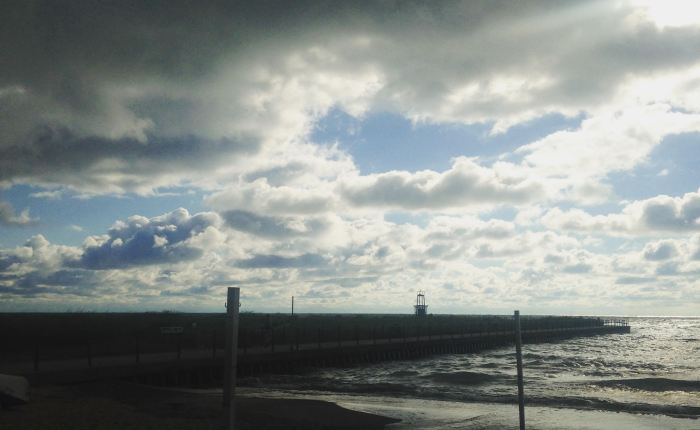
Getting Through

Getting Through

Life is so hard.

I have friends facing so much right now. Friends with cancer diagnoses. Friends facing seemingly unending obstacles in their life’s work. Friends reading words of condemnation and rejection from former mentors and colleagues. Friends struggling with depression and despair. Friends wading through flood waters of many kinds, including the literal.

Friends facing so much that is discouraging, demeaning, and overwhelming.

All my life I’ve tried to fix problems. My brain sees puzzles everywhere and looks for solutions instinctively. Sometimes that’s helpful, but I’ve slowly (too slowly) learned that the things that really matter aren’t puzzles to solve or problems to fix. They are just life. Messy, painful, sometimes beautiful life.

And life is not meant to be fixed or solved. Life is meant to be lived.

I’m beginning to learn.

I used to feel so helpless and useless in the face of pain and problems I could do nothing to resolve. But I’m beginning to understand that even when I can’t fix a thing, I’m not helpless. I still have agency. There’s still something I can do.

I can choose life.

I can choose to sit with pain and confusion and still love in the midst of it. I can name what is wrong and refuse to redefine it as okay. I can have faith for and in friends. I can believe there’s always something more, that nothing has to go the worst way it could. That love is never wasted.

Don’t get me wrong, I still wish I had a magic wand to make everything better. And in its absence, I will still do what I can to heal the wounds of this world and intervene in the violence that creates them. But whatever else I can (or can’t) do, I can be present. Present to this world in all its chaotic pain and beauty. Present to my friends and neighbors as they wrestle with what life has presented them with. Present to each moment I am given.

And one moment at a time, we will get through.

White Supremacy Is My Problem

White Supremacy Is My Problem

I wish it weren't. How I wish it weren't.

As I watched events unfold in Charlottesville this weekend, with friends there attacked because they stand against hatred and violence, I wished it weren't.

I wish that what I believed as a child in the 70s was true – that the Civil Rights Movement had brought equality for all. But the justice of the law is no more just than those who enforce it. And as important as the achievements of the Civil Rights Movement were, there is so much they did not and could not do.

White Supremacy is very much alive, and it's my problem, no matter how much I wish otherwise.

It's my problem.

Every time I've assumed the black woman sitting next to me on the train feels as safe in that space as I do.

Every time I effectively dismissed racism as a "sin problem" that can only be dealt with in individuals' hearts.

Every time I think I've had opportunities only because I worked for them.

Every time I sat in church believing we weren't perpetuating racism because a few black families were there who embraced our theology.

Every time I haven't thought about White Supremacy because I didn't have to, and I had other things to think about.

Every time I believed a person of color was being considered for a job on the same basis I was.

Every time I assumed that a fellow student of color had the same opportunities I had because we were sitting in the same class.

Every time I dismissed White Supremacists as an anomaly, as a fringe element, rather than seeing them as the most visible outworking of a pervasive system, a system I am a part of.

Every time I didn't speak up when someone excused or dismissed white supremacy as something that isn't their problem, or insisted that black resistance is an "equal" problem.

Every time I failed to realize that black friends don't have the same experiences I do when they drive somewhere, or shopping, or taking taxis, or with the police, or doing any one of the many public errands that make up my days.

Every time I was more concerned with protecting me and mine than ensuring justice and safety for someone else.

Ever time I studied "Christian" history and theology without questioning its Eurocentric assumptions and role in establishing the Doctrine of Discovery.

Every time I've avoided speaking up against the assumptions of white supremacy because it might make someone uncomfortable.

I don't believe in white supremacy, but I don't have to believe in it to be a part of it. And if a white supremacist is someone who does believe in it, then I am not a white supremacist. But every time I have acted like white supremacy is not my problem, I'm sure you couldn't tell the difference.

I'm sorry for every time that's happened. I know more than I used to, but I have so much more to learn. I fail in ways I can barely begin to imagine. I will keep working on it, and this is one way to take a step forward.

White supremacy is my problem.

And if you are white, it's your problem, too.

Who Raises Up the Despised?

Who Raises Up the Despised?

(A sermon, on Genesis 29:15-28 and Matthew 13:31-33, 44-45. Audio is available here.)

Jacob, he loved Rachel,
And Rachel, she loved him,
And Leah was just there
For dramatic effect.

(from Rich Mullins’ “Jacob and 2 Women”)

The way the story is told, it’s not easy to understand what Laban was thinking when he pulled his trick on Jacob, and it’s even harder to know how Leah must’ve felt – whether she was glad to go along or not, she wouldn’t have had much choice in their culture but to do what her father told her to do.

We do know something about what Jacob felt though – we know he didn’t want Leah, he wanted Rachel. It would always be about Rachel for Jacob. It would always be Rachel he loved.

Unloved and unwanted. Leah lived her life as the despised wife, always competing with her sister for Jacob and always losing. It’s hard to imagine a more miserable situation.

But that’s not the end of Leah’s story. Later we learn that because she was despised, God gave her children, and ultimately the line of Christ came from the despised wife.

We have a God who sees the unwanted, the overlooked, the powerless, the despised, and raises them up.

Jesus, Leah’s many-greats grandson, always had time for despised women – a Samaritan woman with a less than stellar reputation, a woman caught in adultery, a widow grieving her only son. And it wasn’t just women – Jesus’ whole ministry was filled with the overlooked and unwanted: the men he chose as his closest disciples were all Galileans like himself, and Galilee was considered a backwater by Judean Jews. He spent most of his time with those despised by the religious as drunkards, tax collectors, and sinners, and he went out of his way to help those even his disciples thought were a waste of time – beggars, children, and Gentiles.

His parables were full of unlikely heroes – women, servants, a Samaritan. Over and over again, Jesus urges us to value what is small, hidden, and overlooked. A tiny mustard seed is hidden in the ground and becomes a tree large enough to provide a home for birds. A woman hides a little yeast in three measures of flour – that would be forty to sixty pounds of flour, and it is all leavened for enough bread to feed a village. Treasure and a priceless pearl are found hidden in fields.

This is where the kingdom of heaven is found, Jesus tells us – in small, ordinary things; in overlooked, hidden places. In people and things and places we so easily despise.

We have a God who sees the unwanted, the overlooked, the powerless, the despised, and raises them up.

And that makes me wonder, where are those things in our lives? In our communities?

Some of us know what it feels like to be despised – overlooked, unwanted, or even hated and rejected. And many of us really don’t know what that’s like.

I’m not sure which is more dangerous to us.

If we’ve been blessed not to have experienced being despised, that can make it all too easy to miss what we should see.

If we have been unwanted and despised, and have fought to find a place of acceptance and safety, it’s all too easy not to risk what we’ve gained for the sake of someone else who is despised.

We don’t have to hate someone to despise them; we only have to overlook them. To be uncomfortable enough to avoid them.

Who are those people in our lives and in our communities? The people who threaten the places we are comfortable? To be honest, I struggle with the panhandlers in my neighborhood, especially the ones who are more desperate, abrasive and louder, or who haven’t bathed in a long time. It’s easy for me to try to just ignore them instead of being willing to really see them as fellow human beings God loves.

In most communities, we struggle to include those whose language and culture are different. It’s easier to let them have their own spaces than to welcome them into ours. We struggle to welcome those who don’t think like we do, whose lives challenge our beliefs and call us to change. Humans tend to struggle with anyone who is different; we find our family and tribe and keep others out.

Are we willing to be uncomfortable in order to be more like Jesus? To show his welcome to the unwanted? Because that is what he calls us to do – to spread the “gospel,” the good news. At the very beginning of his ministry, Jesus proclaimed himself to be “good news” to the poor, and freedom for prisoners and the oppressed.

We have a Lord who sees the unwanted, the overlooked, the powerless, the despised, and raises them up.

Jesus is present with us in the bread and wine we will share, but he is present in the world through us, as well. And we take the bread and the wine because it is meant to change us – to give us the eyes of Christ to see the overlooked and the heart of Christ to welcome the despised.

Saint Teresa of Avila put it this way:

Christ has no body but yours,
No hands, no feet on earth but yours,
Yours are the eyes with which he looks
Compassion on this world,
Yours are the feet with which he walks to do good,
Yours are the hands, with which he blesses all the world.
Yours are the hands, yours are the feet,
Yours are the eyes, you are his body.
Christ has no body now but yours,
No hands, no feet on earth but yours,
Yours are the eyes with which he looks
Compassion on this world.
Christ has no body now on earth but yours.

The same God who chose the despised wife is the God who calls us to be the eyes and hands and feet of Christ in the world, who calls us to see the unwanted, the overlooked, the powerless, the despised, and raise them up.

Amen.

The Life of the World to Come

The Life of the World to Come

We said it in church this morning – that last line of the Nicene Creed. The one that reads, “We look for…the life of the world to come.”

For years that meant the life after death to me, and it held deep personal significance. In “the life of the world to come,” I’d see my daddy again. But it was more than that.

When my grandmother was in the last few years of her life, missing the friends and family who were gone, never quite happy, always wanting more of her only grandchild and unable to enjoy me for who I was, I learned to love her beyond what chafed and hurt by believing that in the life to come, she would finally be everything she was meant to be, full of joy and understanding. When I met her then our relationship would be everything it could be, everything it was meant to be.

That same hope got me through several break ups and many bouts of unrequited love. And as I began to realize that so many of the mentors and teachers who have given me the most cannot understand or approve of where their gifts have taken me, I have hoped that in that “life to come,” they will see their way clear to be proud of who I am.

But alongside the comfort, there was also a kind of stuckness. Hope was out there, not here. The great reconciliation, true healing, and abundant life were all beyond the scope of this world.

And sometimes they are.

That’s the first line of the Serenity Prayer: “God, grant me the serenity to accept the things I cannot change.” It’s important, that bit. The whole prayer is named for it, after all.

But that’s pretty much where it stopped for me. God was sovereign, in control of all things and working them all together for good. What could I possibly do in light of that other than show my trust in him by waiting as faithfully as I knew how?

But there’s more to the prayer than serenity. There’s courage. And wisdom. And when it comes to it, serenity isn’t worth much without her sisters.

In the past year, I’ve also learned to hear those words in the Creed another way.

The “life of the world to come” starts tomorrow. And tomorrow is what we are making it today.

This life to come is the second part of the prayer – “the courage to change the things I can.” To change the things we can.

“We look for the life of the world to come.”

If the “arc of the universe bends towards justice,” it does so through us. Because we bend it that way. Because the life of the world to come is not yesterday, and tomorrow does not need to use the road maps of the past.

We look for the life of the world to come because we know there is more than this. More than death, yes. But also more than this, more than today. More than what we find ourselves with. There can be more, we can do more. We can make changes. We can take a step in the direction of justice, in the direction of Love.

And it’s never wasted. That’s what the concept of karma is really about. It’s not just that what you put out there will come back to you. It’s that what you put out there contributes to something greater than you. We are shaping the “arc of the universe” every day. We are making “the life of the world to come” – a life and world we will share.

So I have begun to look for life in this life. I look for life in each step, in each choice I make: what will bring life in the world to come? What will bring life to the world tomorrow?

And there’s always something. Something that in the midst of all the things I can’t change, that I can. It is wisdom that helps me do what I can rather than camp out at the door of all I can’t.

I lived there too long. It’s time to begin moving into the life of the world to come. Today.