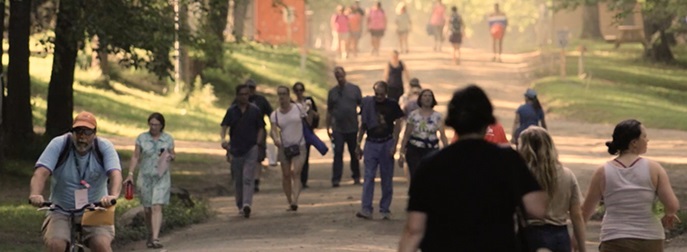
Walking the Wild Goose

Walking the Wild Goose

When I think back on my years attending the Wild Goose Festival, I think of walking.

The first year I attended, I came to speak with a friend. I was still a somewhat conservative but curious evangelical, recovering from my hardcore fundamentalist roots. My friend and I participated in a pre-festival retreat for the speakers, and I remember sitting and listening to Frank Schaeffer, a fellow recovering fundamentalist, speak (or more accurately, rant) and wondering what I’d gotten myself into. Frank felt angry to me, and wherever I was going, I didn’t want it to be an angry place. I was troubled.

Later that evening, long past dark, the retreat ended with a prayer walk through Shakori Hills (where the festival spent its first two years). Gareth Higgins handed me a flashlight, and we all began to slowly venture into the night, a flashlight here and there to help us along. It was hard to see much of anything, but as we walked, silent except the scuff of shoes on the dirt path, my eyes began to adjust. I realized that Frank and Genie Schaeffer were walking beside me, following the light of my flashlight.

And I knew in that moment that we were walking the same path in a much larger sense. My journey would not look quite like theirs, nor theirs like mine. But we had found ourselves here, walking alongside one another and doing our best to find our way forward.

Our paths crossed several times that weekend, and I began to know the whirlwind that is Frank and the calm that is Genie. I heard Frank talk about struggling with the anger he’d brought with him from his fundamentalism, of not wanting his granddaughter to know him as that “angry man.” I sat with Genie in the heat of an afternoon as we talked of transitions and changes and grace.

As year followed year, I’ve walked with many different people at the Goose, renewing friendships and adding them. As I moved farther from traditional evangelicalism, I found new “elders” for my life when the old ones could no longer understand the path ahead of me. I can’t count the times I’ve greeted someone and heard the reply, “Where are you headed? Can you walk with me?” And wherever I was headed, my answer is almost always yes.

I walked alongside Vince Harding one hot afternoon, and was left with an embrace and blessing I will always remember. I’ve walked many times now with my friend Nathan, a young man who I saw come out publicly for the first time during the Q & A of a Goose session, and who the next year told me about his new boyfriend and plans to start seminary. I’ve walked the Goose with Paula Stone Williams, a fellow recovering fundamentalist and one of the bravest people I know. I’ve walked with a newly-out and newly-single father and helped wrangle his two young children.

These days, it’s the first thing I do once I’ve settled in – begin walking the paths looking for friends. Looking to learn what the Goose will have to teach me this year. As the years have gone by, I attend fewer and fewer sessions, my time filled more and more with conversations along the way.

I’ve walked with heroes and strangers. I’ve hugged friends as we’ve passed, and had the joy of introducing and connecting people. This year, I look forward to walking with friends I’ve yet to meet in person, as well as an old friend of my parents who I haven’t seen in around thirty years. I’m eager to see friends from around the country whose faces are dear to me and too rarely seen.

The Wild Goose is far more than a destination; it’s a journey each one of us walks in our own way. And for a few days in July, we have the gift of walking together.


I’m thrilled to be speaking at this year’s Goose July 13-16! Join me and save 25% off weekend pass with the code BEMYGUEST.

Holding the Door

Holding the Door

Driving to work this morning I heard a story about Nashville artist Jason Isbell. Isbell is from rural north Alabama near the Tennessee state line (a couple of hours west of where I grew up). He’s a thoughtful and curious songwriter whose songs are full of the nuances of humanity and real life, and he feels the tensions of the history-haunted south.

I’m a white man living in a white man’s world
Under our roof is a baby girl
I thought this world could be hers one day
But her momma knew better

…I’m a white man living on a white man’s street
I’ve got the bones of the red man under my feet
The highway runs through their burial grounds
Past the oceans of cotton

I’m a white man looking in a black man’s eyes
Wishing I’d never been one of the guys
Who pretended not to hear another white man’s joke
Oh, the times ain’t forgotten

…I’m a white man living in a white man’s nation
I think the man upstairs must’a took a vacation
I still have faith, but I don’t know why
Maybe it’s the fire in my little girl’s eyes

(from “White Man’s World,” by Jason Isbell)

Isbell has found an audience beyond country music, and that audience is growing. “Doors are open to me and I’ll be damned if I’m not gonna walk through ’em,” he says. “But I’m also gonna try to hold ’em for somebody else before they slam in their face. And at the very least, at the very least, discuss it with people.”

It’s a good image: holding the door open for somebody else. He sees what’s happening for him, and he recognizes others aren’t getting the same opportunity.

When I was in college, I took a class in Apologetics. I attended a fundamentalist Baptist university, and that class was part of the theology program. It was a large class, and I was one of only a few women. Apologetics is about how Christians answer hard questions, and I had lots of questions (that had something to do with why I took the class!). But I could sit forever with my hand in the air and never get called on by the (generally good natured) professor. He was never rude or unkind to me, but it was like my hand was invisible. After a few weeks of this, the student who sat behind me, Nate, started raising his hand if mine had been up a while. When the prof called on him, he’d act confused and defer to me to ask my question first.

He held the door open.

Later, in my first real job, I worked as the one-woman office staff for my pastor’s speaking ministry. I had a great relationship with both my pastor and my boss and a good relationship with the other men on the ministry’s board. When they decided to launch a national radio ministry, we began to work with an agency that produced and distributed many of the most well-known evangelical radio ministries. Things were still in development when the president of the agency, Jon, and I met at a conference, and we hit it off. He began to informally mentor me, and when it was time for him to fly in for his first meeting with the board, he asked if I would be in the meeting. I’d never been in a board meeting before, but it was clear Jon expected me to be there. My boss decided I could sit in a chair in the corner of the room and take notes.

Jon arrived, and after the introductions and greetings had gone around the room, he spoke up and said, “Before we get started, can we find another chair? I’d like to make room for Jennifer here at the table.” He shifted things around and held a chair for me right beside him.

He literally and figuratively made a place for me (the only woman in the room) at the table and was intentional about including me in the ensuing discussion.

When it was time for our people to fly out to California to meet with the agency production and distribution teams, Jon told them, “Don’t bother to come if you don’t bring Jennifer!” So off I flew. I learned a lot on that trip, and future board meetings included me. Jon saw I had something important to contribute, and the men started to listen when I spoke up.

Jon held the door open for me.

Doors don’t open the same for everyone. For some of us, generations of access to education and systems that were designed for our benefit turn a lot of doors into the kind that see us coming and slide open with a whoosh of anticipation. We hardly even know a door was there. But those doors don’t recognize everyone, and others of us have to exert a lot of effort to push and pry them open. Sometimes it just requires more than we have. And sometimes the doors are locked to us.

If I can pay attention and recognize the doors, if I can notice when those doors that open for me aren’t opening for someone else, that’s when I can hold the door for them.

And maybe if enough of us notice, we can get the doors re-programmed, or just take them out altogether.

Happy Birthday to the Whole Crazy Messy Lot!

Happy Birthday to the Whole Crazy Messy Lot!

Pentecost is a funny day. It’s full of things we don’t know what to make of – fire, wind, other languages, friends, strangers.

It’s also the birthday of the church, and if I’m honest, that’s something I often feel pretty ambivalent about celebrating. I love her, but she makes me cringe a lot, too.

But Pentecost Sunday is her birthday, and as much as she still needs to grow, a birthday is a good time to look at baby pictures, to celebrate the DNA that’s baked in.

And the DNA of the church is diversity.

Pentecost is often seen in contrast to the story of the city of Babel, but I see it as more of a parallel story.

Babel is part of the origin story of humanity. After only one family was saved from the great flood to reboot the human race, they stuck together. The story begins by telling us they built a great city with a tall skyscraper where they could all stay in one place and speak one language.

And God looked down and saw all the effort they were going to in order to maintain a single identity – a singular “name” for themselves – and wondered just how far they’d go with it. And so he mixed their languages and scattered them across the earth.

It’s the beginning of different languages and cultures, and that was God’s idea. It shouldn’t surprise us that the same God that made creation to increase in diversity also likes diversity in people. 

He likes diversity a lot more than we do. We’re a lot like those first Babylonians that way – we’ll go to a lot of trouble to stay together with those like us, with those who share our “name,” our identity, our truth, the way we see things. 

And while there’s nothing wrong with enjoying being with those who are like us and celebrating our culture together (after all, that’s what God made at Babel!), we tend to go farther. We judge our ways and our culture as inherently better than others, and we find reasons to push others away or insist they assimilate.

But then there’s Pentecost, and in the birth of the church, God reasserts his preference for diversity. Mixing Galilean fishermen and tax collectors and radical zealots wasn’t enough for him. They were gathered together in one place speaking one language, and as the church is born, they begin to speak many different languages. The immigrants and visitors who were in Jerusalem from all over didn’t hear the good news of God’s kingdom in one language; they each heard it in their own language. 

God birthed the church in a glorious mix of languages and cultures that only expanded from there. It’s the opposite of assimilation. God’s good news is endlessly translatable, and when we walk together with those who are different from us, we can see things we never would’ve seen on our own – hear things beyond what our own language can tell us.

While God calls us to unity in him, that unity never comes at the expense of the diversity God glories in. May we learn to glory in it the way God does!

So church, happy birthday! عيد ميلاد سعيد! Hyvää syntymäpäivää! Joyeux anniversaire! Hau’oli la hanau! 생일 축하합니다 Feliz cumpleaños! Penblwydd hapus! С днём рождения! 

The Pain and Perils of Fitting In

The Pain and Perils of Fitting In

“Don’t worry. It’s all right. I’m sure no one will think you’re my friend.”

I’ve been watching Netflix’s new series, Anne with an E. As much as I loved the old Anne of Green Gables series of books and mini series, this one is deeper than those were – grittier and with more human complexity. It takes Anne’s history as an orphan, worked like a slave and abused, seriously.

And it doesn’t sentimentalize the brutality of children. We too easily accept “teasing” and “bullying” as normal rather than recognizing them as the terrorizing acts they are.

Anne Shirley’s vibrant imagination is not just a charming gift of creativity. It is a survival skill, a life raft that keeps her moving through the unlivable.

Those words, “Don’t worry. It’s all right. I’m sure no one will think you’re my friend,” are her response to a schoolmate who is horrified to learn she will be staying with Anne’s family for a few days after her house has caught on fire (and been saved from complete destruction by Anne’s quick thinking).

I’m fairly sure I said much the same words myself more than once while growing up.

There aren’t really words to express what it feels like to know your peers despise you, and that you have to go back to school with them the next day anyway. And the day after that. And the year after that.

For me, it started in fourth grade. By fifth, life was a nightmare, and much like Anne, I fled to my imagination to survive by reading through each day. Recess, lunch, any free moment, I lived in the world of whatever I was reading.

I remember the first time my mother had “room mother” duty and visited my class. That day after school she told me, “You’re right, they hate you. I don’t understand why, but they do.”

I was surprised she could see it. Adults generally didn’t. My fifth grade teacher, Mrs. Gardner*, in particular. I adored her – we all did. She was blonde and young and good natured and fun. And she was concerned that I didn’t socialize and play with the other girls. She took me aside to talk about it and ask if there was a problem.

There was of course. The girls mocked and ostracized me, and her daughter was the ring leader (in a move that I doubt would happen today even in a small private Christian school like ours, her daughter had been assigned to her own mother’s class).

What was I supposed to say? Your daughter is cruel and mean, and I don’t want to play with her any more than she wants to play with me? Kids know better. At least I did. I said something about not knowing how to jump rope (the activity the other girls spent most of their recess time on and that I could never understand the attraction of).

So, Mrs. Gardner made a project out of me. One recess she enlisted her daughter and her friends to teach me to jump rope at recess. I remember all of us kids looking at each other and silently agreeing to go along with the fiction – to protect Mrs. Gardner from the real world.

The next recess we all returned to our regular ways.

After a week or two, Mrs. Gardner tried a different tactic and suspended my library privileges in an attempt to deprive me of my regular refuge.

This wasn’t the first time a teacher tried that with me. In second grade at a different school, a student teacher had a scheme in which we had to read so many books at each reading level before we could advance to reading books in the next. The first level was mostly Dr. Seuss, and I’d pretty much skipped that level long before. Those were “baby books” to me, and I refused to read them on principle. The librarian, Mrs. Redmond, liked me (librarians always liked me) and helped me find other books until the teacher made her stop. Mrs. Redmond told me to get my mother to take me downtown to the public library and get me my own library card so I could read whatever books I wanted, and that’s exactly what we did. (Librarians are more subversive than one might think!)

So when Mrs. Gardner took my school library privileges away, I just started bringing my books from the library downtown. And they saved my sanity and my heart.

Children can be brutal, and adults can be naive fools about them.

In the years that followed (I graduated high school with pretty much the same group of kids and it was one of the happiest days of my life), we all learned to survive. I learned the girls who would tolerate me hanging around (I had to sit somewhere at lunch), and they learned, well, to tolerate me, I suppose. The ostracizing became less overt, or maybe we all just got used to the way things were.

They didn’t understand me nor I them. And for all her good intentions, Mrs. Gardner had only made things worse.

Madeleine L’Engle said once, “If we ever, God forbid, manage to make each child succeed with his peer group, we will produce a race of bland and faceless nonentities, and all poetry and mystery will vanish from the face of the earth.”

I read that when I was 11 or 12, in A Circle of Quiet, the journal in which L’Engle speaks of her own misfit childhood. It helped save my sanity and was perhaps the first time I felt affirmed in being who I was.

I didn’t fit, but it was okay – I didn’t need to.

We shouldn’t have to fit to belong, to be loved. To be delighted in and invited to bring all of ourselves to the table of community and friendship. It’s in embracing our differences that we are rich. Colors, cultures, genders, attractions, affinities, quirks, wounds, and gifts. There are colors of creation we have never imagined. Assimilation creates a gray blob. Melt all the crayons together and you get something so boring as to be useless.

But mix them up in a bowl together, each distinct and wholly itself, and you have the means to create something new and infinitely beautiful.

Don’t worry. It’s alright. You don’t have to be like me for us to be friends.

Actually, I’d rather you weren’t.

*Not her name