Where’s Sunday?

Where’s Sunday?

The symbols and rituals of Holy Week and Easter have not resonated with me this year the way they used to.

Easter has always been my favorite holiday, ever since I was a little girl perched up on a tombstone in the church graveyard for the Sunrise Service and playing in the mountain cemetery where my father was buried under the shadow of three crosses.

Easter always meant something to me, but it became much more of the celebration I felt it should be when I encountered the Anglican liturgy and traditions of Holy Week. Growing up Baptist, we’d tended to squeeze the cross and resurrection into one service on Easter morning, but once I had the opportunity to walk the journey of Jesus through the week of services designed to do just that, it all became even more deeply meaningful to me.

Part of me misses that, because now they don’t resonate the way they used to. But it’s not because I’m numb to them. It’s that other things – things that are part of life today – resonate more vividly now.

Instead of swords in a garden at night, what resonates now is shots in a grandmother’s backyard.

Instead of the betrayal of a kiss, it’s the legal fiction of equality.

Instead of Pilate washing his hands rather than defy the religious authorities, it’s refusals to prosecute and jury acquittals.

Instead of a cross to terrorize all who would defy the status quo power of empire, now it’s a gun.

There is one ritual – one symbol – that still hits me like a punch in the gut: the stripping and washing of the altar at the close of the Maundy Thursday service.

It’s always felt out of place to me at that point in the week, rather than at the close of the Good Friday service. It so vividly evokes the stripping and washing of Christ’s body. The Pietà. A mother holding the body of her murdered child. Washing the body of her child who should not be dead.

That still resonates. Too many mothers. Too many dead children.

Where’s Sunday?

We’ve put resurrection off for them, left the putting right to a final judgement after this life. But even if that’s what’s out there in the great beyond, it shouldn’t be the answer for today, for here. It doesn’t let us off the hook for all we refuse to see and acknowledge, much less put right.

We’ve turned the “first fruits” of resurrection life into an abstract future, discontinuous from this world, that we aren’t responsible for making with the lives we’ve been given.

I suspect that’s why I’m having trouble connecting with most of the symbols and rituals of Holy Week. Life has disrupted my ability to feel the abstract as deeply, to project the story of Jesus over our heads and into a future that’s out of our hands.

In our hands is exactly where God has entrusted the future, God help us.

God’s intervening through us, or He’s not, because we’re too invested in the status quo to cooperate. God’s making all things new through us, or He’s not, because we don’t like what we don’t know. God has “so much more to say” to us, but He’s not, because we’re convinced He gave us everything He had nearly 2000 years ago.

Where’s Sunday? I’m pretty sure we’ve buried it somewhere where it won’t cause any trouble.

I say, let’s go digging. What have we got to lose?
Lent and Loving Outsiders

Lent and Loving Outsiders

Poverty looks like a lot of different things.

Don’t get me wrong, none of those things should overshadow the most obvious meaning: not having stuff. Basic stuff. Ability-to-live stuff. A roof over your head, food to eat, clothes to wear, water to drink that won’t make you sick stuff.

Never forget that is poverty, and far too many around the world and in our “rich” country live it every day.

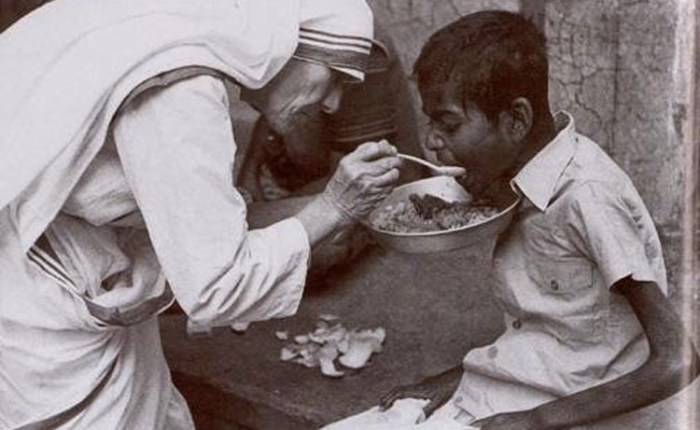
Traditionally, Lent has been a time to focus on giving “alms” the poor. The first time I went to an Ash Wednesday service at the Catholic Church in my neighborhood, I received the ashes on my forehead and was promptly handed a small, flattened cardboard box that I was intended to pop open and fill with my Lenten contributions for the poor.

I love how hand-in-hand that was. “Remember you are dust and to dust you shall return,” I was told. And then I was handed something that also told me, remember we are all dust and need to help each other along the way.

Lent is about self-denial to most of us, but self-denial is not the goal of Lent. “Fasting without praying,” a friend of mine once said, “is like plowing without planting.” Self-denial is pointless unless that space we create with it is filled and planted with something that will take root, and grow to bear the kind of fruit that changes us and changes the world.

The church mothers and fathers knew that seeing the poor is one of those things. And not just seeing in an observational way – though it is all too easy for the poor to become invisible to us. But seeing to identify with, to develop compassion for and empathy with.

That’s challenging. Poverty isn’t pretty. It’s exhausting. And it often hides.

It hides behind jobs that don’t pay a living wage. It hides behind rising housing costs that eat up grocery budgets. It set up camp in the underbrush of that lovely, tree filled nature grove in the park. It hides in cars where someone discreetly sleeps. It hides in open-hearted generosity. It hides in the family judgement and rejection that obliterate a safety net. It hides in discriminatory lending policies that prevent families from investing in homes and businesses to build that safety net. It hides in that job you could lose the moment they find out who you are and who you love. It hides behind court fees that keep people in jail or deprived of their license because they can’t pay them.

Poverty pushes people to the edges and makes them outsiders – people who live along the borders of expectation and what is legal and what life is “supposed” to look like.

Lent asks us to do a lot more than toss money or food at them over there at the edges of our lives (though that’s better than ignoring them altogether).

Lent asks us to go to the edges with them, to turn things upside down and inside out.

It doesn’t just ask us to keep bandaging up the wounds of those the system chews up and spits out (though for God’s sake, we should certainly be doing that!).

It asks us to take on that system. Bring the outsiders in, not by changing them to fit “inside,” but by changing “inside” (us) to include them – become uncomfortable to make a space they can breathe and rest and live in.

Love doesn’t just give to the poor. Love doesn’t even just go out to be with the poor. In a multitude of ways, Love makes a home with the poor.

“The Word became flesh and blood, and moved into the neighborhood.” With those people.

Race, Language, and Intent

Race, Language, and Intent

I once had a friend yell at me and call me a liar because I told him that a meeting he led had made others who were there “feel attacked” (something they had expressed to me). He’d asked me about reactions to the meeting, but he couldn’t accept the answer. He heard it as an attack on him – on his intentions and character – rather than as a report of impact and results.

While that particularly instance was extreme, I don’t think the confusion is unusual. It bothers us when what happens isn’t what we meant to happen, when someone hears something that isn’t what we meant to say. We want to be judged by our good intentions rather than by whatever somehow went awry between those intentions and the outcomes.

If we can take a step back, wisdom tells us that, while our intentions are important, they are far from the only contributor to what actually happened, especially when communication is involved. Context matters, and history is a part of that. Shared meaning and/or purpose is part of it – or not, as the case may be. But all too often, we want to believe that we can control more than we do, and that our intentions are the most important thing.

I see it happen most often when we’re talking about race. When something someone says or does is called “racist,” white Americans want to talk about what their intentions were, what was “in their heart.” And when told they are participants in “systemic racism,” white Americans tend to recoil. We hate the idea that we could be part of something we didn’t choose, something that flies in the face of our good intentions and the way we think about ourselves. Something we don’t want to be true, much less responsible for.

But what if it is true? What if, in spite of our good intentions, we are actually doing harm? Perpetuating harm we don’t intend?

It’s a terrible thought. And the only thing worse than thinking it is not thinking it.

The ways we tend to use language about race are all wrapped up in avoiding the thought. Stereotype. Prejudice. Bias. Bigotry. Discrimination. Racism. White supremacy.

We all recognize these words as negative. White Americans tend to see them as moral defects in personal character – bad intentions and ugly, false beliefs. Black Americans tend to see them as negative as well, but in more nuanced ways.

A stereotype is an idea, an over-generalization. “Black people are good at sports.” “White people like yoga.”  We can know a stereotype and not believe it.

Prejudice is a feeling. “Southerners make me nervous.” Bias is a tendency, an inclination for or against something. “I just like to date taller men.” We can be unaware of our prejudices and biases – they often function subconsciously and influence our choices and decisions in ways that may even undercut our conscious intentions.

Bigotry is believing a stereotype and being prejudiced against it. But people who are bigoted rarely see it that way; they believe the stereotype is really true and dangerous in some way, so they usually see their actions as simply protecting themselves. “Black people don’t keep up their homes, and if one moves onto our block, the value of my house will go down.” Well-intentioned people who are bigoted allow for exceptions: “That black family that moved into the neighborhood, they’ve actually got the nicest yard on the street!” For various reasons (social stigma, financial incentives, etc.) bigoted people may not actually act on their bigotry.

Discrimination is acting either in favor of or with bias against a person or group because of their perceived race. Discrimination can be indirect, particularly when we want to believe in our good intentions. “I’ve got nothing against black people, I’m just more comfortable dating men with a similar background to mine.” We can act on a racial stereotype even if we don’t think we believe it.

White supremacy is the belief that white people are superior to those of other races. White supremacy is also any system (social, religious, economic, housing, judicial, penal, educational, etc.) that reflects the assumption that white people are superior and gives them preference (even indirectly). That assumption may have been a part of the system from its inception – designed to implement the supremacy of white people; or assumptions of white supremacy may have been added to it along the way. Either way, those who continue to use the system are participants in white supremacy, whether they know it or not and regardless of their personal beliefs.  It is not the intentions of those participating in a system that create white supremacy; it’s the effects of the system. White supremacy is a system that results in the preferential treatment of white people.

Racism is a pattern of harms done to a group of people because of their race.  It is a persistent perpetuation of racial stereotypes, bias, prejudice, and discrimination. The key here is the pattern of harms. Racism is in the effects rather than the intent.

When I was a child, a black family lived across the street from us. I loved them the way a child loves neighbors – though the youngest children were several years older than me and too old to be playmates, they were always friendly to me, and the mother fussed over me and gave me my first popcorn balls (a magical Halloween treat from the days before homemade treats became verboten). When I was five or six, we invited the youngest two children to come to Vacation Bible School. As my mother drove us home that night, the three of us entertained ourselves with a game of I Spy. Trying too hard to be clever, I spied “something green,” and after they finally gave up, laughed as I told them the “something green” was the color of their skin in the glow of the dashboard lights. Appalled, my mother made me apologize and after we got home gave me a stern talking to that I didn’t fully understand. I just thought their different skin color was interesting – it didn’t mean anything to me yet.

But it meant something to them. However naïve my comment was (I won’t say innocent because, while I wasn’t trying to embarrass them for being black, I was trying to best them with my cleverness), it happened in a social and historical context that made it more than I knew. It fed into a pattern of harms. It was racist. I didn’t have to plant the seed of racism – that was done generations before me – but I blithely watered that seed, however unknowingly.

We want life to be more neutral than that. We want to believe we all start on an essentially equal playing field and we all have roughly the same ability to work hard and make something of ourselves. We don’t want to believe we are watering seeds we wish had never been planted.

The world we live in is made from much more than our intentions. Black and white American live with a history every day, a history of racism and white supremacy. If we are willing to step back and look, whatever we believe about our intentions, the pattern of results is clear. Like specks of color in a tweed woven with checks, exceptions are everywhere but the pattern is clear. Changing patterns requires changing the machinery that creates them. And we’ll never change what we aren’t willing to see.

To Be a Woman

To Be a Woman

In 6th grade, I was an outcast.

It was nothing new; it’d been that way for several years by then. By 4th grade, the girls in my class at the Christian day school we attended had decided I was unworthy, and it stuck. As an adult I came to understand that I was their scapegoat – they projected all their own fears of rejection on me and cast me outside the camp. But at the time, I just knew that they despised me.

I didn’t wear the right clothes, or look the right way. I didn’t care about the things they cared about. I thought the things they cared about were silly and did little to hide it. (That didn’t exactly help.)

But I longed for friends. I was living as an introvert, quite contrary to my nature, and I longed to be seen – for my companionship to be enjoyed simply because I was myself.

One day at school, while a group of us were working on a special project, a couple of the girls included me in their play. They were braiding each other’s hair and trying different styles, and they began to brush my long hair and pull it into a complicated kind of ponytail, a new style for me to try.

I loved it. I felt alive. Part of the reason girls play with each other’s hair is because it can feel so good and be so relaxing. The pull of a brush, the tug of braiding, the focus of attention. It’s an intimacy, allowing another to shape your appearance, however impermanently.

I thought that, for whatever reason, the wall had cracked and a friendship had begun with these girls. I wasn’t so thoroughly on the outside anymore.

Then, as we were rejoining the rest of the class, one of them said something about the other girls maybe liking me now, with my new hair style, and it all came clear. I had merely been their project, an object of their pity. They wanted to change me so I would be more acceptable.

I fought back tears as I pulled that carefully worked ponytail apart.

I had nothing against the hair style, but I wanted to be wanted for who I was. Not because I’d changed something to fit in.

I became possibly the first of the hipsters in that moment in the early 80s. If it was popular, “in,” I despised it. And when the girls adopted something trendy – neon sweatshirts or black lipstick – I despised them for it.

There was little I understood about those girls, or most females really – particularly in groups. And while there were and are women in my life I love and respect and even like, I avoid groups and activities for women like the plague. There is nothing more likely to make me feel like the only alien on the planet.

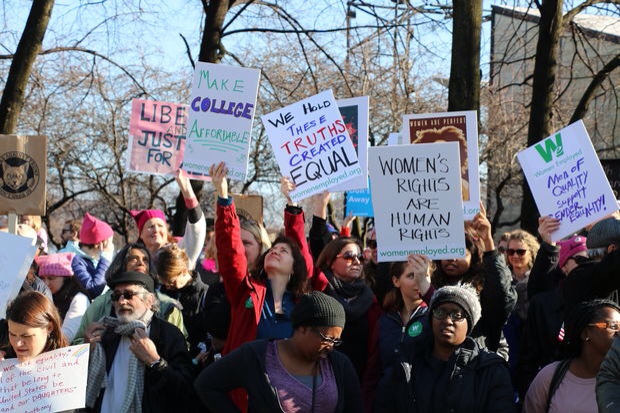
But when I went to the Women’s March a year ago this weekend, I didn’t feel that way.

I didn’t go as part of any organized group, though there were many represented, and it didn’t matter. I hadn’t even particularly planned on going. I was meeting an old friend for breakfast that morning and had thought I could maybe go downtown to the march when we were done. He ended up deciding to go too, and by the time we got to the area, the Chicago march had been officially canceled due to the crowds. But it didn’t change anything.

The streets were filled with women of all ages and colors and sizes. A sprinkling of men were there too, most carrying daughters or pushing strollers. The signs made it clear that there were many concerns represented – all of the things women care about. Though the most common sign, “Keep your hands off my pussy!”, referenced the bragging claim of the recently elected president and asserted a woman’s self-possession. Her possession of a fully human self, with all the rights of dignity and self-determination that entails.

And for once, surrounded by hundreds of thousands of women, I didn’t feel like an alien. I felt no pressure – explicit or implicit – to fit anyone else’s idea of what it means to be acceptable as a girl, as a woman.

All I had to do was show up, as a woman, for other women.

And I marched, for hours up and down the streets of Chicago.

I marched for the women I know who were and are afraid every day. The women who are afraid because of the color of their children’s skin. The women who are afraid to go to a public bathroom, afraid they will be harassed or attacked because they don’t fit someone’s idea of what a woman looks like.

I marched for the women who are my neighbors, who are afraid their families will be torn apart by deportations. I marched for my nieces and great-nieces, for the daughters of friends, so that they would never believe that any man has the right to their body. I marched for the dignity and equality of my sisters. I marched for every little girl who doesn’t fit.

I marched for a lot of women I love who hated the very idea of that march.

I marched because we don’t have to fit anybody else’s idea of what it means to be a woman.

This weekend, women around the country marched again. Women around the country are running for office. Women around the country (and the world) are speaking up against harassment and abuse and their own silence in the face of the assumptions of men.

They aren’t marching because they can’t deal with these things – women have for millennia been figuring out how to deal with these things. How to survive. They, we, are marching because no woman should have to deal with these things.

And no woman should ever have to fit anyone else’s idea of what it looks like to be a woman.