Lent and Loving Outsiders

Lent and Loving Outsiders

Poverty looks like a lot of different things.

Don’t get me wrong, none of those things should overshadow the most obvious meaning: not having stuff. Basic stuff. Ability-to-live stuff. A roof over your head, food to eat, clothes to wear, water to drink that won’t make you sick stuff.

Never forget that is poverty, and far too many around the world and in our “rich” country live it every day.

Traditionally, Lent has been a time to focus on giving “alms” the poor. The first time I went to an Ash Wednesday service at the Catholic Church in my neighborhood, I received the ashes on my forehead and was promptly handed a small, flattened cardboard box that I was intended to pop open and fill with my Lenten contributions for the poor.

I love how hand-in-hand that was. “Remember you are dust and to dust you shall return,” I was told. And then I was handed something that also told me, remember we are all dust and need to help each other along the way.

Lent is about self-denial to most of us, but self-denial is not the goal of Lent. “Fasting without praying,” a friend of mine once said, “is like plowing without planting.” Self-denial is pointless unless that space we create with it is filled and planted with something that will take root, and grow to bear the kind of fruit that changes us and changes the world.

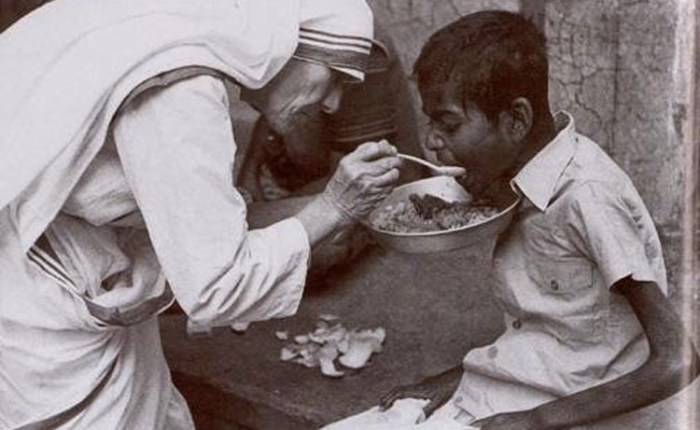
The church mothers and fathers knew that seeing the poor is one of those things. And not just seeing in an observational way – though it is all too easy for the poor to become invisible to us. But seeing to identify with, to develop compassion for and empathy with.

That’s challenging. Poverty isn’t pretty. It’s exhausting. And it often hides.

It hides behind jobs that don’t pay a living wage. It hides behind rising housing costs that eat up grocery budgets. It set up camp in the underbrush of that lovely, tree filled nature grove in the park. It hides in cars where someone discreetly sleeps. It hides in open-hearted generosity. It hides in the family judgement and rejection that obliterate a safety net. It hides in discriminatory lending policies that prevent families from investing in homes and businesses to build that safety net. It hides in that job you could lose the moment they find out who you are and who you love. It hides behind court fees that keep people in jail or deprived of their license because they can’t pay them.

Poverty pushes people to the edges and makes them outsiders – people who live along the borders of expectation and what is legal and what life is “supposed” to look like.

Lent asks us to do a lot more than toss money or food at them over there at the edges of our lives (though that’s better than ignoring them altogether).

Lent asks us to go to the edges with them, to turn things upside down and inside out.

It doesn’t just ask us to keep bandaging up the wounds of those the system chews up and spits out (though for God’s sake, we should certainly be doing that!).

It asks us to take on that system. Bring the outsiders in, not by changing them to fit “inside,” but by changing “inside” (us) to include them – become uncomfortable to make a space they can breathe and rest and live in.

Love doesn’t just give to the poor. Love doesn’t even just go out to be with the poor. In a multitude of ways, Love makes a home with the poor.

“The Word became flesh and blood, and moved into the neighborhood.” With those people.
Accumulating a Life

Accumulating a Life

I read an interview recently about how small, seemingly inconsequential biases can accumulate to create larger inequalities. Each time a man repeats and gets credit for a woman’s ideas in a meeting because we hear men differently. Each time a black child’s behavior is reprimanded more harshly than a white child’s because we see black children differently without even realizing it. Each time a job applicant is not pursued because of an ethnic name and our preference for the familiar. Small individual acts (“micro-aggressions”) add up to big impacts on both individuals and organizations.

Systems of wealth and credit, education, and the legal system all collect both privileges and discriminations, however small, into cumulative effects. The whole is greater than the sum of the parts, and the impacts cross generations.

It’s a theory that helps us understand how racism and sexism function long after those explicit attitudes may have fallen out of fashion and faded. But it also helps explain much that that is beautiful and good.

Life itself, after all, is an “accumulation mechanism.” Each day builds on those that have gone before it. Each choice, for better or worse, wears the grooves of habit into our character and personality. Evil and hate and fear grow because of what we add to them. Love and kindness and beauty intervene because we do.

Our lives and our world become what we make them because of two things: what we add to them, and what we accumulate with.

So many decisions, acts, and words make up our lives – from what time I get up in the morning to how I great my neighbor on the sidewalk. What I spend, what I eat, whether I take the elevator or the stairs. What I choose to be intentional about and what goes on autopilot – and what kind of habits I’ve loaded into that autopilot. But things I have no control over make up my life as well – from what time the sun rises to how my neighbor greets me.

And there were things given to me before I even knew it that make up my life today. The genes and words of my parents, and their parents. The choices of teachers and friends and strangers, both living and long gone.

So many things come to me whether I chose them or not. But what I can begin to choose along the way is how I receive those things – how I sort them into meaning and significance, and whether I hold onto them or release them.

Consciously and unconsciously, we choose what to collect both of our own actions and the actions of others’. We sift words and acts, holding onto some and releasing others to oblivion. Much of this is unconscious. Early in life, the voices of family and authority – tempered by personality – teach us what to keep and what to ignore, and those filters function with a strong confirmation bias throughout our lives.

But life itself also gives us opportunities to flush out some systems and accumulate differently. Each day is new. Forgiveness and release can transform what has collected. Meaning can be reassessed and rewritten. And while we may never truly start from scratch again, we can change what we are accumulating.

That’s true for each of us as individuals, and it’s also true for us as a society. But that’s harder.

Because the filters that let some of us keep good things make others lose them. And the systems that give some of us room to make mistakes and grow don’t give others those same opportunities. Too many of us are only concerned with how the mechanisms for accumulation work for us, and we insist they must be working the same way for everyone else.

Principles can be deceiving. In theory, they work the same for everyone. But while in theory, there’s no difference between theory and practice, in practice, there is. Principles have to be judged by their real impact across the board, on a broad range of individuals and an array of different situations.

Too often, in our lives and in our society, the most vulnerable are sacrificed – the most vulnerable parts of ourselves and the most vulnerable among us. And too often, we don’t even want to know it’s happening, so we let the accumulation mechanisms keep running without asking if we really want what they are collecting. If what it’s building are really our best selves and our best world.

Our best selves and our best world are worth building, if we can find the courage to try.

White Supremacy Is My Problem

White Supremacy Is My Problem

I wish it weren't. How I wish it weren't.

As I watched events unfold in Charlottesville this weekend, with friends there attacked because they stand against hatred and violence, I wished it weren't.

I wish that what I believed as a child in the 70s was true – that the Civil Rights Movement had brought equality for all. But the justice of the law is no more just than those who enforce it. And as important as the achievements of the Civil Rights Movement were, there is so much they did not and could not do.

White Supremacy is very much alive, and it's my problem, no matter how much I wish otherwise.

It's my problem.

Every time I've assumed the black woman sitting next to me on the train feels as safe in that space as I do.

Every time I effectively dismissed racism as a "sin problem" that can only be dealt with in individuals' hearts.

Every time I think I've had opportunities only because I worked for them.

Every time I sat in church believing we weren't perpetuating racism because a few black families were there who embraced our theology.

Every time I haven't thought about White Supremacy because I didn't have to, and I had other things to think about.

Every time I believed a person of color was being considered for a job on the same basis I was.

Every time I assumed that a fellow student of color had the same opportunities I had because we were sitting in the same class.

Every time I dismissed White Supremacists as an anomaly, as a fringe element, rather than seeing them as the most visible outworking of a pervasive system, a system I am a part of.

Every time I didn't speak up when someone excused or dismissed white supremacy as something that isn't their problem, or insisted that black resistance is an "equal" problem.

Every time I failed to realize that black friends don't have the same experiences I do when they drive somewhere, or shopping, or taking taxis, or with the police, or doing any one of the many public errands that make up my days.

Every time I was more concerned with protecting me and mine than ensuring justice and safety for someone else.

Ever time I studied "Christian" history and theology without questioning its Eurocentric assumptions and role in establishing the Doctrine of Discovery.

Every time I've avoided speaking up against the assumptions of white supremacy because it might make someone uncomfortable.

I don't believe in white supremacy, but I don't have to believe in it to be a part of it. And if a white supremacist is someone who does believe in it, then I am not a white supremacist. But every time I have acted like white supremacy is not my problem, I'm sure you couldn't tell the difference.

I'm sorry for every time that's happened. I know more than I used to, but I have so much more to learn. I fail in ways I can barely begin to imagine. I will keep working on it, and this is one way to take a step forward.

White supremacy is my problem.

And if you are white, it's your problem, too.

What If I’m Wrong? (About LGBTQ+ Inclusion)

What If I’m Wrong? (About LGBTQ+ Inclusion)

“But what if you’re wrong?”

It’s the question that characterized the religious context I lived most of my life in more than maybe any other. It has its corollary in, “Are you sure you’re right?” and both questions brought into focus what was most important to that community, and by extension to God: we dare not risk being wrong. If in doubt, err on the side of caution. Countless preachers urged us not to trust them, but to “search the Scriptures” for ourselves. It wasn’t a responsibility to be passed on to anyone else.

We wanted to be faithful – to love God and obey him and stay as far from sin as possible. The constant questioning of ourselves, of our motives and our thinking, was meant to keep us safe.

More often it kept me frozen – “But what if you’re wrong?”

That question was never more present or profound to me as it was in the days and months when I began to intentionally explore the “issue” of LGBTQ+ Christians.

It was actually the very question that drove me to ask more – “But what if I’m wrong?” I’d been raised by folk for whom that subject was settled absolutely. The Bible was “clear,” and sex was created for marriage between a man and a woman. Period. And they didn’t just believe that, they argued for it loudly and publicly, vehemently attacking the “gay agenda” and “gay lifestyle.”

And while the methods often felt misguided to me, I shared the underlying conviction and straightforward sexual ethic.

But…what if we were wrong? What if, as much as we were seeking to be faithful, there was something we were missing?

I’d been in churches that welcomed those who “struggled with same-sex attraction” in non-coercive ways that were full of grace and patience and hope (and I’d received much healing in various areas of my own life in those communities), but what if there was more? What if we were still missing something?

So when I was introduced to a community of people who were working to build bridges between the LGBTQ+ community and conservative evangelical churches, I got involved. I asked lots of questions of pastors who’d had a change of heart and mind, and I listened to scores of stories from LGBTQ+ people. Some of those stories were told publicly, and some of them were entrusted to me privately. They all changed me.

I realized something was very much missing – we were not loving real people, with their real lives that don’t neatly fit our “biblical” prescriptions. It wasn’t an “issue” for me anymore, it was people. I heard too many stories of rejection by families, condemnation by church communities, and suicide attempted. (The stories of successful suicides are all second hand.)

I was introduced to a very different reality than I’d seen before: the ugly, deeply rotten fruit of traditional church teachings on sexuality. And when the fruit is persistently bad, something is terribly wrong with the tree. Something needs to be reconsidered or even thrown out altogether.

But…what if I was wrong? I’d studied the biblical texts – original languages and contexts. I knew that there were good arguments that those texts decrying same-sex sexual activities shouldn’t be read in the traditional ways. But those arguments weren’t water-tight. They raised questions, but didn’t seem conclusive.

My mind and heart had shifted, but these different possibilities in the text felt shaky to stand on. I could never be sure I was right about them.

I found a mentor in Dietrich Bonhoeffer, the German theologian who was deeply committed to non-violence and yet entered into a plot to assassinate Hitler. He was captured and executed a few weeks before Nazi regime collapsed.

In his vast writings on Christian ethics, Bonhoeffer observes that there are times when what is required to keep your conscience clear and what is required to love your neighbor contradict. In that contradiction, it is better to bear guilt yourself in order to love your neighbor.

As I looked at the lives of my LGBTQ+ brothers and sisters who had found acceptance and affirmation of all of who they are in affirming churches (and more importantly, in their own hearts before God), I saw the fruit of their lives blossoming – love, joy, peace, patience, compassion, goodness, faithfulness, self-control. 

Looking at the life of Jesus, I realized that maybe we’d been missing the point. Jesus was far more concerned with loving people than with getting it “right” – or even with them getting it right. The Samaritan woman at the well who was concerned about the right way to worship God. Hungry disciples on a Sabbath walk through a wheat field. A woman condemned by the religious leaders for adultery. Outsiders casting out demons in his name.

Even if I was wrong, if I was missing something, I was no longer willing to risk their lives on the altar of being right, whatever the cost to me.

I’ve never regretted that decision. And as time has passed, I have only become more convinced that God’s heart for his LGBTQ+ children is love and complete affirmation and inclusion in the community of his followers. He has called them “clean” and we are in defiance of his Spirit when we insist otherwise.

I don’t believe I’m wrong. But if I am? LGBTQ+ folk are being invited into the embrace of the love of God, and his Spirit is quite capable of guiding them into any change he desires, regardless of their sexuality and/or orientation. If I am wrong? LGBTQ+ youth in our churches will know they can live, loved as they are by God and his people.

If I am wrong? Their lives are worth it.