The Life We Choose

The Life We Choose

Life is a funny thing. In so many ways, it chooses us. When we live, the family and communities we are born into, and where. The traditions we know, the language we learn.

We choose none of them and yet they form the foundation of who we are and how we see the world.

And for most people through most of history, that was it. Those parameters defined their lives, the choices available to them prescribed already.

But even the most constrained, I think, had to choose to live, choose to be awake to life. To seek beauty and goodness and faithfulness with each breath.

Born in this time, to my parents, in a place called the United States, I’ve had the privilege of more choices than most. The privilege to make choices for myself that matter. To choose where I live and how, to know that there is more to learn, and that what I believe need not be the same thing my parents believed.

In so many ways, a field of options has been opened before me.

But in all of those choices, I must still choose to live.

Near the beginning of the movie The Way, Martin Sheen’s character tells his son, “My life here might not seem like much to you, but it’s the life I choose.” His son replies, “You don’t choose a life, Dad. You live one.”

They are both right, of course. We make choices that shape our lives – our homes, families, work, education, worship, beliefs – but we must still choose to live them.
And choosing to live our lives goes far beyond those other choices we make.

There’s an embroidered sampler that hangs in my kitchen. It is the Serenity Prayer.

God, grant me the serenity
To accept the things I cannot change,
The courage to change the things I can,
And the wisdom to know the difference.

There is so much I cannot change.

The faith I was given as an infant, its names and symbols and stories. They are with me – embraced or abandoned, I must wrestle them. But I can choose the shape of my belief and how I live it out. I cannot choose what that faith has done in the world – done to the world – for good or ill, but I can choose what it will do in the world through me.

For the most part, I’ve had no choice in the people I meet. But I can choose who I seek to know, whose lives I invite to shape my own, who I choose to partner in the project of humanity with. And I can choose to put myself in places to meet new people, to learn new stories, to allow my vision of humanity to be expanded and changed.

I cannot choose who will accept or reject me, but I can choose who I accept or reject. I cannot choose who will love me, but I can choose who I will love.

I cannot choose the days that will be given me to live, but I can choose to live them, all of them. The ones filled with the choices I have made, and the ones filled with the choices others made for me, and the ones filled with things no one chose or we all chose in some amalgamated impossible way.

The ancient text presents a choice to the people: “Today I have placed before you life and death, blessing and cursing. Now choose life.”

It is the one choice we have every day, with every breath. Today. Whatever it brings to us or we bring to it, we can choose to live it, to the depth of our lungs and the tips of our fingers and the reaches of imagination and hope.

Now choose life. This life. Your life.

Whatever you do. Live.
Walking the Wild Goose

Walking the Wild Goose

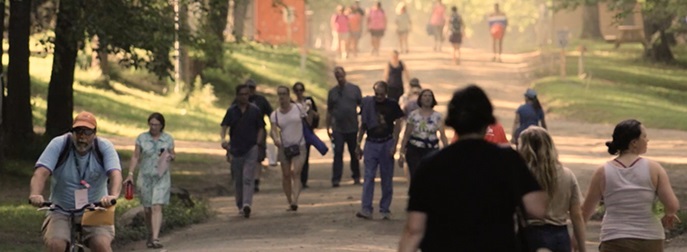
When I think back on my years attending the Wild Goose Festival, I think of walking.

The first year I attended, I came to speak with a friend. I was still a somewhat conservative but curious evangelical, recovering from my hardcore fundamentalist roots. My friend and I participated in a pre-festival retreat for the speakers, and I remember sitting and listening to Frank Schaeffer, a fellow recovering fundamentalist, speak (or more accurately, rant) and wondering what I’d gotten myself into. Frank felt angry to me, and wherever I was going, I didn’t want it to be an angry place. I was troubled.

Later that evening, long past dark, the retreat ended with a prayer walk through Shakori Hills (where the festival spent its first two years). Gareth Higgins handed me a flashlight, and we all began to slowly venture into the night, a flashlight here and there to help us along. It was hard to see much of anything, but as we walked, silent except the scuff of shoes on the dirt path, my eyes began to adjust. I realized that Frank and Genie Schaeffer were walking beside me, following the light of my flashlight.

And I knew in that moment that we were walking the same path in a much larger sense. My journey would not look quite like theirs, nor theirs like mine. But we had found ourselves here, walking alongside one another and doing our best to find our way forward.

Our paths crossed several times that weekend, and I began to know the whirlwind that is Frank and the calm that is Genie. I heard Frank talk about struggling with the anger he’d brought with him from his fundamentalism, of not wanting his granddaughter to know him as that “angry man.” I sat with Genie in the heat of an afternoon as we talked of transitions and changes and grace.

As year followed year, I’ve walked with many different people at the Goose, renewing friendships and adding them. As I moved farther from traditional evangelicalism, I found new “elders” for my life when the old ones could no longer understand the path ahead of me. I can’t count the times I’ve greeted someone and heard the reply, “Where are you headed? Can you walk with me?” And wherever I was headed, my answer is almost always yes.

I walked alongside Vince Harding one hot afternoon, and was left with an embrace and blessing I will always remember. I’ve walked many times now with my friend Nathan, a young man who I saw come out publicly for the first time during the Q & A of a Goose session, and who the next year told me about his new boyfriend and plans to start seminary. I’ve walked the Goose with Paula Stone Williams, a fellow recovering fundamentalist and one of the bravest people I know. I’ve walked with a newly-out and newly-single father and helped wrangle his two young children.

These days, it’s the first thing I do once I’ve settled in – begin walking the paths looking for friends. Looking to learn what the Goose will have to teach me this year. As the years have gone by, I attend fewer and fewer sessions, my time filled more and more with conversations along the way.

I’ve walked with heroes and strangers. I’ve hugged friends as we’ve passed, and had the joy of introducing and connecting people. This year, I look forward to walking with friends I’ve yet to meet in person, as well as an old friend of my parents who I haven’t seen in around thirty years. I’m eager to see friends from around the country whose faces are dear to me and too rarely seen.

The Wild Goose is far more than a destination; it’s a journey each one of us walks in our own way. And for a few days in July, we have the gift of walking together.


I’m thrilled to be speaking at this year’s Goose July 13-16! Join me and save 25% off weekend pass with the code BEMYGUEST.

Happy Birthday to the Whole Crazy Messy Lot!

Happy Birthday to the Whole Crazy Messy Lot!

Pentecost is a funny day. It’s full of things we don’t know what to make of – fire, wind, other languages, friends, strangers.

It’s also the birthday of the church, and if I’m honest, that’s something I often feel pretty ambivalent about celebrating. I love her, but she makes me cringe a lot, too.

But Pentecost Sunday is her birthday, and as much as she still needs to grow, a birthday is a good time to look at baby pictures, to celebrate the DNA that’s baked in.

And the DNA of the church is diversity.

Pentecost is often seen in contrast to the story of the city of Babel, but I see it as more of a parallel story.

Babel is part of the origin story of humanity. After only one family was saved from the great flood to reboot the human race, they stuck together. The story begins by telling us they built a great city with a tall skyscraper where they could all stay in one place and speak one language.

And God looked down and saw all the effort they were going to in order to maintain a single identity – a singular “name” for themselves – and wondered just how far they’d go with it. And so he mixed their languages and scattered them across the earth.

It’s the beginning of different languages and cultures, and that was God’s idea. It shouldn’t surprise us that the same God that made creation to increase in diversity also likes diversity in people. 

He likes diversity a lot more than we do. We’re a lot like those first Babylonians that way – we’ll go to a lot of trouble to stay together with those like us, with those who share our “name,” our identity, our truth, the way we see things. 

And while there’s nothing wrong with enjoying being with those who are like us and celebrating our culture together (after all, that’s what God made at Babel!), we tend to go farther. We judge our ways and our culture as inherently better than others, and we find reasons to push others away or insist they assimilate.

But then there’s Pentecost, and in the birth of the church, God reasserts his preference for diversity. Mixing Galilean fishermen and tax collectors and radical zealots wasn’t enough for him. They were gathered together in one place speaking one language, and as the church is born, they begin to speak many different languages. The immigrants and visitors who were in Jerusalem from all over didn’t hear the good news of God’s kingdom in one language; they each heard it in their own language. 

God birthed the church in a glorious mix of languages and cultures that only expanded from there. It’s the opposite of assimilation. God’s good news is endlessly translatable, and when we walk together with those who are different from us, we can see things we never would’ve seen on our own – hear things beyond what our own language can tell us.

While God calls us to unity in him, that unity never comes at the expense of the diversity God glories in. May we learn to glory in it the way God does!

So church, happy birthday! عيد ميلاد سعيد! Hyvää syntymäpäivää! Joyeux anniversaire! Hau’oli la hanau! 생일 축하합니다 Feliz cumpleaños! Penblwydd hapus! С днём рождения! 

My Father’s Voice

My Father’s Voice

I turned forty-five a couple of weeks ago. I’m fourteen years older than my father now. He died from ALS a month after my third birthday. He was just thirty-one.

I don’t remember the sound of my daddy’s voice, but I remember how it felt. He had a deep bass voice and a rounded, barrel chest I loved to snuggle into and lay my head on. I remember the feel of that rumbling bass.

I have other memories of him, but they are all the memories of a small child. The book he read me every night cuddled up on my Bambi sheets. (The same book. Every night. Buzzy, the Funny Crow.) Looking for him early one morning to get him up to make my breakfast, only to find him already in the kitchen at the stove. When he lost the strength to pick me up any more, but I could still crawl up into the big green recliner our church bought for him. The day he fell and couldn’t get up, and I went and got my big stuffed bear to put under his head while someone went to get the neighbor boy to help get him up.

There’s a short clip of tape from an interview the local news station did with him. I managed to find someone to record the reel to reel on VHS years ago. I only watched it once. He could only say a few words before he had to work to breathe for a few more. It hurt too much to hear – there was so little to recognize in his voice.

But there was one time I’ve heard his voice. It was around fifteen years ago, and I was working at the small, fundamentalist Bible college where my parents met. I was helping prepare for our big donor event of the year when my boss introduced me to an alumnus who was there to help with the decorating. We shook hands, and as he heard my name, a startled look crossed his face. “Are you Gene Ould’s daughter?” he asked, and when I said yes, he started to cry.

Will* had been in school with my folks in the 60s, and had known them even before they’d started dating. He’d been friends with Daddy, and they had long conversations in the dorm talking about life and theology – the things most college students talk about but with a good bit more Bible and religion in the mix.

Eventually, they also talked about the fact that Will was gay (though I doubt he used that word then, and when I knew him would describe himself as “same-sex attracted”). “Your daddy was the only person I told who didn’t treat me any differently,” he said with tears in his eyes. “He didn’t need to leave the door to his room open when I was there. He didn’t change the way he talked to me.”

And I heard it. I heard my father’s voice loving his friend, accepting him just as he was. I don’t know what my daddy thought about homosexuality – though it was the 60s, and I know he had a conservative sexual ethic. But I do know that whatever he thought it didn’t change the way he loved his friend.

Nothing anyone has told me about my father has ever meant more to me.

On my birthday this year I was surprised by a message from an old friend of my parents from those Bible college days, a man I knew as a child and haven’t seen or spoken to in over twenty years, though we’ve been connected on Facebook for a bit. He wrote to wish me a happy birthday and tell me how proud he is of what I’ve done with my blog. He talked about how Daddy was always asking questions and about his courage. And he said he was glad to see my father’s DNA in me.

My voice is my own. And my journey has gone far beyond where my daddy’s life allowed his to go. But I hope that somewhere in that undeniable DNA, when I speak, the echoes of my father’s voice still rumble in this world.


*Name changed