Prophecy and Patterns

Prophecy and Patterns
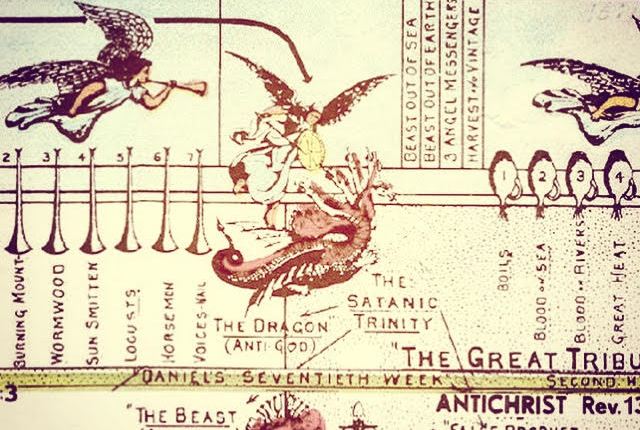
When I was a kid, every classroom I was in had maps and charts that pulled down in front of the blackboard at the front of the room. Whether it was a Sunday School room or a classroom at the Christian school I attended, there was one chart I remember seeing most. It was a timeline of history that focused on the end of time – the “tribulation,” as we called it.

I grew up in the heart of Dispensationalism. I didn’t know that’s what it was at the time. We didn’t often talk about it by name. We just read the Bible the “right” way and “took it at its word.”

Dispensationalism was the first attempt at constructing a “biblical theology” – which doesn’t mean a theology based on the Bible so much as a theology which takes the whole Bible into account. But what we focused on most was “eschatology” – the study of the end times, particularly from the book of Revelation.

Dispensationalist eschatology tells a story, and a gripping story at that (as the success of the “Left Behind” series of books that was based on it illustrates).

There will come a time when a political leader will arise who is the very antithesis of Jesus – the “Antichrist.” He will convince people, including the people of God, that he is committed to their interests, and they will be grateful for him. But there are forces of evil behind him, and the people of God (along with everyone else) will be destroyed, except a remnant of those who resisted him and will be saved by Jesus in the end.

The Antichrist is a deceiver and manipulator who presents himself as a savior. But he is a false savior who is the very opposite of Jesus.

In the version of Dispensationalism I was taught, all the true believers would be raptured up into heaven before things got that bad, but the “rapture” isn’t part of the story Revelation tells.

The Antichrist was the boogeyman of my childhood, which is not to make light of him. He was (and is) a deeply scary figure to be taken very seriously.

Which is why I have been baffled to see so many of the folks who taught me about him support or at least defend Donald Trump over the past months.

I am not saying that Donald Trump is the Antichrist who brings about the end of days. The Bible speaks of multiple antichrists – false saviors – who will come. And Revelation is a unique genre of writing called “apocalyptic literature,” which should not be understood as straightforward prophecy in symbolic language.

More than a road map for the End, Revelation is describing a pattern for how God’s people – as well as everyone else – will be deceived and destroyed. Such leaders have come before, and they will come again.

I’ve just never seen a political figure in my lifetime fit that pattern like Trump. In his personal behavior, leadership, and in the powers behind him, what I was warned about is clearly on display, supported and defended by the very people who warned me. (And he hasn’t even tried very hard to cater to them.) He is a deceiver, ready to turn justice, right, and truth upside down and inside out to serve his own interests.

I don’t believe we are fated to see the pattern play out, though.

The other message of the Book of Revelation, the more central message, in whatever way you interpret the book, is that Jesus is King. Jesus is the Victor.

Jesus is the good news in a book full of dire warnings and deadly news.

And the people the Bible calls “the Body of Christ,” those who are willing to be “little Christs” (the original meaning of the word “Christian”) in this world, can be that good news in the face of any Antichrist that shows up.

Defending the voiceless and the vulnerable. Speaking truth in the face of power and privilege. Standing up for the kind of love Jesus exemplified – “to heal the brokenhearted, to proclaim release to the captives, recovery of sight to the blind, to deliver those who are crushed, and to proclaim the acceptable year of the Lord” (Luke 4:18-19 quoting Isaiah 61:1-2).

The pattern will always repeat. But so does the good news.

Here (a monologue)

Here (a monologue)

So many years
Trying to live as someone other than who I am

Because I didn’t know

I didn’t know I wasn’t who everyone told me I was
(Or didn’t)
Who else was I supposed to know to be?
When the only language you hear (know)
Doesn’t fit
Collecting a piece here
Catching a glimmer there
And finally taking a leap
To see what I could find
(It wasn’t where I was)

And you were there
Here
Wherever it is I am
You were always there
(Here)
Wherever I wasn’t ready to be
But getting there
(Here)
There
Where when I pinch myself I can feel it
Now

Maybe I’ll need to leap again
Ask the questions of becoming
Wonder
Wander
Off the path (another one)
And you’ll be there
(Here)

Won’t you?

The Risk of Forgetting

The Risk of Forgetting

All who love will lose.

CS Lewis, who I think missed much about love, got this right:

“To love at all is to be vulnerable. Love anything, and your heart will certainly be wrung and possibly be broken.” (The Four Loves)

Friends will fail you – not to mention themselves. Lovers will leave. The life you love will through you a curve ball. (And then another.)

Even God will disappoint – silent when shouting is called for, holding back when intervention is needed, just letting us royally mess things up.

And yet…

There is still love. It is never really love that betrays us.

Friends will still be there, even if they are new ones. Lovers show us more of ourselves and the possibilities of life. The life you love is recreated again and again.

Resurrection will always come.

And in the silence of God there are still such gifts. The sun, still obeying the word that first made it shine. Rain, still watering everything. Beauty, stubbornly decorating the world. Breath, still filling lungs when we have forgotten how. Love, still rising in the most unexpected places and ways.

The true risk of love is not in losing, but in forgetting.

Forgetting the warmth of the sun in the frigid dark of winter. Forgetting what once made us smile. Forgetting the joy, the exhilarating beauty of actually living. Forgetting what delighted us in the sheer otherness of another. Forgetting the gifts we have received.

Even when they are gone, they are no less gifts. And when they are gone, there are more to receive.

Because love is always giving. It is not a limited resource. We cannot give it all away, and there will always be more to find. In every ending, there is a beginning. One of the saints said that.

In Advent, as the Christian year is both ended and begun, Jesus is proclaimed Alpha and Omega – the beginning and the end. I think perhaps I always took that too linearly. Perhaps it means that they come together, beginning and ending. That in every beginning there is an ending, and in every ending, a beginning.

God is love – both beginning and ending and ending and beginning. But never leaving.

The world and us – we are full of such possibility, beyond what we can conceive. Love won’t forget.

No Story Without Leaving Home

No Story Without Leaving Home

It’s there in the beginning – Adam and Eve left the Garden. Noah left. Abraham left. Jacob. Joseph. David. Daniel. Jonah. Joseph and Mary. Jesus. They all left.

There is no story without leaving home.

It means grieving. Even good change includes loss that needs to be grieved. Things will never be quite the same again, and it’s important to acknowledge that.

Love isn’t strong because it doesn’t change. Love is strong because it bears change, even embraces it.

Grief is a funny thing. It means both letting go and holding close. Pausing to sit, or getting a move on. Anger and peace. Hope and release.

Whatever it looks like, grief is part of stepping over the threshold to leave. Or realizing that’s what we already did without knowing it.

Leaving home also means a journey. An adventure. The unknown.

It’s risk and opportunity interwoven – you can’t get one without the other. Which is why sometimes people choose not to go, to live with the smaller story. They are afraid of the risks, and the opportunities don’t feel worth it.

But we’ll never have a capacity for love and joy greater than our capacity to risk pain and loss.

You can’t get one without the other.

The one that would save – protect – their life? They will lose it.

But in accepting the risk and the loss, we can also find life we never imagined. That’s the opportunity – to grow beyond home. To meet people, encounter ideas, face challenges we never would have known at home. And in discovering the world beyond, we will also discover ourselves, finding healing and strength and ability in ourselves we never recognized or needed at home.

There’s no story without leaving home.

It can look like so many things, from moving out to changing paradigms. The thing is, it’s never really done. We know what it looks like for teenagers and young adults to begin to find their own way and discover who they are apart from their family. But so many of us carry home with us without even realizing, like a turtle shell we just assume is part of our very being.

Assumptions we learned from family and community when we were young just look like reality to us, and that shell of home feels like safety and security. But there are places it keeps us from going, life it keeps us from living.

There is no story without leaving home.

And it’s the journey of a lifetime.