All the Saints

All the Saints

Last week I was part of three different services commemorating All Saints Day, the day in the Christian year when we remember those who’ve gone before us, who’ve inspired us, who’ve taught us, and are no longer with us.

Each year, there are more that I remember. Some are historic and named by tradition, but others are more personal.

Paul of Tarsus, that passionate and sometimes abrasive religious zealot who it had once made complete sense to that God wanted him to torture and kill those who had a different understanding of what God wanted.

Teresa of Avila, who said “Christ has no body now but yours. No hands, no feet on earth but yours. Yours are the eyes through which he looks compassion on this world. Yours are the feet with which he walks to do good. Yours are the hands through which he blesses all the world.”

Her young friend, John of the Cross, who taught us of “the dark night of the soul” – the spiritual crisis that we may experience in our journey to know the unknowable God.

Teresa of Calcutta whose compassion for those suffering and dying persisted through decades of painful spiritual drought.

Fred Rogers, the patron saint of kindness and patience who became “as a child” and became an example of what it looks like to welcome to children.

Johnny Cash, whose raw humanity was never hidden. Who visited the prisoner and wore black in solidarity with all who suffer injustice.

Gene Ould, who found his calling confined by disease to a chair in the living room and spoke the love of Jesus to all he encountered from that chair.

Madelaine L’Engle, who first showed me Jesus beyond the boundaries I knew (she was an Episcopalian! Gasp!).

Martin Luther King, Jr. whose sins we’ve ignored for the sake of his profound sacrifice.

Oscar Schindler, a philandering businessman who loved luxury and saved so many lives.

C.S. Lewis. James Baldwin. John Campbell. Sylvia Rivera. Alexander Hamilton. Rich Mullins. Leonard Allred. Harvey Milk. Wayne Barber. So many more.

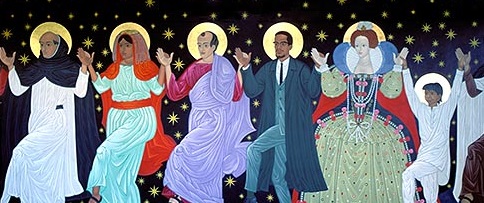
Some of those names you may know. Some you almost certainly do not. But they are all saints, and all so very human. But we make symbols out of saints and deny them their full personhood, and in doing so, deny our kinship with them as well. Their stories – if we really listen to them – tell us it’s in our deepest, weakest, flawed, mistake-prone, too-often-selfish humanity that goodness also exists. And it’s in our kinship across all boundaries that righteousness is found.

Saints are human beings, and humans are neither angels nor monsters, though we are capable of beautiful and horrible things. Great good and deep evil both. All of us. All the saints.


(The icon of the Dancing Saints is from St. Gregory’s Church.)

Other People’s Children

Other People’s Children

When I turned 30, I gave myself two gifts: a colorful 1940s era vintage dress handmade in Paris, and finding my childhood pediatrician.

Dr. Dunn was my doctor from the time I was born until we moved to a different city when I was 8. I was prone to ear infections, so he saw me around ten times a year on average. We lost a lot of the men in my life through those years – my daddy, grandpa, and great-grandpa, and my “adopted” Grandpa Duggins, among others. Dr. Dunn was one of the few men who was reliably there through all of those losses.

And he was a wonderful man. A gifted pediatrician, Dr. Dunn was also a Shakespearean actor, collector of African violets, and a musician in a local, old time style band playing the hammered dulcimer. He had a full white beard and twinkling eyes. He was unfailingly kind to me, and I always looked forward to going to the doctor.

More than twenty years later, back in the city I was born in, I tracked him down. When I called and explained who I was, he was delighted I’d found him and invited my mother and I to visit him and his wife in their home. It was a lovely time catching up, and before we left they invited me to join their family at a fiddlers’ festival in the Carolina mountains later that summer.

I took them up on that offer, and spent a wonderful weekend camping with their large family and enjoying the old time music of the region. (Old time is traditional mountain music similar to bluegrass, but while in bluegrass different instruments take turns with the melody, in old time, the fiddle always leads).

It was a beautiful weekend, but it was a conversation at a picnic table one night that shifted something in me.

I was sitting with Dr. Dunn and a couple of his grown sons as they talked. It was 2002, not even a full year after 9/11, and the war on terrorism was never far from anyone’s mind.

“If we want to end this,“ Dr. Dunn said passionately, “Every time a suicide bomber blows himself up, we will bomb their entire family.”

I was stunned. “But what about the children?” I asked. “They’re innocent!”

“Their children don’t matter if they are threatening my grandchildren!” he declared.

I couldn’t believe what I was hearing. This man I had only known as kind and gentle, who had made it his life’s work to care for other people’s children, was ready to destroy children for his own grandchildren’s sake.

My head and heart were spinning, and for the first time in my life, I thought that maybe there could be something good in not having children of my own.

I always wanted children – at least one. I love kids. Nieces and nephews, my cousins’ children (one of their girls is the only child I’ve ever waited for in the hospital as she was born), the friends’ children who I’ve known and loved from birth, the neighbors’ kids playing on the beach a few blocks from my apartment.

None of the children I love are mine. And as I have come to terms with age and circumstances, I have accepted the reality that the children I love will always be other people’s children.

That’s something I’ve grieved, but there’s also a gift in it – it means that I can want for all of those children everything I would want for my own. There’s nothing I have to protect, nothing I have to lose, in doing so. Rather than having my maternal instincts captured by this one particular child of my own, every child calls out to the mother in me.

When I heard those words come out of my beloved doctor’s mouth, something shifted for me. Something opened up in the way I look at the world. I saw how the love of “our” children can become twisted into something that is toxic to “their” children.

And the world is full of endless “us and thems.” Once we begin, we will see the threat of “them” everywhere, and it is so easy to harden our hearts. It’s how we destroy each other – kill in spirit and then in flesh.

“Love your neighbor as yourself” must also mean “love your neighbor’s children as your own.”

The children of my friends and family. The children of the stranger. The children of parents who, like Mary and Joseph, brought their children far from home to a country where they could be safe to grow and thrive. The children of my enemies, even.

That day began a change in me – a change in how I look at the world, in how I understand and live out my faith, in my relationships, in my politics, in everything.

I don’t live and work to give a better life to my own children. I live and work to help give a better life and world to other people’s children. To children of every shade and nationality and religion. Children full of hopes and dreams and questions. Children I know, and children I will never meet.

But each of them is equally precious, all of these children who belong to other people.

The Children We Owned

The Children We Owned

When I was growing up, one of the things I loved about visiting my grandmother in West Virginia was when she would go to a cabinet in the front room and pull out a box. She’d open the box and very carefully take out a handmade, handwritten cloth-bound book. It was about thirteen inches tall, maybe eight inches wide, around two inches thick, and inside it’s cover, in penmanship that looked like it came off the Declaration of Independence, was the name of my great-great-great-great grandfather, James Fields.

James was a Virginian, a tobacco farmer and the son of a tobacco farmer. The book is a collection of math lessons. It’s full of tables and measures and problems, including:

30 Days hath September
April June and November
All the rest hath 31
Except February hath 28 alone
But when of Leap year it doth combine
the time when February hath 29
for February its fourth year doth Come
Does gain a day from the Traveling Sun

It was the back pages of the book that always fascinated me most. They include poems that were transcribed (poet unknown). Both are filled with Christian imagery and implore the reader to be faithful to Jesus. One stanza reads:

Sweet rivers of salvation
Through Canaan’s land doth role
Bright darling berms of glory
Illuminates my soul
As ponderous Crowns of glory
All set with diamonds bright
And there my smiling Jesus reigns
Who is my heart’s delight

The back pages also include a record of the births (and sometimes deaths) of James and his wife Elizabeth’s children. Beginning in 1815, they had eight children, with the last born in 1834.

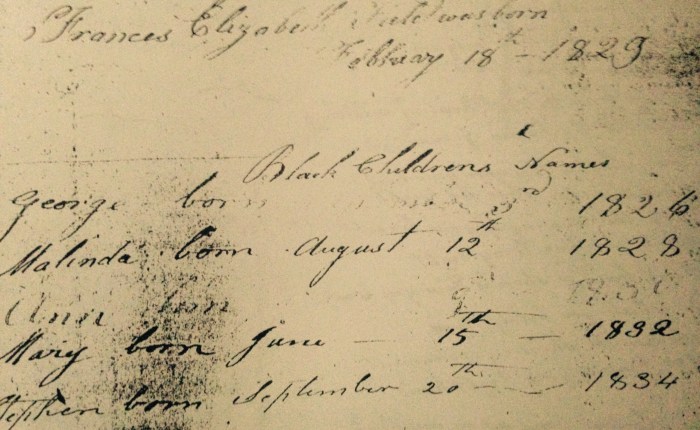
Alongside the births of his own children, James also records the births of “black children” – slaves.

George born September 3rd 1826
Malinda born August 12th 1828
Ann born January 9th 1830
Mary born June 15th 1832
Stephen born September 20th 1834

Five additional children are listed as born to Malinda:

Charlotte Elliot born March 5th 1846
Berry Frank born July 29th 1848
Julias Gilpin born May 17th 1851
Sarah Ann born May 27th 1860
Robert Lee born January 14th 1864

That last name gets to me most. Little Robert Lee, born just over a year after the Emancipation Proclamation and fifteen months before his namesake’s surrender at Appomattox.

When I was younger, those names were not much more than a curiosity to me – few slave owners bothered to record slave births by name. I was captured much more by the reality that James Fields had created these pages with his own thoughts and hands, and that they had been preserved and passed down parent to child until they had reached me. It was like a string across nearly 200 years of history connecting me with my ancestor in a way that the abstraction of genetics never could.

The mythology of the South was what I knew – states’ rights, Northern aggression, the prevalence of a benign slavery, freedom from federal government interference, the high moral character of Robert E. Lee and Stonewall Jackson.

And like everything involving real people, the realities of the country, the war, and slavery are incredibly complicated.

But that mythology? It’s just that – myth. Slavery is always inherently violent, the South fought the war to defend it, and southern generals led that violent conflict. That strand that connects me through 200 years to my ancestors is a thread of violence woven through our whole history.

My family owned slaves – children – to the end, and they fought for Virginia and the Confederacy to defend their “right” to own those human beings.

I’m glad I know. Many people with southern roots don’t. I’ll not be ashamed of my family history – I’ll not hide it. I mourn what my relatives did, and what they believed that allowed them to record slaves births and celebrations of their faith in Christ on the same page. I am not proud.

It’s a heritage I’ve seen so clearly at work throughout my lifetime and especially today – that ability to hold tightly to a “Christian” faith and to the way things are at the same time.

I understand it because I lived it myself for so long, and no doubt there are tentacles of that belief still entwined in my life. Those tentacles are woven throughout America – North and South – as well, and too many are blind to them. But I will root them out and repent of them, every one I find, both in my own life and in this world.

Because if there’s a Jesus worth following, his work is to proclaim good news to all of us who still live in poverty of many kinds because of racism and the generational impacts of slavery and its successors. If there’s a Jesus worth following, he proclaims liberty to all of us who are held captive by the normativity of whiteness, and the recovery of sight for all who are blind to the air of white supremacy we breathe every day. And he sets free those whose lives are marked by the oppression of suspicion and violence because of the darkness of their skin.

I come from people who claimed ownership of other human beings to support their way of life, who fought to defend that practice, and who named an enslaved child after a general defending slavery. They were willing to die for it.

What am I willing to die for?

Who Raises Up the Despised?

Who Raises Up the Despised?

(A sermon, on Genesis 29:15-28 and Matthew 13:31-33, 44-45. Audio is available here.)

Jacob, he loved Rachel,
And Rachel, she loved him,
And Leah was just there
For dramatic effect.

(from Rich Mullins’ “Jacob and 2 Women”)

The way the story is told, it’s not easy to understand what Laban was thinking when he pulled his trick on Jacob, and it’s even harder to know how Leah must’ve felt – whether she was glad to go along or not, she wouldn’t have had much choice in their culture but to do what her father told her to do.

We do know something about what Jacob felt though – we know he didn’t want Leah, he wanted Rachel. It would always be about Rachel for Jacob. It would always be Rachel he loved.

Unloved and unwanted. Leah lived her life as the despised wife, always competing with her sister for Jacob and always losing. It’s hard to imagine a more miserable situation.

But that’s not the end of Leah’s story. Later we learn that because she was despised, God gave her children, and ultimately the line of Christ came from the despised wife.

We have a God who sees the unwanted, the overlooked, the powerless, the despised, and raises them up.

Jesus, Leah’s many-greats grandson, always had time for despised women – a Samaritan woman with a less than stellar reputation, a woman caught in adultery, a widow grieving her only son. And it wasn’t just women – Jesus’ whole ministry was filled with the overlooked and unwanted: the men he chose as his closest disciples were all Galileans like himself, and Galilee was considered a backwater by Judean Jews. He spent most of his time with those despised by the religious as drunkards, tax collectors, and sinners, and he went out of his way to help those even his disciples thought were a waste of time – beggars, children, and Gentiles.

His parables were full of unlikely heroes – women, servants, a Samaritan. Over and over again, Jesus urges us to value what is small, hidden, and overlooked. A tiny mustard seed is hidden in the ground and becomes a tree large enough to provide a home for birds. A woman hides a little yeast in three measures of flour – that would be forty to sixty pounds of flour, and it is all leavened for enough bread to feed a village. Treasure and a priceless pearl are found hidden in fields.

This is where the kingdom of heaven is found, Jesus tells us – in small, ordinary things; in overlooked, hidden places. In people and things and places we so easily despise.

We have a God who sees the unwanted, the overlooked, the powerless, the despised, and raises them up.

And that makes me wonder, where are those things in our lives? In our communities?

Some of us know what it feels like to be despised – overlooked, unwanted, or even hated and rejected. And many of us really don’t know what that’s like.

I’m not sure which is more dangerous to us.

If we’ve been blessed not to have experienced being despised, that can make it all too easy to miss what we should see.

If we have been unwanted and despised, and have fought to find a place of acceptance and safety, it’s all too easy not to risk what we’ve gained for the sake of someone else who is despised.

We don’t have to hate someone to despise them; we only have to overlook them. To be uncomfortable enough to avoid them.

Who are those people in our lives and in our communities? The people who threaten the places we are comfortable? To be honest, I struggle with the panhandlers in my neighborhood, especially the ones who are more desperate, abrasive and louder, or who haven’t bathed in a long time. It’s easy for me to try to just ignore them instead of being willing to really see them as fellow human beings God loves.

In most communities, we struggle to include those whose language and culture are different. It’s easier to let them have their own spaces than to welcome them into ours. We struggle to welcome those who don’t think like we do, whose lives challenge our beliefs and call us to change. Humans tend to struggle with anyone who is different; we find our family and tribe and keep others out.

Are we willing to be uncomfortable in order to be more like Jesus? To show his welcome to the unwanted? Because that is what he calls us to do – to spread the “gospel,” the good news. At the very beginning of his ministry, Jesus proclaimed himself to be “good news” to the poor, and freedom for prisoners and the oppressed.

We have a Lord who sees the unwanted, the overlooked, the powerless, the despised, and raises them up.

Jesus is present with us in the bread and wine we will share, but he is present in the world through us, as well. And we take the bread and the wine because it is meant to change us – to give us the eyes of Christ to see the overlooked and the heart of Christ to welcome the despised.

Saint Teresa of Avila put it this way:

Christ has no body but yours,
No hands, no feet on earth but yours,
Yours are the eyes with which he looks
Compassion on this world,
Yours are the feet with which he walks to do good,
Yours are the hands, with which he blesses all the world.
Yours are the hands, yours are the feet,
Yours are the eyes, you are his body.
Christ has no body now but yours,
No hands, no feet on earth but yours,
Yours are the eyes with which he looks
Compassion on this world.
Christ has no body now on earth but yours.

The same God who chose the despised wife is the God who calls us to be the eyes and hands and feet of Christ in the world, who calls us to see the unwanted, the overlooked, the powerless, the despised, and raise them up.

Amen.