The Biggest Picture

The Biggest Picture

It was a good question.

I was sitting in a friend’s living room with a dozen or so others, and we’d been talking about faith. One friend, Michael, isn’t religious, but in his vocation as a sign-language interpreter, he spends many Sundays in a variety of different churches. He listens more carefully than anyone I’ve ever known, and works hard to (literally) embody the words he translates, and all those sermons in all those churches had left him with a question.

“If God gave his people the Bible –inspired by him in some special way, and the Holy Spirit who dwells in every Christian gives you the ability to understand it, why do Christians understand it so differently? Why do you disagree about so much?”

As I said, it was a good question. One I’ve wrestled with for years.

I grew up in a staunchly fundamentalist family and in proudly fundamentalist churches and schools, but the deeper my relationship with God grew and the more I studied the Bible, the further I’d been drawn from that context. Where God was taking me gradually went from just different to contradicting many of the conclusions and beliefs of the faith that had nurtured me.

That was hard, emotionally as well as intellectually, and I wrestled with it.

Whether they are differences in denominations or theology, we who are Christians have very different understandings of the Bible. You can parse those out by philosophical commitments or cultural biases, by tradition or personal inclination or translation, but Michael’s question holds.

Why, with one Bible and one Spirit, do we believe and live so differently?

I don’t deny that some are reading wrongly, with unexamined commitments shaping their understanding of both what Scripture is and what it says. And some may well be defiantly disregarding the Spirit to do what they want with it.

But those explanations aren’t adequate. Not when people who love and are devoted to Jesus, whose lives show the fruit of the Holy Spirit’s work, understand the Bible in such different – even opposing – ways.

I’ve seen that fruit in the lives of fundamentalists and in the lives of progressives. In the lives of Roman Catholics and in the lives of Baptists. In the lives of all kinds of people with contradictory theologies and convictions.

And I believe the witness of that fruit.

I do believe the same Spirit is at work in all of our lives. We all come from different places and are walking different journeys, and none of us are following perfectly. But following perfectly was never the point. We follow faithfully, doing our best, and God works.

I answered Michael’s question that night in the best way I knew how. I talked about my family and my own struggles with the same tensions and contradictions.

I do believe God’s Spirit is at work in both them and me, as well as in millions of other people who disagree with each other. I believe God has an end game bigger and better and more overflowing with goodness and justice and love than we can come anywhere near imagining.

We can barely catch glimpses of it from where we are. And we each come to those glimpses from such different places. But I believe Love is pulling it all together in the end, weaving what we see as contradictions into a tapestry that leaves no one out and nothing undone.

And here? Now? There are people, like my family, who are introducing people to the Love that is God that I could never reach. And, hopefully, there are people I’m helping to meet that Love who they could never make that connection with.

It’s not an easy hope, and it doesn’t resolve anything now. But I trust that there will ultimately be a resolution beyond all the ways we think about such things. That while contradictions are no illusion, there is Something bigger than the contradictions, and it’s going to make them irrelevant one day.

And I’m doing my best to trust Love and live into that future I can’t see yet.

No Story Without Leaving Home

No Story Without Leaving Home

It’s there in the beginning – Adam and Eve left the Garden. Noah left. Abraham left. Jacob. Joseph. David. Daniel. Jonah. Joseph and Mary. Jesus. They all left.

There is no story without leaving home.

It means grieving. Even good change includes loss that needs to be grieved. Things will never be quite the same again, and it’s important to acknowledge that.

Love isn’t strong because it doesn’t change. Love is strong because it bears change, even embraces it.

Grief is a funny thing. It means both letting go and holding close. Pausing to sit, or getting a move on. Anger and peace. Hope and release.

Whatever it looks like, grief is part of stepping over the threshold to leave. Or realizing that’s what we already did without knowing it.

Leaving home also means a journey. An adventure. The unknown.

It’s risk and opportunity interwoven – you can’t get one without the other. Which is why sometimes people choose not to go, to live with the smaller story. They are afraid of the risks, and the opportunities don’t feel worth it.

But we’ll never have a capacity for love and joy greater than our capacity to risk pain and loss.

You can’t get one without the other.

The one that would save – protect – their life? They will lose it.

But in accepting the risk and the loss, we can also find life we never imagined. That’s the opportunity – to grow beyond home. To meet people, encounter ideas, face challenges we never would have known at home. And in discovering the world beyond, we will also discover ourselves, finding healing and strength and ability in ourselves we never recognized or needed at home.

There’s no story without leaving home.

It can look like so many things, from moving out to changing paradigms. The thing is, it’s never really done. We know what it looks like for teenagers and young adults to begin to find their own way and discover who they are apart from their family. But so many of us carry home with us without even realizing, like a turtle shell we just assume is part of our very being.

Assumptions we learned from family and community when we were young just look like reality to us, and that shell of home feels like safety and security. But there are places it keeps us from going, life it keeps us from living.

There is no story without leaving home.

And it’s the journey of a lifetime.

Loving the Cubs

Loving the Cubs

I don’t have a long history with the Cubs. And I don’t have much of a history with baseball at all.

I moved to Chicago twelve years ago, and was largely amused by my new Cubs-fan friends. (Hi, Dan!) If the Cubs were winning, “Don’t worry, they’ll get over it!” I’d assure them. And I told them, “Going to a game at Wrigley Field is on my Chicago bucket list, but if they win, can I get my money back? I want the real Chicago experience!”

I’ve been cheering for and with those friends this year, and particularly the past few weeks during the post-season. As game seven approached the 9th inning, I began to make my way down to Wrigley with thousands of other fans, and I’m thrilled beyond words to have celebrated with them after we watched that final catch peering through bar windows to try to follow the action in Cleveland.

For so many of my friends, loving the Cubs goes back generations. Following the Cubs and always hoping for “next year” is the stuff of family rituals and memories.

I realized this week that my affection has similar associations.

My daddy died just after my third birthday. He had ALS – also known as Lou Gehrig’s disease. As a young girl, I watched Gehrig’s own story, The Pride of the Yankees, with the intensity of a detective looking for clues to who my father was – and would have been. And Gehrig was a worthy designated hitter.

The feel of vintage baseball became inextricably associated with Daddy, with a warmth and goodness and affection that only comes with the memories and associations of childhood.

I didn’t feel it when I went to a game at the concrete behemoth the White Sox call home, but it was there the first time I went to a game at Wrigley Field. One of only two Major League parks left where Gehrig played, it’s a place where vintage baseball lives. The joy and disappointment and hope of decade upon decade echo in its confines.

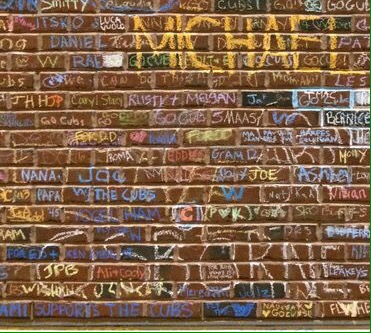
And there’s something about the fans. They waited their whole lifetimes to see the Cubs win the Series, and when they finally did, they covered the brick walls of Wrigley Field with the names of those who didn’t live long enough to see it. The walls have become a memorial to those the fans wanted to share this day with. Loved ones who taught them to love the Cubs – who shared so many games. But not this one.

This city that I love has been filled with the aroma of history this week. History shared together – every player who wore the uniform in the past 108 years, and every fan who cheered. The Cubs are about that continuity. It’s something that’s as big as and bigger than baseball.

I was here when the White Sox won the World Series, and blessings on my Sox fan friends, but it was nothing like this. Even the joy that a Blackhawks championship brings the City is totally different.

Nobody was writing names on walls.

I will never be a life-long Chicagoan. But in an accidental and convoluted way, my Daddy taught me to love the Cubs. And this week has taught me that I belong to this City.

Maybe I should go write his name on that wall.