What If I’m Wrong? (About LGBTQ+ Inclusion)

What If I’m Wrong? (About LGBTQ+ Inclusion)

“But what if you’re wrong?”

It’s the question that characterized the religious context I lived most of my life in more than maybe any other. It has its corollary in, “Are you sure you’re right?” and both questions brought into focus what was most important to that community, and by extension to God: we dare not risk being wrong. If in doubt, err on the side of caution. Countless preachers urged us not to trust them, but to “search the Scriptures” for ourselves. It wasn’t a responsibility to be passed on to anyone else.

We wanted to be faithful – to love God and obey him and stay as far from sin as possible. The constant questioning of ourselves, of our motives and our thinking, was meant to keep us safe.

More often it kept me frozen – “But what if you’re wrong?”

That question was never more present or profound to me as it was in the days and months when I began to intentionally explore the “issue” of LGBTQ+ Christians.

It was actually the very question that drove me to ask more – “But what if I’m wrong?” I’d been raised by folk for whom that subject was settled absolutely. The Bible was “clear,” and sex was created for marriage between a man and a woman. Period. And they didn’t just believe that, they argued for it loudly and publicly, vehemently attacking the “gay agenda” and “gay lifestyle.”

And while the methods often felt misguided to me, I shared the underlying conviction and straightforward sexual ethic.

But…what if we were wrong? What if, as much as we were seeking to be faithful, there was something we were missing?

I’d been in churches that welcomed those who “struggled with same-sex attraction” in non-coercive ways that were full of grace and patience and hope (and I’d received much healing in various areas of my own life in those communities), but what if there was more? What if we were still missing something?

So when I was introduced to a community of people who were working to build bridges between the LGBTQ+ community and conservative evangelical churches, I got involved. I asked lots of questions of pastors who’d had a change of heart and mind, and I listened to scores of stories from LGBTQ+ people. Some of those stories were told publicly, and some of them were entrusted to me privately. They all changed me.

I realized something was very much missing – we were not loving real people, with their real lives that don’t neatly fit our “biblical” prescriptions. It wasn’t an “issue” for me anymore, it was people. I heard too many stories of rejection by families, condemnation by church communities, and suicide attempted. (The stories of successful suicides are all second hand.)

I was introduced to a very different reality than I’d seen before: the ugly, deeply rotten fruit of traditional church teachings on sexuality. And when the fruit is persistently bad, something is terribly wrong with the tree. Something needs to be reconsidered or even thrown out altogether.

But…what if I was wrong? I’d studied the biblical texts – original languages and contexts. I knew that there were good arguments that those texts decrying same-sex sexual activities shouldn’t be read in the traditional ways. But those arguments weren’t water-tight. They raised questions, but didn’t seem conclusive.

My mind and heart had shifted, but these different possibilities in the text felt shaky to stand on. I could never be sure I was right about them.

I found a mentor in Dietrich Bonhoeffer, the German theologian who was deeply committed to non-violence and yet entered into a plot to assassinate Hitler. He was captured and executed a few weeks before Nazi regime collapsed.

In his vast writings on Christian ethics, Bonhoeffer observes that there are times when what is required to keep your conscience clear and what is required to love your neighbor contradict. In that contradiction, it is better to bear guilt yourself in order to love your neighbor.

As I looked at the lives of my LGBTQ+ brothers and sisters who had found acceptance and affirmation of all of who they are in affirming churches (and more importantly, in their own hearts before God), I saw the fruit of their lives blossoming – love, joy, peace, patience, compassion, goodness, faithfulness, self-control. 

Looking at the life of Jesus, I realized that maybe we’d been missing the point. Jesus was far more concerned with loving people than with getting it “right” – or even with them getting it right. The Samaritan woman at the well who was concerned about the right way to worship God. Hungry disciples on a Sabbath walk through a wheat field. A woman condemned by the religious leaders for adultery. Outsiders casting out demons in his name.

Even if I was wrong, if I was missing something, I was no longer willing to risk their lives on the altar of being right, whatever the cost to me.

I’ve never regretted that decision. And as time has passed, I have only become more convinced that God’s heart for his LGBTQ+ children is love and complete affirmation and inclusion in the community of his followers. He has called them “clean” and we are in defiance of his Spirit when we insist otherwise.

I don’t believe I’m wrong. But if I am? LGBTQ+ folk are being invited into the embrace of the love of God, and his Spirit is quite capable of guiding them into any change he desires, regardless of their sexuality and/or orientation. If I am wrong? LGBTQ+ youth in our churches will know they can live, loved as they are by God and his people.

If I am wrong? Their lives are worth it.

Let Your Yea Be Yea

Let Your Yea Be Yea

A couple of weeks ago, over the course of two days, pretty much everyone in the church felt betrayed by Eugene Peterson, a man whose life and work as a pastor has deeply impacted and formed so many of us. He is a prolific writer, and everything I’ve ever read from him – whether it was about discipleship, or theology, or ministry, or even his translation of the Bible, The Message – came out of a pastor’s heart. As I worked on my own Master of Divinity degree and considered my own work in pastoring (something that, while I’ve never held the title, I’ve found is nonetheless part of my life), Eugene Peterson has been a significant model for me.

On Wednesday, Peterson affirmed that if he were pastoring today he would perform a same-sex marriage if asked to by Christians of good faith, and millions of Christians who are convinced the Bible condemns same-sex relationships felt betrayed. On Thursday, he reversed that affirmation, and LGBTQI+ believers who have fought for their faith felt betrayed.

Between Wednesday and Thursday, LifeWay Christian stores threatened to stop carrying all of his books, including The Message. LifeWay is the largest Christian bookstore chain in the country and is affiliated with the Southern Baptist Convention. “LifeWay only carries resources in our stores by authors who hold to the biblical view of marriage,” they said, by which they mean “our interpretation of the biblical view of marriage.” LifeWay has a lot of weight, and they are willing to throw it around.

And on Thursday, Peterson retracted his earlier statement, saying, “To clarify, I affirm a biblical view of marriage: one man to one woman. I affirm a biblical view of everything.”

I can only imagine what it is to be Eugene Peterson, and I don’t know why he did what he did. He’s 84 and has spent his lifetime trying to live faithfully as a pastor and a pastor of pastors. I continue to love him, and respect him in many ways.

But he doesn’t get a pass from me on this. I don’t expect him to be perfect, and I don’t expect him to have everything figured out. But I do expect him to take responsibility for his words. All of them.

Particularly their pastoral implications on the real lives of real people who are rejected and ostracized by the church every day.

When I was in grade school, I was the opposite of popular. I was bullied – overtly rejected and ostracized day in and day out. The other girls weren’t interested in playing with me, didn’t even want to be seen with me. But my parents were friends with some of their parents, and most of us went to church together. When our families were visiting, or we were alone for some reason, some of them would play with me. We would have a good time together. Sometimes they even seemed to actually like me – for a little while. Then we would be back at school and it was like those times never happened.

There was one girl in particular – she was one of the most popular. We both had to walk to where we would wait for our parents every day after school. We weren’t allowed to walk alone, and she agreed to let me walk with her, but told me I had to walk half a block behind or in front of her so she wouldn’t be seen with me. Once we arrived, we’d play and have fun together while we waited, but not if any other friends were around.

After college, I found myself at the same church with her, and we became friends. I asked her about it once. She didn’t even remember any of the things that were so painful to me. “All I remember,” she said, “is how afraid I was they would reject me.”

It gave me a certain sympathy for her – she’d been a child acting out of her own insecurities. She was too afraid of what others would think to be a friend to me, and she let those who would reject her control how she treated me, the one who was rejected every day.

Eugene Peterson is no child. Lives are at stake, and those lives aren’t those of straight conservatives with traditional views on gender and sexuality. LGBTQI+ kids in non-affirming communities have exponentially higher suicide rates than those in affirming communities. And every voice makes a difference.

We all have journeys. Change is a process, and it’s sometimes appropriate to honestly say, “I don’t know – I haven’t figured that out yet.” It’s one thing to be in process. It’s another to say yes or no.

Either Wednesday was true, or Thursday was. Either way, Eugene Peterson owes an apology to the LGBTQI+ community.

Proud.

Proud.

The first weekend in June my friend Lauren was in town and we connected for dinner. It was the second time this spring we’ve had the chance to connect, and I’ve been so grateful for these opportunities. We were friends and fellow students in seminary over ten years ago, and we hadn’t seen each other since.

A lot has happened in those ten years. My own faith has come alive in new ways as I have sought to follow Jesus outside the lines and delve deeper into the Love that is the Life of all things.

And Lauren…when we were in school together, Lauren was a “he.” She transitioned a few years ago and I am so glad I have the opportunity to know the beautiful woman she is today.

While we were good friends in seminary, I had no idea Lauren was trans. What I did know was that my friend didn’t fit the masculine ideals our conservative evangelical school had for ministers. (Of course, I hardly fit those ideals either, but since they hadn’t quite figured out the same kind of ideals for women in ministry, I never encountered the same kind of pressure to conform.)

The school nearly refused to grant Lauren’s degree, though in the end, Lauren managed.

As she put it to me, she “zipped up her man-suit every morning,” but it was killing her.

There’s no way I can know what that must feel like. I can barely imagine.

What I do know is that there is life and peace in her now that wasn’t there before. She is at home in her own skin in a way she never was in seminary, and it is beautiful to see.

In that sense, Lauren’s story is much like that of other trans folk I know. They fight to live with honesty in the world with courage that takes my breath away. They have been willing to lose the whole world to gain their own soul. I am beyond grateful for all I have learned from them.

That is true to some degree of every LGBTQ+ person I know, and I am proud of them. Proud to know them, and proud to stand beside them.

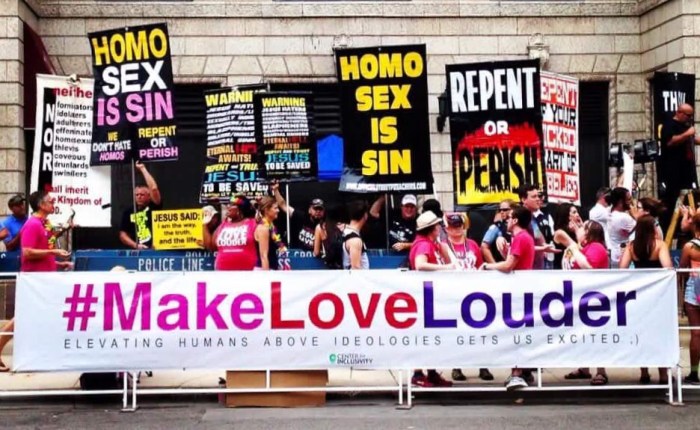
June is Pride month, and in a couple of weeks I will be at Chicago’s Pride parade, standing for Love between the parade and the “Christian” protesters who proclaim something else entirely. Cheering on the friends and strangers marching, encouraging them to “Make Love Louder” than the hate.

Because there’s more than one kind of pride. There’s the pride of vanity and privilege and self-aggrandizement. And then there’s the pride that stands tall in the face of all that would demean and dehumanize. The pride that refuses to bow to shame and fear. The pride that won’t hide inside that zipped up suit that isn’t who they are. The pride of those who know Who loves them.

That pride is hard-won, and I am so proud of those who have won it.

Happy Pride, y’all!

Losing Terry

Losing Terry

When I met Terry we were standing in front of a shark tank.

I was a member at the Tennessee Aquarium, and between my college classes during the day and political events I attended as a Republican activist, I loved to spend an hour or two at the aquarium enjoying the beauty of the darkened “river canyon” walkway with its glowing tanks. The Gulf tank was the largest, rising three stories high.

Terry worked at the aquarium and tended to be on duty the same days I was a regular. I would come an hour or two before closing on weekdays. There were usually few visitors then, and in the glow of the Gulf of Mexico tank we started talking.

I don’t remember how many weeks it took for us to exchange names and contact information, but we learned a lot about each other.

I was in college at the fundamentalist Baptist university in town, from a family where far more of the men were preachers than not. Terry was a biology major at the local branch of the State university, the youngest son of a black Church of God minister.

We talked about the animals – I’m sure we started there. But since I was always (always) wearing a bright blue “I BACK ZACH” button for the local Republican congressional candidate, we were talking politics before long. Affirmative action was a long running discussion and I heard Terry’s perspective (though it was years before those seeds blossomed into a different position).

For all our differences, we became friends. We met for lunch sometimes, or dinner. I introduced him to some of my friends, and they became friends in their own right. My grandmother, who always wanted to know what I’d been doing when she called, started asking if we were dating, but no. We were friends. (She eventually started started expressing concern about what people might think of me if they thought we were dating. I assured her that anyone who would think less of me for dating Terry because he was black was not someone whose opinion I cared about. She stopped.)

Terry came to my college graduation knowing not a soul there except me. My family was looking for him, though, and when he showed up with flowers for me, both grandmothers hugged him warmly.

I’d met some of his family once or twice when we’d stop by his house. His father and I sat on their stoop one afternoon good naturedly debating eternal security (the idea that a person is “once saved, always saved”). He had at least five or six older brothers and sisters, all with or pursuing advanced degrees. Their mother had volunteered at their schools, Terry told me, and had known their assignments better than they did. She was determined her children would succeed academically, and they did.

When I came to Terry’s graduation in the huge university arena, his family were watching for me, and I was brought back to their house for the celebratory dinner. I sat squeezed around the table in the tiny kitchen with Terry and several of his siblings, and the rhythm of give and take and teasing eventually drew me in. Terry and I had always had a similar rhythm and soon his sisters were teasing him about the little blonde white girl getting the best of him.

We both stayed in the area and stayed in touch, and a few months later when I began to have debilitating anxiety attacks that wrecked me physically and kept me unable to work or drive safely for months, Terry nervously drove out to my folks’ place in rural northwest Georgia to visit and take me on outings. (He joked nervously that he could always feel the neighbors staring at him as he drove into the neighborhood.)

I remember one night when we spent hours on the phone. He’d just been to a family gathering and found out a cousin he was close to was gay. He was wondering what it would mean if it turned out to be biological. I remember saying that “we’re born sinful” and why would this be different? Something to be repented, changed, healed, but that didn’t mean he didn’t love his cousin.

That was what I believed, and I believed it was enough for a long time.

Eventually Terry moved down to Atlanta, but every time he was home for a visit or holiday, we’d make plans to get together. We had plans one Thanksgiving, but then I didn’t hear from him. I called his folks, but they always said he was out. I didn’t hear from him that weekend, and he never returned any of the messages I left on his Atlanta number.

Eventually, I stopped calling.

And then over a year later, I thought of him, impulsively dialed his number, and he picked up.

He was surprised to hear from me, caught off guard, but we ended up talking for hours. That previous Thanksgiving he’d come out as gay – to his family (he’d had to leave the house and hadn’t been back) as well as most friends. Everyone but me. He hadn’t been able to bring himself to tell me, he said.

“But why couldn’t you?” I remember asking through tears. “Didn’t you know I’d still love you?”

“That’s why I couldn’t tell you. I knew you’d still love me, and I knew what you believe and that it would always hurt you for me, and I didn’t want you to think of me that way.”

We cried and we talked, and we found our friendship again, tentatively, over the distance.

A couple of months later or so, I was huddled on the living room sofa, reeling and crying and devastated over the breakup of my first serious relationship (my first relationship period, and I was blind-sided on Valentines Day, no less, but that’s another story). The phone rang and my mother came in to tell me it was Terry calling for me.

And I couldn’t do it. I was overwhelmed with pain and confusion and I couldn’t handle the emotional complexity of loving Terry in that moment. I told her to tell him I was sorry but I couldn’t talk right then and would call him back when I could.

I wanted to find my balance first, to be present to something other than the pain that was swallowing me.

But deep down, I knew what he’d likely hear. After our vulnerable connection after all those months, he’d just hear no. He’d hear rejection.

And when days later I called him, he never returned my calls. I was sorry, but deep down, I wasn’t surprised. I had let my own stuff trump what I knew my friend needed.

I never heard from Terry again, and I’ve never managed to contact him since.

It was decades before my understanding and beliefs about what it means to be gay (or lesbian or bisexual or trans or queer or intersex) changed. And when I love and enjoy my LGBTQI+ friends and advocate for them and their community, I’m not making anything up to Terry. They aren’t Terry.

But I think of him, and I hope that I will never again let my own sense of need get in the way of accepting and welcoming a friend and making sure they know it.