Taking Another Way

Taking Another Way

I have not chosen the easy way.

Following Jesus to the place where I affirm and advocate for my transgender and gay and bisexual and lesbian and queer friends has been one of the most challenging and at times painful things I have ever done. It certainly hasn’t been a “feel-good” path.

And I am not where I am because I don’t really know the arguments against same-sex marriage. A member of my family literally wrote the book on those arguments, and I made them myself for many years. Sincerely, and with a desire to be both faithful and loving.

I am also not here because I think I’m smarter than the Scriptures. I’ve sought a good education in the Bible and theology – from a highly respected conservative seminary – and my respect for the gift God has given us in the Bible has only grown. So has my awareness of the assumptions we bring to it, and I want to do my best to engage what’s been given to us on its own terms rather than mine or anyone else’s.

I do believe I know things now I didn’t know before. I’ve met people, loved them, and lived life alongside them. I’ve realized that many things I once believed are only partial truths – there’s more. And I know there’s more than I know now. The more I learn, the more aware I become of how much I don’t know.

Life was simpler before, and easier. But also smaller.

There are many people I love on the path I chose to leave, and I know they don’t understand. The thirty year old me wouldn’t have understood either. I would’ve thought I understood – that this me was rebellious or at least deceived. That this me had to have lost the faith to stay faithful. There was no other explanation. Looking at where I am now, I would have thought I must have sacrificed truth to emotion.

I get it. I do. Which doesn’t mean it hurts any less to be judged in that way.

I wish those who do not agree or understand could trust my love for Jesus and my relationship with him. I wish they (you?) could continue to trust the work of God you’ve seen in my life all along, even if you can’t understand how it’s brought me here. I wish you could trust the fruit of the Spirit in me – the increasing love, joy, peace, faith. The shalom – wholeness and integration – that has blossomed. The way that as love has grown and expanded in me, fear has diminished.

I wish you could see, but I understand why you can’t.

Just know, it wasn’t the easy way.
Unclobbering and Shared Stories 

Unclobbering and Shared Stories 

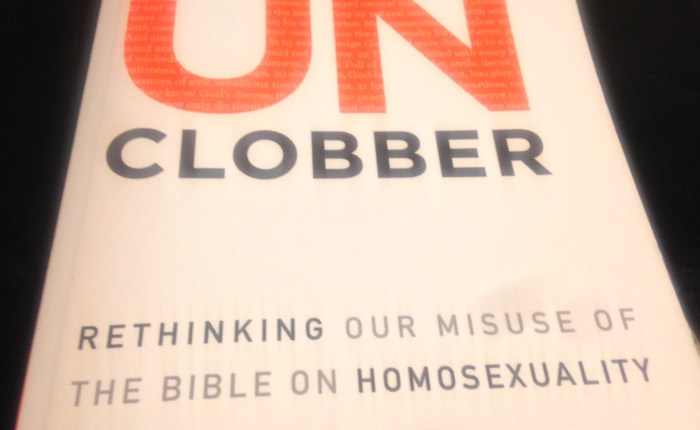
A friend of mine, Colby Martin, has written a book that’s about to be released. I’m proud of him, not just because of the enormous work such a project means, and not even because it’s a brave and beautiful book.

I’m proud of him most because of the life he has engaged and shaped in himself – it’s a brave and beautiful journey he has walked to be able to write this book.

Unclobber is part memoir and part exploration of the Bible’s “clobber” passages – those verses that convince believers that God condemns same sex desires and acts. When Colby came to understand those passages differently, he lost friends and the position as pastor he was called to in a conservative evangelical church.

It’s not the book about affirming my LGBTQ+ sisters and brothers that I would write, and I’m glad. While there is strong resonance between our journeys, Colby’s story is uniquely his and uniquely valuable for that.

For me, his story is most powerful in a place where it both deeply connects with and departs from my own.

Colby changed his mind and heart because of his deep commitment to be faithful to Scripture and following Jesus. He had no questions about his own sexuality, no friends or family members who were gay.

Like me, Colby didn’t come to see things differently because he had a stake in the game. I would say that we both began to look deeper because we saw that Jesus has a stake in the game.

It’s not an easy path. While there is, as Colby expresses so well, a deep peace that comes with living in alignment – mind, heart, spirit, and outward behavior all in harmony; that peace can come with deep loss.

I am fortunate that, unlike Colby, my own journey did not jeopardize my calling or the ability to support a family. But there are deep losses nonetheless. When what it looks like to be faithful changes for you, to those for whom it hasn’t changed, you appear to be unfaithful.

Following Jesus can take us down different paths, paths that can seem confusing (and worse) to those who love us. But once seen, the vision cannot be unseen. Once known, new understanding cannot be unknown.

I’m reminded of the parable Jesus told of the Pearl of Great Price. A merchant sells everything in order to gain one thing that matters most to him (a thing that would look absurdly impractical to the parable’s audience – he can’t eat it or shelter under it, and it would be difficult to sell, if he even intends that).

It’s a parable that challenges us to know what it is that we value most. That will not look the same for all of us, even those of us who follow Jesus, and that’s hard sometimes.

I’m grateful for Colby and his journey. I’m grateful for friends who have counted and paid the cost, and continue to follow as faithfully as they know how.

And as we share our stories, I’m hopeful. I’m hopeful that we can continue to challenge our fears and blindspots, that we can embrace a faith that is ever more just and generous.

That together we can create a world that overflows with the shalom, beauty, and love of God to all.

Abandoning the Shoes that Brought Me Here

Abandoning the Shoes that Brought Me Here

There’s a poem I’ve been living with for the last couple of months. Written by David Whyte, it’s about a pilgrimage in Spain, Camino de Santiago or The Way of St. James, and the traditions that have arisen at its end at Finisterre:

The road in the end taking the path the sun had taken,
into the western sea,

and the moon rising behind you
as you stood where ground turned to ocean:

no way
to your future now but the way your shadow could take,
walking before you across water, going where shadows go,

no way to make sense of a world that wouldn’t let you pass
except to call an end to the way you had come,
to take out each frayed letter you brought
and light their illumined corners, and to read
them as they drifted through the western light;
to empty your bags; to sort this and to leave that;

to promise what you needed to promise all along,

and to abandon the shoes that had brought you here
right at the water’s edge, not because you had given up
but because now, you would find a different way to tread,
and because, through it all, part of you could still walk on,
no matter how, over the waves.

from Pilgrim, copyright 2012 Many Rivers Press

My family is hardcore fundamentalist. I often tell people that they believe Jerry Falwell started to compromise along the way. It’s funny (not to them), but true. They didn’t jump on the anti-gay bandwagon in the 90s; my step-father built it in the 80s.

They taught me many things.

They taught me that God’s love was great and that he had committed himself to working certain ways, within certain boundaries.

That’s the thing about fundamentalism (and much of Christianity that wouldn’t describe itself as such) — it’s not just people that are inside or outside those boundaries. God’s work is inside them, too, and his only work outside those boundaries is to call people to come inside them to him.

They also introduced me to Jesus and taught me to do what he wanted me to do no matter what they or anybody else thought.

And I followed Jesus to places that stretched them. I went to seminary and got an MDiv at a scary “neo-evangelical” school. I started preaching a little. And they rolled with it.

But then I saw Jesus dancing on the other side of the boundary line, and I knew what it would mean to cross that line, to follow him there. In the end, it was no choice really — of course I would follow him.

But I didn’t know how. The shoes that had brought me here weren’t made to dance, much less walk on across the water.

I didn’t begin to know how to walk across that line.

So with the help of a friend, I began to walk along it — to get to know a community of LGBTQ followers of Jesus who were trying to figure things out themselves. I listened, for months. Some of them came to trust me enough to honor me with the gift of their stories and struggles. They grew to be family to me.

They gave me space to learn to take off my shoes, to learn to walk without them. To let old ways of understanding and believing and relating die, and new ones be born and grow.

And one day, after about a year, I looked around and realized I’d left the line far in the distance. I’d taken off my shoes to find the ground on which I was standing was holy.

That moment was beautiful and terrifying.

I knew what it would mean. I knew that for many of my family and friends, crossing that line meant they would rewrite the story of Jesus in my life as a delusion — if the path had led me here, it had to be false.

And that meant that so many people I love, whose fingerprints I’m proud are on my life, who gave me the shoes that brought me here, would no longer be home for me. Elders whose voices brought deep wisdom to my life would not advise me going forward.

I’d found a new family, new elders, but they will never be replacements.

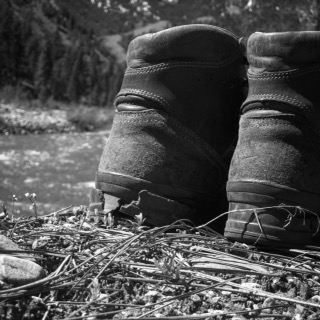
The shoes that brought me here still mark the water’s edge. They are well worn to the shape of my feet and journey. And they stand empty there in testimony that there is yet more beyond.

…to abandon the shoes that had brought you here
right at the water’s edge, not because you had given up
but because now, you would find a different way to tread,
and because, through it all, part of you could still walk on,
no matter how, over the waves.

After the Parade

After the Parade

Pride was a beautiful, powerful, heartbreaking, exuberantly fun experience all rolled into one. It is, indeed, the opposite of shame, and that is beautiful to behold.

Some impressions…

Forty-nine pictures going by, each with a name and an age on it. Too young, all of them.

The protesters themselves. While I have known few believers who would adopt their big signs and bullhorns tactics, I have known many who would promote their message. At one time, I agreed with it myself (though it never sat easy with me). I believe they believe every word, and it breaks my heart.

The gratitude and amazement on faces because for love’s sake we choose to stand in that space, in front of the people saying the vilest, most hateful things for the whole four hour parade.

The power of humor to diffuse a volatile situation. From the man who simply holds a neon colored arrow sign marked “Secretly Gay” pointed at the protesters all day, to the double entendre of #MakeLoveLouder, laughter was a clear relief to many in the wake of Pulse and in the face of loathing.

PFLAG. They make me cry. Parents who fight for their kids. Parents who’ve too often had to fight their communities and churches (and sometimes even themselves) to love their kids.

The other group that gets to me are the churches who march. There are so many of them — a sea of signs. Too many to read all of them as they go by. A stunningly beautiful problem.

The beautiful strength of friends who’ve fought (still fight) their own varieties of battles to live love with integrity — with all of who they are. They fight for others even when it costs them.

In the midst of all the “F— you”s directed at the protesters, just how many of the parade participants, with tears in their eyes and pain on their faces, made heart symbols with their hands and shouted “We still love you!”

It was a beautiful, powerful, heartbreaking, exuberantly fun experience all rolled into one.

And then I had to come down from it.

Friends all had obligations elsewhere, and as I walked down the crowded Boystown streets by myself, I struggled with feelings I’d been wrestling with ever since the Pulse shooting.

This is a community I own as family, and yet in so many ways, I don’t belong to it. I’m a white, cisgender, heteronormative woman. I’ll never know what it is to fear rejection because of who I could love — do love. I don’t know what it’s like to never feel physically or emotionally safe just being myself in public. I’ll never know what it is to fight against hating the part of myself that loves and desires. Not the way LGBTQ+ friends do. For all of the sideways ways I can relate to all those things, it’s not the same.

And yet.

I love this community. I love the way they make family. I love the way they fight to live wholly as who they are with integrity. I love the way they defy shame with love. I love that I can be myself with them in a way I’ve rarely been with people “like me.”

But walking down Halstead, I was so aware that for all that these spaces feel like home, they are not my spaces. At least not yet, and I’m not sure how much they ever can or should be.

I felt very much in between.

But it was Pride. And as I walked along a tree lined side street, a young man passing by in a group of friends stopped short and said, “Oh my God, you’re beautiful! Can I give you a hug?” He gave me a sweet, sweaty hug and went on his way.

I walked on smiling, nothing resolved but everything affirmed. Especially love. I can’t imagine that happening with such innocent, exuberant joy anywhere else. And for all my in betweenness, there’s nowhere else I’d rather call home.