Accumulating a Life

Accumulating a Life

I read an interview recently about how small, seemingly inconsequential biases can accumulate to create larger inequalities. Each time a man repeats and gets credit for a woman’s ideas in a meeting because we hear men differently. Each time a black child’s behavior is reprimanded more harshly than a white child’s because we see black children differently without even realizing it. Each time a job applicant is not pursued because of an ethnic name and our preference for the familiar. Small individual acts (“micro-aggressions”) add up to big impacts on both individuals and organizations.

Systems of wealth and credit, education, and the legal system all collect both privileges and discriminations, however small, into cumulative effects. The whole is greater than the sum of the parts, and the impacts cross generations.

It’s a theory that helps us understand how racism and sexism function long after those explicit attitudes may have fallen out of fashion and faded. But it also helps explain much that that is beautiful and good.

Life itself, after all, is an “accumulation mechanism.” Each day builds on those that have gone before it. Each choice, for better or worse, wears the grooves of habit into our character and personality. Evil and hate and fear grow because of what we add to them. Love and kindness and beauty intervene because we do.

Our lives and our world become what we make them because of two things: what we add to them, and what we accumulate with.

So many decisions, acts, and words make up our lives – from what time I get up in the morning to how I great my neighbor on the sidewalk. What I spend, what I eat, whether I take the elevator or the stairs. What I choose to be intentional about and what goes on autopilot – and what kind of habits I’ve loaded into that autopilot. But things I have no control over make up my life as well – from what time the sun rises to how my neighbor greets me.

And there were things given to me before I even knew it that make up my life today. The genes and words of my parents, and their parents. The choices of teachers and friends and strangers, both living and long gone.

So many things come to me whether I chose them or not. But what I can begin to choose along the way is how I receive those things – how I sort them into meaning and significance, and whether I hold onto them or release them.

Consciously and unconsciously, we choose what to collect both of our own actions and the actions of others’. We sift words and acts, holding onto some and releasing others to oblivion. Much of this is unconscious. Early in life, the voices of family and authority – tempered by personality – teach us what to keep and what to ignore, and those filters function with a strong confirmation bias throughout our lives.

But life itself also gives us opportunities to flush out some systems and accumulate differently. Each day is new. Forgiveness and release can transform what has collected. Meaning can be reassessed and rewritten. And while we may never truly start from scratch again, we can change what we are accumulating.

That’s true for each of us as individuals, and it’s also true for us as a society. But that’s harder.

Because the filters that let some of us keep good things make others lose them. And the systems that give some of us room to make mistakes and grow don’t give others those same opportunities. Too many of us are only concerned with how the mechanisms for accumulation work for us, and we insist they must be working the same way for everyone else.

Principles can be deceiving. In theory, they work the same for everyone. But while in theory, there’s no difference between theory and practice, in practice, there is. Principles have to be judged by their real impact across the board, on a broad range of individuals and an array of different situations.

Too often, in our lives and in our society, the most vulnerable are sacrificed – the most vulnerable parts of ourselves and the most vulnerable among us. And too often, we don’t even want to know it’s happening, so we let the accumulation mechanisms keep running without asking if we really want what they are collecting. If what it’s building are really our best selves and our best world.

Our best selves and our best world are worth building, if we can find the courage to try.

Promises Better Broken

Promises Better Broken

There was a man, the story went, who wanted to be a leader of his people. He was from a humble background and had known much rejection, but now he had an opportunity. If he could pull off a victory, he would be praised and appointed to lead. He made a promise about what he would do if he was successful, and when he won, he kept his promise.

That promise was to sacrifice the first thing or person to meet him when he arrived home safely and victorious as a burnt offering to God, and the first to run out to meet him was his daughter, his only child.

The man’s name was Jephthah, and the story is in the book of Judges in the Hebrew Bible. Scholars debate what the text means and whether Jephthah actually killed his daughter to fulfill his vow, or instead dedicated her to serve God and never marry or have children, much like a nun. But I was taught a “plain reading” of the text, and according to that reading, Jephthah – heartbroken – kept his vow and killed his child as a sacrifice to God.

That way of reading the text is consistent within the book of Judges. One generation removed from their own slavery in Egypt, the Israelites have conquered the land God led them to and began using the former inhabitants as their own slaves.

As the generation who won those victories die off, the people forget. They go back to old ways and worshiping other gods, straying from the God who was teaching them that child sacrifice and the burdens of divine bargains were not what he was about. Raiders terrorize the people, and they are desperate to protect themselves and their own.

The “judges,” leaders who periodically appear throughout this time to defeat the raiders, are all flawed according to the understanding of the time. Some, like Samson, Gideon, and Jephthah, are morally flawed, and some bear flaws or curses of nature: Deborah is a woman, and Ehud is left-handed.

The moral of Jephthah’s story as I was taught it was to be careful what you promise God (and others), because such promises must be kept.

That’s not a bad lesson – avoiding rash promises is a good thing to do in any context. But the idea that bad promises to God or anyone else must be kept, regardless of the cost? That is a horrible lesson. I always found it deeply troubling that the same God who stopped Israel’s patriarch Abraham from sacrificing his son, Isaac, would consider it more important that Jephthah keep his promise even if it cost his daughter’s life.

I don’t believe that understanding does reflect who God is. I believe it reflects just how much his people miss or forget who God really is. The God of Israel is not a God who values the keeping of bad promises – to himself or anyone else. As Jesus shows us, the God of Israel is one who is willing to take guilt upon himself for the sake of loving others.

I’ve remembered this story a lot as I’ve listened to Republican lawmakers talk about why they want to repeal the Affordable Care Act – “Obamacare.” For so many, it just comes down to “because we promised we would.” Keeping that promise is more important than the lives and well-being of the most vulnerable among us. The principle trumps real people.

And I’ve realized, that’s just what I was taught (alongside many other voters), through Jephthah’s story and in so many other ways. We got God so deeply, tragically wrong. We believed in loving our neighbors, but we believed certain principles must guide and define that love regardless of the consequences to that neighbor (or ourselves). We were willing to die for those principles, but like Jephthah, we were also too willing to let others die for them. We just want that promise kept, regardless of the consequences.

Like Israel, those descendants of Isaac whose very existence was predicated on God refusing a child sacrifice, we so readily respond to fear and chaos and evil by embracing leaders who will make those sacrifices for the sake of principle. Principles are so much more straightforward than the messiness of loving people, of considering the needs of the most vulnerable before our own.

Some promises are better broken. Rash promises, surely. But even promises made thoughtfully and with the best of intentions can end up having devastating, unforeseen consequences. Those promises are best abandoned, but sometimes we want to cling to the principle we are convinced will work, despite all evidence to the contrary.

A wise and very humane person once said, “In theory, there’s no difference between theory and practice, but in practice, there is.” The principles that work in theory can betray us in practice, and it’s what happens in practice that really matters. Following God, loving others, is always harder and messier than following principles. Than just keeping promises.

Other People’s Children

Other People’s Children

When I turned 30, I gave myself two gifts: a colorful 1940s era vintage dress handmade in Paris, and finding my childhood pediatrician.

Dr. Dunn was my doctor from the time I was born until we moved to a different city when I was 8. I was prone to ear infections, so he saw me around ten times a year on average. We lost a lot of the men in my life through those years – my daddy, grandpa, and great-grandpa, and my “adopted” Grandpa Duggins, among others. Dr. Dunn was one of the few men who was reliably there through all of those losses.

And he was a wonderful man. A gifted pediatrician, Dr. Dunn was also a Shakespearean actor, collector of African violets, and a musician in a local, old time style band playing the hammered dulcimer. He had a full white beard and twinkling eyes. He was unfailingly kind to me, and I always looked forward to going to the doctor.

More than twenty years later, back in the city I was born in, I tracked him down. When I called and explained who I was, he was delighted I’d found him and invited my mother and I to visit him and his wife in their home. It was a lovely time catching up, and before we left they invited me to join their family at a fiddlers’ festival in the Carolina mountains later that summer.

I took them up on that offer, and spent a wonderful weekend camping with their large family and enjoying the old time music of the region. (Old time is traditional mountain music similar to bluegrass, but while in bluegrass different instruments take turns with the melody, in old time, the fiddle always leads).

It was a beautiful weekend, but it was a conversation at a picnic table one night that shifted something in me.

I was sitting with Dr. Dunn and a couple of his grown sons as they talked. It was 2002, not even a full year after 9/11, and the war on terrorism was never far from anyone’s mind.

“If we want to end this,“ Dr. Dunn said passionately, “Every time a suicide bomber blows himself up, we will bomb their entire family.”

I was stunned. “But what about the children?” I asked. “They’re innocent!”

“Their children don’t matter if they are threatening my grandchildren!” he declared.

I couldn’t believe what I was hearing. This man I had only known as kind and gentle, who had made it his life’s work to care for other people’s children, was ready to destroy children for his own grandchildren’s sake.

My head and heart were spinning, and for the first time in my life, I thought that maybe there could be something good in not having children of my own.

I always wanted children – at least one. I love kids. Nieces and nephews, my cousins’ children (one of their girls is the only child I’ve ever waited for in the hospital as she was born), the friends’ children who I’ve known and loved from birth, the neighbors’ kids playing on the beach a few blocks from my apartment.

None of the children I love are mine. And as I have come to terms with age and circumstances, I have accepted the reality that the children I love will always be other people’s children.

That’s something I’ve grieved, but there’s also a gift in it – it means that I can want for all of those children everything I would want for my own. There’s nothing I have to protect, nothing I have to lose, in doing so. Rather than having my maternal instincts captured by this one particular child of my own, every child calls out to the mother in me.

When I heard those words come out of my beloved doctor’s mouth, something shifted for me. Something opened up in the way I look at the world. I saw how the love of “our” children can become twisted into something that is toxic to “their” children.

And the world is full of endless “us and thems.” Once we begin, we will see the threat of “them” everywhere, and it is so easy to harden our hearts. It’s how we destroy each other – kill in spirit and then in flesh.

“Love your neighbor as yourself” must also mean “love your neighbor’s children as your own.”

The children of my friends and family. The children of the stranger. The children of parents who, like Mary and Joseph, brought their children far from home to a country where they could be safe to grow and thrive. The children of my enemies, even.

That day began a change in me – a change in how I look at the world, in how I understand and live out my faith, in my relationships, in my politics, in everything.

I don’t live and work to give a better life to my own children. I live and work to help give a better life and world to other people’s children. To children of every shade and nationality and religion. Children full of hopes and dreams and questions. Children I know, and children I will never meet.

But each of them is equally precious, all of these children who belong to other people.

Prophecy and Patterns

Prophecy and Patterns
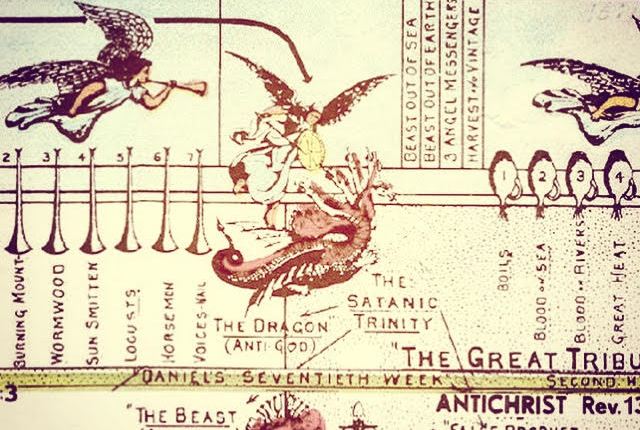
When I was a kid, every classroom I was in had maps and charts that pulled down in front of the blackboard at the front of the room. Whether it was a Sunday School room or a classroom at the Christian school I attended, there was one chart I remember seeing most. It was a timeline of history that focused on the end of time – the “tribulation,” as we called it.

I grew up in the heart of Dispensationalism. I didn’t know that’s what it was at the time. We didn’t often talk about it by name. We just read the Bible the “right” way and “took it at its word.”

Dispensationalism was the first attempt at constructing a “biblical theology” – which doesn’t mean a theology based on the Bible so much as a theology which takes the whole Bible into account. But what we focused on most was “eschatology” – the study of the end times, particularly from the book of Revelation.

Dispensationalist eschatology tells a story, and a gripping story at that (as the success of the “Left Behind” series of books that was based on it illustrates).

There will come a time when a political leader will arise who is the very antithesis of Jesus – the “Antichrist.” He will convince people, including the people of God, that he is committed to their interests, and they will be grateful for him. But there are forces of evil behind him, and the people of God (along with everyone else) will be destroyed, except a remnant of those who resisted him and will be saved by Jesus in the end.

The Antichrist is a deceiver and manipulator who presents himself as a savior. But he is a false savior who is the very opposite of Jesus.

In the version of Dispensationalism I was taught, all the true believers would be raptured up into heaven before things got that bad, but the “rapture” isn’t part of the story Revelation tells.

The Antichrist was the boogeyman of my childhood, which is not to make light of him. He was (and is) a deeply scary figure to be taken very seriously.

Which is why I have been baffled to see so many of the folks who taught me about him support or at least defend Donald Trump over the past months.

I am not saying that Donald Trump is the Antichrist who brings about the end of days. The Bible speaks of multiple antichrists – false saviors – who will come. And Revelation is a unique genre of writing called “apocalyptic literature,” which should not be understood as straightforward prophecy in symbolic language.

More than a road map for the End, Revelation is describing a pattern for how God’s people – as well as everyone else – will be deceived and destroyed. Such leaders have come before, and they will come again.

I’ve just never seen a political figure in my lifetime fit that pattern like Trump. In his personal behavior, leadership, and in the powers behind him, what I was warned about is clearly on display, supported and defended by the very people who warned me. (And he hasn’t even tried very hard to cater to them.) He is a deceiver, ready to turn justice, right, and truth upside down and inside out to serve his own interests.

I don’t believe we are fated to see the pattern play out, though.

The other message of the Book of Revelation, the more central message, in whatever way you interpret the book, is that Jesus is King. Jesus is the Victor.

Jesus is the good news in a book full of dire warnings and deadly news.

And the people the Bible calls “the Body of Christ,” those who are willing to be “little Christs” (the original meaning of the word “Christian”) in this world, can be that good news in the face of any Antichrist that shows up.

Defending the voiceless and the vulnerable. Speaking truth in the face of power and privilege. Standing up for the kind of love Jesus exemplified – “to heal the brokenhearted, to proclaim release to the captives, recovery of sight to the blind, to deliver those who are crushed, and to proclaim the acceptable year of the Lord” (Luke 4:18-19 quoting Isaiah 61:1-2).

The pattern will always repeat. But so does the good news.