Speaking Out

Speaking Out

Last night I sang my first karaoke song ever. At church. (Another story!)

For me, it was something that, if I was ever going to do it, I just had to do it – sort of like jumping off the end of a diving board into cold water. At some point you have to stop thinking about it and thinking about how scary it is and just hit go.

The song I picked is one I know inside out – it got me through Junior High! Barry Manilow’s “I Made It Through the Rain.”

We dreamers have our ways

Of facing rainy days

And somehow we survive

We keep the feelings warm

Protect them from the storm

Until our time arrives

Then one day the sun appears

And we come shining through those lonely years

I made it through the rain

I kept my world protected

I made it thought the rain

I kept my point of view

I made it through the rain

And found myself respected

By the others who

Got rained on too

And made it through

As I sang those lyrics, I realized how true it’s become of my life.

Last Tuesday evening was significant for me. I was right where I’ve been every first Tuesday for going on three years now – attending OUTspoken at Sidetrack, Chicago’s monthly LGBTQ storytelling night in Boystown. Chicago has a vibrant storytelling scene (think The Moth – true stories told live), but in the midst of all the amazing storytelling events every month, OUTspoken stands out. Members of the LGBTQ community share their stories. Sometime those stories are from fifty years ago and sometimes they’re from yesterday. Sometimes they’re funny and sometimes they’re painful and sometimes they’re both and sometimes they’re really hard to listen to and sometimes they’re full of joy.

They are always beautiful.

They’re stories of lives that have been ignored and attacked and demonized and condemned and have found a way to live anyway, from voices that have been shamed and dismissed and silenced and yet still speak out. OUTspoken is a powerful, sacred space where those lives are celebrated and those voices honored.

I have always felt honored and humbled to hear those stories. They are gifts of courage and they have shown me how to be more deeply human and often given me wisdom to navigate my own life.

But last Tuesday, I was on the other side of the mic.

The invitation to tell my own story in that space was one of the greatest honors I’ve ever been given. It was only the second time OUTspoken has had a night of “ally” storytellers, and it would have been an amazing evening had I only been sitting in the audience. My fellow storytellers told remarkable, beautiful stories. But to share some of my own journey….

It wasn’t easy. I spent months thinking about it and working on the words I wanted to offer in this space that doesn’t belong to me and yet nonetheless is so special to me. Storytelling is about so much more than telling a story; it’s about sharing our lives and ourselves. When I tell a story, I’m offering my own sliver of the human experience, and those who receive it offer kinship. The recognition that, yes! in all our individual peculiarities we really do belong to each other.

Storytelling is creating (or finding) a kind of chosen family – something the LGBTQ community has had to do by cruel necessity, but which is deeply valuable far beyond that necessity. Kinship destroys the illusion of us and them while honoring the difference of me and you. We don’t have to be alike to belong to each other, to recognize each other. To recognize and respect the others who got rained on too and made it through.

I told my story, and I received so much more than I could give. A beautiful introduction that said, “You belong here!” The attentiveness of folks who wanted to know what brought me there. The warm laughter of connection. More hugs than I could count. And the generosity of thank-yous I don’t deserve from the very people who taught me how to be brave enough to speak out.
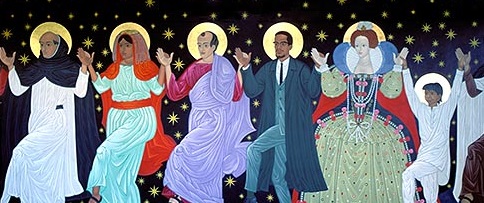
All the Saints

All the Saints

Last week I was part of three different services commemorating All Saints Day, the day in the Christian year when we remember those who’ve gone before us, who’ve inspired us, who’ve taught us, and are no longer with us.

Each year, there are more that I remember. Some are historic and named by tradition, but others are more personal.

Paul of Tarsus, that passionate and sometimes abrasive religious zealot who it had once made complete sense to that God wanted him to torture and kill those who had a different understanding of what God wanted.

Teresa of Avila, who said “Christ has no body now but yours. No hands, no feet on earth but yours. Yours are the eyes through which he looks compassion on this world. Yours are the feet with which he walks to do good. Yours are the hands through which he blesses all the world.”

Her young friend, John of the Cross, who taught us of “the dark night of the soul” – the spiritual crisis that we may experience in our journey to know the unknowable God.

Teresa of Calcutta whose compassion for those suffering and dying persisted through decades of painful spiritual drought.

Fred Rogers, the patron saint of kindness and patience who became “as a child” and became an example of what it looks like to welcome to children.

Johnny Cash, whose raw humanity was never hidden. Who visited the prisoner and wore black in solidarity with all who suffer injustice.

Gene Ould, who found his calling confined by disease to a chair in the living room and spoke the love of Jesus to all he encountered from that chair.

Madelaine L’Engle, who first showed me Jesus beyond the boundaries I knew (she was an Episcopalian! Gasp!).

Martin Luther King, Jr. whose sins we’ve ignored for the sake of his profound sacrifice.

Oscar Schindler, a philandering businessman who loved luxury and saved so many lives.

C.S. Lewis. James Baldwin. John Campbell. Sylvia Rivera. Alexander Hamilton. Rich Mullins. Leonard Allred. Harvey Milk. Wayne Barber. So many more.

Some of those names you may know. Some you almost certainly do not. But they are all saints, and all so very human. But we make symbols out of saints and deny them their full personhood, and in doing so, deny our kinship with them as well. Their stories – if we really listen to them – tell us it’s in our deepest, weakest, flawed, mistake-prone, too-often-selfish humanity that goodness also exists. And it’s in our kinship across all boundaries that righteousness is found.

Saints are human beings, and humans are neither angels nor monsters, though we are capable of beautiful and horrible things. Great good and deep evil both. All of us. All the saints.


(The icon of the Dancing Saints is from St. Gregory’s Church.)

Promises Better Broken

Promises Better Broken

There was a man, the story went, who wanted to be a leader of his people. He was from a humble background and had known much rejection, but now he had an opportunity. If he could pull off a victory, he would be praised and appointed to lead. He made a promise about what he would do if he was successful, and when he won, he kept his promise.

That promise was to sacrifice the first thing or person to meet him when he arrived home safely and victorious as a burnt offering to God, and the first to run out to meet him was his daughter, his only child.

The man’s name was Jephthah, and the story is in the book of Judges in the Hebrew Bible. Scholars debate what the text means and whether Jephthah actually killed his daughter to fulfill his vow, or instead dedicated her to serve God and never marry or have children, much like a nun. But I was taught a “plain reading” of the text, and according to that reading, Jephthah – heartbroken – kept his vow and killed his child as a sacrifice to God.

That way of reading the text is consistent within the book of Judges. One generation removed from their own slavery in Egypt, the Israelites have conquered the land God led them to and began using the former inhabitants as their own slaves.

As the generation who won those victories die off, the people forget. They go back to old ways and worshiping other gods, straying from the God who was teaching them that child sacrifice and the burdens of divine bargains were not what he was about. Raiders terrorize the people, and they are desperate to protect themselves and their own.

The “judges,” leaders who periodically appear throughout this time to defeat the raiders, are all flawed according to the understanding of the time. Some, like Samson, Gideon, and Jephthah, are morally flawed, and some bear flaws or curses of nature: Deborah is a woman, and Ehud is left-handed.

The moral of Jephthah’s story as I was taught it was to be careful what you promise God (and others), because such promises must be kept.

That’s not a bad lesson – avoiding rash promises is a good thing to do in any context. But the idea that bad promises to God or anyone else must be kept, regardless of the cost? That is a horrible lesson. I always found it deeply troubling that the same God who stopped Israel’s patriarch Abraham from sacrificing his son, Isaac, would consider it more important that Jephthah keep his promise even if it cost his daughter’s life.

I don’t believe that understanding does reflect who God is. I believe it reflects just how much his people miss or forget who God really is. The God of Israel is not a God who values the keeping of bad promises – to himself or anyone else. As Jesus shows us, the God of Israel is one who is willing to take guilt upon himself for the sake of loving others.

I’ve remembered this story a lot as I’ve listened to Republican lawmakers talk about why they want to repeal the Affordable Care Act – “Obamacare.” For so many, it just comes down to “because we promised we would.” Keeping that promise is more important than the lives and well-being of the most vulnerable among us. The principle trumps real people.

And I’ve realized, that’s just what I was taught (alongside many other voters), through Jephthah’s story and in so many other ways. We got God so deeply, tragically wrong. We believed in loving our neighbors, but we believed certain principles must guide and define that love regardless of the consequences to that neighbor (or ourselves). We were willing to die for those principles, but like Jephthah, we were also too willing to let others die for them. We just want that promise kept, regardless of the consequences.

Like Israel, those descendants of Isaac whose very existence was predicated on God refusing a child sacrifice, we so readily respond to fear and chaos and evil by embracing leaders who will make those sacrifices for the sake of principle. Principles are so much more straightforward than the messiness of loving people, of considering the needs of the most vulnerable before our own.

Some promises are better broken. Rash promises, surely. But even promises made thoughtfully and with the best of intentions can end up having devastating, unforeseen consequences. Those promises are best abandoned, but sometimes we want to cling to the principle we are convinced will work, despite all evidence to the contrary.

A wise and very humane person once said, “In theory, there’s no difference between theory and practice, but in practice, there is.” The principles that work in theory can betray us in practice, and it’s what happens in practice that really matters. Following God, loving others, is always harder and messier than following principles. Than just keeping promises.

Holding the Door

Holding the Door

Driving to work this morning I heard a story about Nashville artist Jason Isbell. Isbell is from rural north Alabama near the Tennessee state line (a couple of hours west of where I grew up). He’s a thoughtful and curious songwriter whose songs are full of the nuances of humanity and real life, and he feels the tensions of the history-haunted south.

I’m a white man living in a white man’s world
Under our roof is a baby girl
I thought this world could be hers one day
But her momma knew better

…I’m a white man living on a white man’s street
I’ve got the bones of the red man under my feet
The highway runs through their burial grounds
Past the oceans of cotton

I’m a white man looking in a black man’s eyes
Wishing I’d never been one of the guys
Who pretended not to hear another white man’s joke
Oh, the times ain’t forgotten

…I’m a white man living in a white man’s nation
I think the man upstairs must’a took a vacation
I still have faith, but I don’t know why
Maybe it’s the fire in my little girl’s eyes

(from “White Man’s World,” by Jason Isbell)

Isbell has found an audience beyond country music, and that audience is growing. “Doors are open to me and I’ll be damned if I’m not gonna walk through ’em,” he says. “But I’m also gonna try to hold ’em for somebody else before they slam in their face. And at the very least, at the very least, discuss it with people.”

It’s a good image: holding the door open for somebody else. He sees what’s happening for him, and he recognizes others aren’t getting the same opportunity.

When I was in college, I took a class in Apologetics. I attended a fundamentalist Baptist university, and that class was part of the theology program. It was a large class, and I was one of only a few women. Apologetics is about how Christians answer hard questions, and I had lots of questions (that had something to do with why I took the class!). But I could sit forever with my hand in the air and never get called on by the (generally good natured) professor. He was never rude or unkind to me, but it was like my hand was invisible. After a few weeks of this, the student who sat behind me, Nate, started raising his hand if mine had been up a while. When the prof called on him, he’d act confused and defer to me to ask my question first.

He held the door open.

Later, in my first real job, I worked as the one-woman office staff for my pastor’s speaking ministry. I had a great relationship with both my pastor and my boss and a good relationship with the other men on the ministry’s board. When they decided to launch a national radio ministry, we began to work with an agency that produced and distributed many of the most well-known evangelical radio ministries. Things were still in development when the president of the agency, Jon, and I met at a conference, and we hit it off. He began to informally mentor me, and when it was time for him to fly in for his first meeting with the board, he asked if I would be in the meeting. I’d never been in a board meeting before, but it was clear Jon expected me to be there. My boss decided I could sit in a chair in the corner of the room and take notes.

Jon arrived, and after the introductions and greetings had gone around the room, he spoke up and said, “Before we get started, can we find another chair? I’d like to make room for Jennifer here at the table.” He shifted things around and held a chair for me right beside him.

He literally and figuratively made a place for me (the only woman in the room) at the table and was intentional about including me in the ensuing discussion.

When it was time for our people to fly out to California to meet with the agency production and distribution teams, Jon told them, “Don’t bother to come if you don’t bring Jennifer!” So off I flew. I learned a lot on that trip, and future board meetings included me. Jon saw I had something important to contribute, and the men started to listen when I spoke up.

Jon held the door open for me.

Doors don’t open the same for everyone. For some of us, generations of access to education and systems that were designed for our benefit turn a lot of doors into the kind that see us coming and slide open with a whoosh of anticipation. We hardly even know a door was there. But those doors don’t recognize everyone, and others of us have to exert a lot of effort to push and pry them open. Sometimes it just requires more than we have. And sometimes the doors are locked to us.

If I can pay attention and recognize the doors, if I can notice when those doors that open for me aren’t opening for someone else, that’s when I can hold the door for them.

And maybe if enough of us notice, we can get the doors re-programmed, or just take them out altogether.