Walking the Wild Goose

Walking the Wild Goose

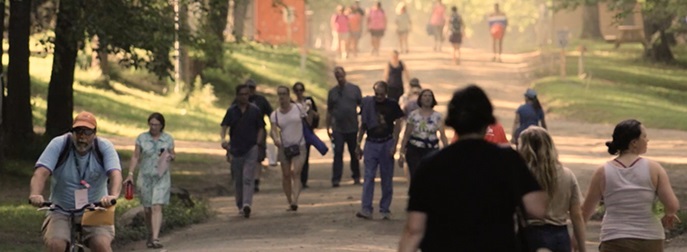
When I think back on my years attending the Wild Goose Festival, I think of walking.

The first year I attended, I came to speak with a friend. I was still a somewhat conservative but curious evangelical, recovering from my hardcore fundamentalist roots. My friend and I participated in a pre-festival retreat for the speakers, and I remember sitting and listening to Frank Schaeffer, a fellow recovering fundamentalist, speak (or more accurately, rant) and wondering what I’d gotten myself into. Frank felt angry to me, and wherever I was going, I didn’t want it to be an angry place. I was troubled.

Later that evening, long past dark, the retreat ended with a prayer walk through Shakori Hills (where the festival spent its first two years). Gareth Higgins handed me a flashlight, and we all began to slowly venture into the night, a flashlight here and there to help us along. It was hard to see much of anything, but as we walked, silent except the scuff of shoes on the dirt path, my eyes began to adjust. I realized that Frank and Genie Schaeffer were walking beside me, following the light of my flashlight.

And I knew in that moment that we were walking the same path in a much larger sense. My journey would not look quite like theirs, nor theirs like mine. But we had found ourselves here, walking alongside one another and doing our best to find our way forward.

Our paths crossed several times that weekend, and I began to know the whirlwind that is Frank and the calm that is Genie. I heard Frank talk about struggling with the anger he’d brought with him from his fundamentalism, of not wanting his granddaughter to know him as that “angry man.” I sat with Genie in the heat of an afternoon as we talked of transitions and changes and grace.

As year followed year, I’ve walked with many different people at the Goose, renewing friendships and adding them. As I moved farther from traditional evangelicalism, I found new “elders” for my life when the old ones could no longer understand the path ahead of me. I can’t count the times I’ve greeted someone and heard the reply, “Where are you headed? Can you walk with me?” And wherever I was headed, my answer is almost always yes.

I walked alongside Vince Harding one hot afternoon, and was left with an embrace and blessing I will always remember. I’ve walked many times now with my friend Nathan, a young man who I saw come out publicly for the first time during the Q & A of a Goose session, and who the next year told me about his new boyfriend and plans to start seminary. I’ve walked the Goose with Paula Stone Williams, a fellow recovering fundamentalist and one of the bravest people I know. I’ve walked with a newly-out and newly-single father and helped wrangle his two young children.

These days, it’s the first thing I do once I’ve settled in – begin walking the paths looking for friends. Looking to learn what the Goose will have to teach me this year. As the years have gone by, I attend fewer and fewer sessions, my time filled more and more with conversations along the way.

I’ve walked with heroes and strangers. I’ve hugged friends as we’ve passed, and had the joy of introducing and connecting people. This year, I look forward to walking with friends I’ve yet to meet in person, as well as an old friend of my parents who I haven’t seen in around thirty years. I’m eager to see friends from around the country whose faces are dear to me and too rarely seen.

The Wild Goose is far more than a destination; it’s a journey each one of us walks in our own way. And for a few days in July, we have the gift of walking together.


I’m thrilled to be speaking at this year’s Goose July 13-16! Join me and save 25% off weekend pass with the code BEMYGUEST.
Proud.

Proud.

The first weekend in June my friend Lauren was in town and we connected for dinner. It was the second time this spring we’ve had the chance to connect, and I’ve been so grateful for these opportunities. We were friends and fellow students in seminary over ten years ago, and we hadn’t seen each other since.

A lot has happened in those ten years. My own faith has come alive in new ways as I have sought to follow Jesus outside the lines and delve deeper into the Love that is the Life of all things.

And Lauren…when we were in school together, Lauren was a “he.” She transitioned a few years ago and I am so glad I have the opportunity to know the beautiful woman she is today.

While we were good friends in seminary, I had no idea Lauren was trans. What I did know was that my friend didn’t fit the masculine ideals our conservative evangelical school had for ministers. (Of course, I hardly fit those ideals either, but since they hadn’t quite figured out the same kind of ideals for women in ministry, I never encountered the same kind of pressure to conform.)

The school nearly refused to grant Lauren’s degree, though in the end, Lauren managed.

As she put it to me, she “zipped up her man-suit every morning,” but it was killing her.

There’s no way I can know what that must feel like. I can barely imagine.

What I do know is that there is life and peace in her now that wasn’t there before. She is at home in her own skin in a way she never was in seminary, and it is beautiful to see.

In that sense, Lauren’s story is much like that of other trans folk I know. They fight to live with honesty in the world with courage that takes my breath away. They have been willing to lose the whole world to gain their own soul. I am beyond grateful for all I have learned from them.

That is true to some degree of every LGBTQ+ person I know, and I am proud of them. Proud to know them, and proud to stand beside them.

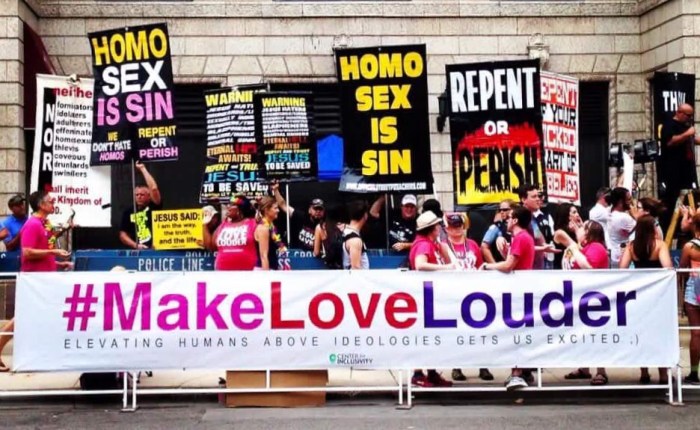
June is Pride month, and in a couple of weeks I will be at Chicago’s Pride parade, standing for Love between the parade and the “Christian” protesters who proclaim something else entirely. Cheering on the friends and strangers marching, encouraging them to “Make Love Louder” than the hate.

Because there’s more than one kind of pride. There’s the pride of vanity and privilege and self-aggrandizement. And then there’s the pride that stands tall in the face of all that would demean and dehumanize. The pride that refuses to bow to shame and fear. The pride that won’t hide inside that zipped up suit that isn’t who they are. The pride of those who know Who loves them.

That pride is hard-won, and I am so proud of those who have won it.

Happy Pride, y’all!

Minding My Mind

Minding My Mind

A few months ago I started trying a daily practice of meditation – what’s referred to as “mindfulness,” actually. The idea is to quiet the mind and focus the attention on breathing, continually drawing stray thoughts back in. I’ve been using an app with a seven day series for beginners, just ten minutes a day.

And I’m terrible at it.

My brain is going in so many directions at once. And while sometimes it’s worry about what might happen or rehashing what has already happened, most of the time it’s just a running commentary. Most evenings it’s felt like all I’m doing the whole time is running after stray thoughts. I get one back only to realize another one is already well down another path. It’s like wrangling a pack of pre-schoolers.

And I’m learning that’s okay – learning not to get anxious about getting it “right.” Learning not to get frustrated by my hyperactive thoughts. Learning to struggle to learn something. Learning to give it time.

I have noticed something, though. The app encourages me to “pay attention” to my breath. It coaches me to draw those straying thoughts back to “pay attention.” And I’m beginning to think that, for me, trying to “pay attention” is part of the problem.

When I pay attention to something, I mentally pull back to observe. To pay attention to an experience is to, in some sense, take myself out of it so I can turn around and watch it. 

But I’ve learned something different in the past few years – I’ve learned a little of what it means to be present. For me, at least, that’s entirely different.

When I’m able to be fully present, I don’t need to pay attention – I’m there. I’m not thinking, I’m knowing. I’m not using my mind, I am. My whole self, including my mind, flowing together and simply being. Feeling, responding, improvising, experiencing, living.

I could never pay attention to a kiss and really be present to the kiss, just enjoying the kiss, at the same time. 

Mindfulness seems to work in a bit of the same way. If I can stop paying attention to my breath and just be present with it, my mind stops racing off in eight directions. It’s not easy to shush the commentary (“see, now this is working! Interesting that paying attention is so different…hey, maybe there’s a blog post in that!”).

But it’s a start. Somewhere to try learning more about myself and how I engage life and encounter the world.

If I can just stop paying attention long enough.

A Doubter’s Creed

A Doubter’s Creed

“We believe in God…”

The Creed is an ancient statement of belief that many Christians around the world recite each week. There are several creeds, and the Nicene version is commonly used. Most every line is the result of an argument – as much an assertion about what beliefs “we” don’t accept as of what “we” do affirm.

That history troubles me. I know too well what drawing those lines in the sand between “us” and the other does, what an insistence about what we know to be true of great mystery can become.

It comforts me that the Creed’s actual language is “I believe” rather than “I know” (though it seems it has been treated much more as a statement of the latter).

But what about when I am not even sure what I believe? Then it comforts me to remember that the Latin credo may be better translated “I trust,” than with our modern, enlightenment understanding of “believe.”

But credo has deeper roots than that. Its original meaning is “to place one’s heart.”

Where does my heart find its place, its rest?

Not always in the carefully constructed words of the Creed, words that sometimes revel in mystery and sometimes seem to wall it in.

There is an early tradition in the Eastern church called apophatic theology that says the only way to think about God, the Divine Good, is by asserting what God is not. Everything that we say God is falls short – incomplete at best and too often misleading altogether.

The best of the apophatic tradition leads not just to an intellectual exercise or sort of mental qualifier footnoting everything we assert about who God is. At its best, it opens us up to approaching God beyond our categories. It expands our ability to trust God beyond our understanding.

If Ultimate Reality is Love, definitions don’t come easily.

Love is messy and confusing and full of pain as well as joy. Too often I have experienced love as qualified and redefined past any recognizability or, in truth, any actual loving.

That is not love. Love is not an intellectual exercise. Love is not rejection, not alienation, not abandonment. It is not self-serving and doesn’t keep score. Love isn’t arrogant or presumptuous. Love doesn’t find satisfaction in being proven right. Love doesn’t look back, doesn’t hold back. Love doesn’t give up on people.

The old Anglo-Saxon word “believe” comes from the same root (lief) as the German belieben, which means “belove.”

When I’m not sure how to say the Creed, not sure what I think or “believe” about these things, it helps to know what and who I love. It helps to know I place my heart, my trust in Love.

And it helps to know that when he was asked what was most important, Jesus didn’t say anything about what we were supposed to believe. He said the most important thing was to love.

And when I don’t know what I believe, I do still know I love.