Prophecy and Patterns

Prophecy and Patterns
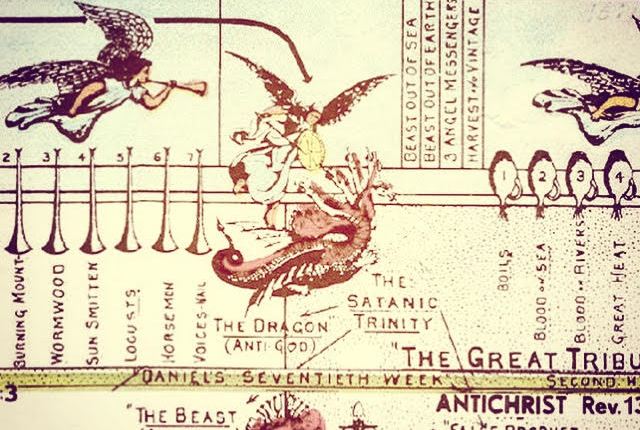
When I was a kid, every classroom I was in had maps and charts that pulled down in front of the blackboard at the front of the room. Whether it was a Sunday School room or a classroom at the Christian school I attended, there was one chart I remember seeing most. It was a timeline of history that focused on the end of time – the “tribulation,” as we called it.

I grew up in the heart of Dispensationalism. I didn’t know that’s what it was at the time. We didn’t often talk about it by name. We just read the Bible the “right” way and “took it at its word.”

Dispensationalism was the first attempt at constructing a “biblical theology” – which doesn’t mean a theology based on the Bible so much as a theology which takes the whole Bible into account. But what we focused on most was “eschatology” – the study of the end times, particularly from the book of Revelation.

Dispensationalist eschatology tells a story, and a gripping story at that (as the success of the “Left Behind” series of books that was based on it illustrates).

There will come a time when a political leader will arise who is the very antithesis of Jesus – the “Antichrist.” He will convince people, including the people of God, that he is committed to their interests, and they will be grateful for him. But there are forces of evil behind him, and the people of God (along with everyone else) will be destroyed, except a remnant of those who resisted him and will be saved by Jesus in the end.

The Antichrist is a deceiver and manipulator who presents himself as a savior. But he is a false savior who is the very opposite of Jesus.

In the version of Dispensationalism I was taught, all the true believers would be raptured up into heaven before things got that bad, but the “rapture” isn’t part of the story Revelation tells.

The Antichrist was the boogeyman of my childhood, which is not to make light of him. He was (and is) a deeply scary figure to be taken very seriously.

Which is why I have been baffled to see so many of the folks who taught me about him support or at least defend Donald Trump over the past months.

I am not saying that Donald Trump is the Antichrist who brings about the end of days. The Bible speaks of multiple antichrists – false saviors – who will come. And Revelation is a unique genre of writing called “apocalyptic literature,” which should not be understood as straightforward prophecy in symbolic language.

More than a road map for the End, Revelation is describing a pattern for how God’s people – as well as everyone else – will be deceived and destroyed. Such leaders have come before, and they will come again.

I’ve just never seen a political figure in my lifetime fit that pattern like Trump. In his personal behavior, leadership, and in the powers behind him, what I was warned about is clearly on display, supported and defended by the very people who warned me. (And he hasn’t even tried very hard to cater to them.) He is a deceiver, ready to turn justice, right, and truth upside down and inside out to serve his own interests.

I don’t believe we are fated to see the pattern play out, though.

The other message of the Book of Revelation, the more central message, in whatever way you interpret the book, is that Jesus is King. Jesus is the Victor.

Jesus is the good news in a book full of dire warnings and deadly news.

And the people the Bible calls “the Body of Christ,” those who are willing to be “little Christs” (the original meaning of the word “Christian”) in this world, can be that good news in the face of any Antichrist that shows up.

Defending the voiceless and the vulnerable. Speaking truth in the face of power and privilege. Standing up for the kind of love Jesus exemplified – “to heal the brokenhearted, to proclaim release to the captives, recovery of sight to the blind, to deliver those who are crushed, and to proclaim the acceptable year of the Lord” (Luke 4:18-19 quoting Isaiah 61:1-2).

The pattern will always repeat. But so does the good news.

Here (a monologue)

Here (a monologue)

So many years
Trying to live as someone other than who I am

Because I didn’t know

I didn’t know I wasn’t who everyone told me I was
(Or didn’t)
Who else was I supposed to know to be?
When the only language you hear (know)
Doesn’t fit
Collecting a piece here
Catching a glimmer there
And finally taking a leap
To see what I could find
(It wasn’t where I was)

And you were there
Here
Wherever it is I am
You were always there
(Here)
Wherever I wasn’t ready to be
But getting there
(Here)
There
Where when I pinch myself I can feel it
Now

Maybe I’ll need to leap again
Ask the questions of becoming
Wonder
Wander
Off the path (another one)
And you’ll be there
(Here)

Won’t you?

Waiting for Nemo

Waiting for Nemo

Years ago, when I lived at my folk’s place in a small development past the outer edges of the suburbs in the country, there was a cat.

He was black, and at first we just caught a glimpse of him every now and then, but it was enough for Mama to get some cat food to put out. (While not a believer in indoor animals, she liked to encourage strays to hang around the house and cut down on mice and snakes.)

I’ve always had a fondness for black cats, and I started thinking of him as “Hamlet.”

The next time we saw the cat, I put a bowl of food out on the back deck. He ran as soon as I opened the door, but later that evening we saw him eating. I did the same thing the next time we saw him, and the time after that. And eventually he would come back for the food sooner and sooner after I’d gone back inside.

One evening, I decided to stay out on the deck when I put the food out. I curled up in a chair as far from the food as I could. It took a while, but eventually he sidled up to his bowl and ate anyway.

After that, I stayed on the deck every time I put out his food, gradually moving the bowl closer and closer to the chairs, until eventually it was just just an arm’s length away.

The whole time, if I moved to get up, or even just lifted my arm, he was gone. But I could talk to him. I’d talk to him and meow, and he’d meow back. We’d have whole tentative conversations out there on the deck.

But always at arm’s length.

He was so close, but so skittish.

I started moving more naturally –talking with my hands – as I sat and we talked. And he stopped startling unless I moved toward him, so I never did.

But gradually he started moving closer to me, until one day he walked around me and rubbed lightly against my side. If I moved to pet him, he was gone.

He was still afraid, but part of him wanted to trust me.

One day, as he rubbed against my side, I lifted my arm at the elbow and he walked under it, arching his back under my hand.

It was the breakthrough. Soon I was petting him naturally and his attention was as much on me as his food.

Our conversations lengthened, a series of meows I was mirroring from him. “Who knows what you’re talking about?” Mama remarked.

But talk we did, and soon, if I saw a black dot far off in the neighboring farm fields, I would walk out on the deck, say, “Good morning!” in a normal voice, and watch a small black head pop up and then streak across the fields to me.

One evening when I returned from work, I was standing beside my car outside the garage when I heard a distinctive “Meow!” I looked around the corner of the house, and there, 18 feet above me on the deck, was Hamlet. We talked back and forth for a bit, and then I watched him gather himself and jump down to me.

Mama said, “Cats don’t jump like that. I wonder what you told him?”

After I moved away from home, if I was visiting my folks and we were talking outside, Hamlet would always show up to see me.

One evening, in the dead of winter, Mama and I were talking in a basement room when I thought I heard something. “Meow…meow!” Hamlet was outside the small, high basement window where he’d heard me, and I went out for a visit on the porch.

That was one of the last times I saw him. One of the dogs that roamed the neighborhood got him.

This past spring when I went to meet Nemo to consider adoption, he didn’t want anything to do with me (or much of anyone, to be fair). He hated the shelter, and especially the kittens being raised in a big cage in the center of the room we met in. He stalked around the room muttering, “Damn kittens! Seriously?” like a grumpy old man.

I liked him. He was black (with a white shirt front and collar), he was intelligent, and he spoke his mind.

I was looking for my first pet, and as we waited to see if he’d warm up to me, I told the shelter manager and the cat-person friend with me about Hamlet.

Nemo didn’t warm up that day, but they gave him to me anyway. “I really had my doubts,” my friend said, “but when you talked about that cat, I knew you wouldn’t rush Nemo. You’d give him the space to get to know you.”

And he did. At home, I let him explore and soon he was rubbing against my legs and offering his head to be petted. All these months later, we’ve bonded, but he’s still the same cat.

He’s always happy to see me in the morning and when I get home from work – talkative and ready for attention. When he’s caught up on things, though, he’ll settle down somewhere. Maybe keep an eye on things.

When I go to him, it rarely works for long. He’ll tolerate a moment of affection before moving away. But often, if I let him go and just wait a while, he’ll come back and leap up to settle in my lap.

Patience has never been my strong point, but I’m learning to wait. It’s hard sometimes, but it’s part of the relationship with this cat of mine. And when I wait and respect his terms and timing, he eventually comes.

Patience is hard.

It’s always been worth the wait.

Hidden Roots

Hidden Roots

The days when things felt good were the days when the systems of injustice and bias were already in the ground we walked on, the ground we built our homes and families and careers on. The ground we built our communities and churches and safety and sense of well-being on.

What we see happening – the rise of overt racism, the excusing of bigotry and bias, the anger of those who have borne it – these are not something new. They are the green shoots of those roots finally breaking the surface of the soil and showing themselves in the light of day.

We cut off the weeds of racism (or many of us thought we did), but we didn’t pull it up by the roots. And that root system spread. And because we didn’t see it above ground we thought all was well. We went about living our lives, even building good things, on ground that was pervaded with evil.

But the plants broke the surface of the soil again, here and there, and too many of us thought (think?), “The last vestiges.”

It’s far more than the occasional bad apple, far more than the isolated incidents we’d like to believe it is. Instead it is the outworking of the whole system of roots we’ve been building everything on all along.

Just because we were blind to it, didn’t realize, even meant well, doesn’t change the reality.

Yet we keep chopping at the weeds where we can see them, because we don’t want to think about what it would mean to dig everything up and clear the roots.

My folks live in the country (its suburban-ish country, but one of their neighbors is a horse farm with a rodeo, so…), and when my mother goes out to weed poison oak in their yard it’s no simple task.

It’s not the plants that are really the problem (though they are the reason she weeds with every inch of skin except her face covered), but the root system that produces them. It spreads from plant to plant, far deeper than you expect. And if you don’t get it all it spreads again.

The poison we see is the outgrowth of those roots. The poison hurts us and it needs to be cleared.

But the roots, the roots are under everything.