Hope Comes

Hope Comes

Hope comes last.

Do you have any idea how much that bothers me?

In Romans 5, Paul says that “suffering produces perseverance; perseverance produces character; and character, hope.”

Sometimes I don’t know what kind of world he lived in to say such a thing. Not the part in the middle – “perseverance produces character.” That can make sense. Practice and exercise, sticking with it – I see that producing character in myself and others.

But “suffering produces perseverance”? No. It doesn’t. Not on its own, at least. Unrelieved suffering without hope produced despair. Then numbness. Deadening. Unrelieved suffering produces the realization that one can actually get through the unendurable, but not intact.

I’ve lived with enough suffering myself, and alongside the suffering of others, not to spiritualize it. Abusive relationships, abusive systems. Suffering kills.

Persistent suffering teaches a person that it won’t matter what you do. It kills agency. You feel like a placeholder in the world, but something knows you’re meant for more than that.

Suffering produces silence.

Without hope.

Hope can change everything.

Hope is a gift we can give each other, but we have to receive it, or give it to ourselves, first.

Hope says, this can change. I – we – can do something different.

Hope says, this world can change. We can grow and learn, and it can be filled with beauty, love, and peace. We can choose that.

Hope says, I can change. My life can change. But I have to choose to change things.

In so many ways, I was taught to wait for things to change. To “wait on the Lord” – for direction, for a date, for a calling, for life. I remember the day, Easter Sunday in the parking lot after church, when I first said it (to myself as much as to my friend). “If I want my life to be different, nothing is very likely to change unless I make some changes.”

That was the day I began to find my agency. When I began to go out to find direction, a date, a calling, a life. And it turns out, they are there for the finding (though not without that perseverance).

Suffering will happen – the result of wrongs done both intentionally and accidentally, by both ourselves and others. The result of death, that final enemy. The result of life that just is, changing seasons and moving ever onward with little regard for our three-score-and-ten.

But we have today – really that’s all we have. And we can chose beauty and love and generosity today, even if we know that choice will bring suffering tomorrow.

That’s the hope – that there is always beauty and love and generosity to be chosen.

Paul’s equation only works as a cycle. It only works when, in the face of suffering, we can share hope with each other. When we can choose together beauty and love with generosity in the middle of suffering. When we can fight alongside each other for the agency to right the injustices that so often trap us in suffering.

Then suffering can produce perseverance, and perseverance can produce character, and character can produce even more hope. Enough to infect the world.
Goodbye and Hello

Goodbye and Hello

When I was 25, like so many other young evangelicals in the ’90s, I kissed dating goodbye.

Of course, it was a bit easier since I’d never been on a date.

I was a late bloomer to put it gently. From elementary school on I was a social pariah with my peers. By Jr. High, I was spending my free time with college students (fundamentalist Baptist theater majors, to be more precise), and by the time I was actually in college and at a reasonable dateable age, I was firmly ensconced as the kid sister.

When I was 25, I struck up a conversation with a guy I knew slightly at an outing for my singles group from church. We ended up talking that whole evening, and after spending several more group outings in a similar fashion, we had a conversation. He’d been married before and divorced, and he wanted to do things differently — he wanted to do courtship instead of dating.

Courtship meant you didn’t do things one-on-one unless marriage was in the offing. The man asked the girl’s parents for permission to court her. And nothing physical — not even a kiss.

I was all in. The idea that one should take these things seriously appealed to me. I had been explicitly taught, “Don’t go on a first date with anyone you wouldn’t marry — then you won’t have to break their heart and yours down the line.” My parents have lots of wisdom, and maintaining a conversation with them as a part of the process made sense.

And other than telling him that, no way was my first kiss going to be the public one on my wedding day! (a compromise he agreed to), I was content to honor the physical boundaries.

(In retrospect, most people miss how bone-melting holding hands can be when you’re not wondering how far you can get away with — or he will try — going.)

We courted for an intense three months until he showed up for our Valentine’s date and broke up with me, glad “things hadn’t gone too far.”

For him maybe.

I was blindsided. When he showed up for the date and asked if we could go for a walk, I was honestly thinking, “Well, I know we’ve covered money and kids and all the important stuff, but it’s really too soon for him to propose!”

A few years later and a second relationship ended, I did some counseling with a pastor who told me, “I can’t believe I’m actually saying this, but you really need to learn how to casual date.”

It was so true. While the courtship model was intended to honor men and women and help them take romantic relationships seriously, for me it gave a first date the weight of near-engagement. I had to be fully invested from the start, just getting to know someone, and the results were devastating me.

It took well over a decade for me to find a context where I could learn to “casual date.” Evangelical churches and seminary contexts are so messed up on dating that approaching it casually is nigh to impossible. And it was particularly so for me — it’s hard to take a first date lightly when you’re only being asked out once every couple of years. Maybe.

I now realize that may have been because while I certainly belonged, I just as certainly didn’t fit the conservative evangelical contexts I was in.

I made my own chance a few years ago when, after being affectionately bullied into it by a friend, I dove into online dating. There’s nothing like ten first dates in three weeks to help you learn to take a first date lightly!

I decided to say yes to meeting anyone whose profile didn’t scream (or whisper) “Absolutely not!” and give myself the chance to be surprised. I found I could take the person seriously while taking the date lightly. And I found that men who hadn’t been raised in an evangelical culture tended to be more emotionally and relationally mature (though there are always exceptions going both directions).

I kissed dating hello, and I began to understand how to enter a story without needing to know what the ending could or should be.

For more stories about “Life After I Kissed Dating Goodbye” see http://www.lifeafterikdg.com/

Abandoning the Shoes that Brought Me Here

Abandoning the Shoes that Brought Me Here

There’s a poem I’ve been living with for the last couple of months. Written by David Whyte, it’s about a pilgrimage in Spain, Camino de Santiago or The Way of St. James, and the traditions that have arisen at its end at Finisterre:

The road in the end taking the path the sun had taken,
into the western sea,

and the moon rising behind you
as you stood where ground turned to ocean:

no way
to your future now but the way your shadow could take,
walking before you across water, going where shadows go,

no way to make sense of a world that wouldn’t let you pass
except to call an end to the way you had come,
to take out each frayed letter you brought
and light their illumined corners, and to read
them as they drifted through the western light;
to empty your bags; to sort this and to leave that;

to promise what you needed to promise all along,

and to abandon the shoes that had brought you here
right at the water’s edge, not because you had given up
but because now, you would find a different way to tread,
and because, through it all, part of you could still walk on,
no matter how, over the waves.

from Pilgrim, copyright 2012 Many Rivers Press

My family is hardcore fundamentalist. I often tell people that they believe Jerry Falwell started to compromise along the way. It’s funny (not to them), but true. They didn’t jump on the anti-gay bandwagon in the 90s; my step-father built it in the 80s.

They taught me many things.

They taught me that God’s love was great and that he had committed himself to working certain ways, within certain boundaries.

That’s the thing about fundamentalism (and much of Christianity that wouldn’t describe itself as such) — it’s not just people that are inside or outside those boundaries. God’s work is inside them, too, and his only work outside those boundaries is to call people to come inside them to him.

They also introduced me to Jesus and taught me to do what he wanted me to do no matter what they or anybody else thought.

And I followed Jesus to places that stretched them. I went to seminary and got an MDiv at a scary “neo-evangelical” school. I started preaching a little. And they rolled with it.

But then I saw Jesus dancing on the other side of the boundary line, and I knew what it would mean to cross that line, to follow him there. In the end, it was no choice really — of course I would follow him.

But I didn’t know how. The shoes that had brought me here weren’t made to dance, much less walk on across the water.

I didn’t begin to know how to walk across that line.

So with the help of a friend, I began to walk along it — to get to know a community of LGBTQ followers of Jesus who were trying to figure things out themselves. I listened, for months. Some of them came to trust me enough to honor me with the gift of their stories and struggles. They grew to be family to me.

They gave me space to learn to take off my shoes, to learn to walk without them. To let old ways of understanding and believing and relating die, and new ones be born and grow.

And one day, after about a year, I looked around and realized I’d left the line far in the distance. I’d taken off my shoes to find the ground on which I was standing was holy.

That moment was beautiful and terrifying.

I knew what it would mean. I knew that for many of my family and friends, crossing that line meant they would rewrite the story of Jesus in my life as a delusion — if the path had led me here, it had to be false.

And that meant that so many people I love, whose fingerprints I’m proud are on my life, who gave me the shoes that brought me here, would no longer be home for me. Elders whose voices brought deep wisdom to my life would not advise me going forward.

I’d found a new family, new elders, but they will never be replacements.

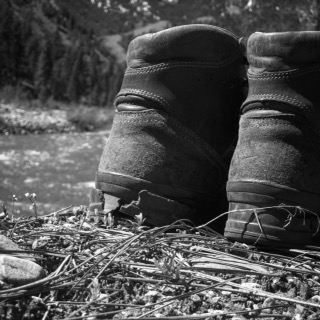
The shoes that brought me here still mark the water’s edge. They are well worn to the shape of my feet and journey. And they stand empty there in testimony that there is yet more beyond.

…to abandon the shoes that had brought you here
right at the water’s edge, not because you had given up
but because now, you would find a different way to tread,
and because, through it all, part of you could still walk on,
no matter how, over the waves.

An Open Door 99 Floors Up

An Open Door 99 Floors Up

It was a first date. We’d never met, but I recognized him from his picture as he waited for me across the street from the L station. It was early December, before sunset, and we were meeting downtown to look at Christmas lights after he finished his shift.

The streets were crowded with shoppers, the Christmas decorations sparkled and twinkled, and we were hitting it off. I liked his deep, resonant voice and we talked in an easy rhythm. He was tall, black Irish with broad shoulders, and there was a spark in his eye I liked.

When he offered to show me the skyscraper where he worked as a building engineer, I was game.

I love these buildings that hold up the sky — I always have. When I walk the city canyons at their feet, they make me breathe deep and feel tall (all 5’2″ of me). I’ll probably never get over walking around like a tourist downtown with my head turned to the sky.

We got in one elevator to take us up to the building management office, and after he picked up some keys, another took us higher.

The 99th floor was filled with machinery bigger than my apartment — all the guts of the building, rumbling away. As we walked around the huge space, he guided me to an ordinary door, turned the key in its lock, and opened a door to the glory of the city at dusk.

The sky was pink and dark purple, and the city glittered with lights. As I leaned out into the view, I could feel a surprisingly warm breeze embrace me. There was nothing between me and the city and sky but the wind.

It was a door to nowhere that opened into maybe the biggest view I’d ever seen. In the end, there were four of them, one on each outer wall of the building, each of them with a completely different but equally spectacular view.

I didn’t have to go up those elevators with him on our first date, and I surely didn’t have to lean out each of those doors. There was obvious risk. But I did go up, and I did lean out, and I saw things I’d never seen before, and I saw familiar things from an entirely new perspective. I felt a wind that I’ll never feel again – the warm wind that embraces the highest floors of that building.

I’ll never forget what it felt like to stand in an open door 99 floors up with nothing between me and the world but the wind.

I’ll never forget what it felt like to lean out into the risk and the beauty. To breathe it all in and feel my world expand to fill it. To hold the impossible fullness of it all.

We talked for over eight hours of walking and eating and more walking that night, but I’m not sure I ever really stopped leaning out into that wind.